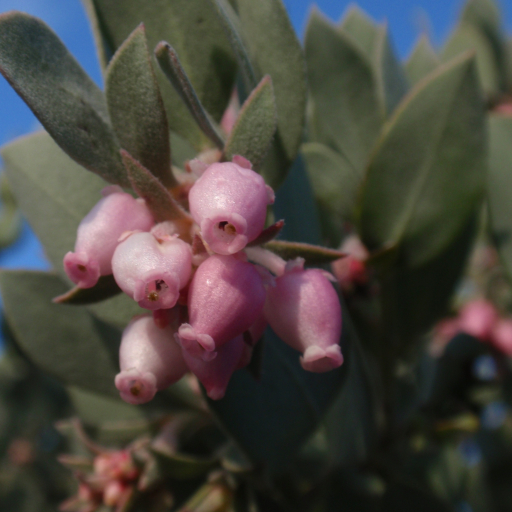
Plant Overview
Known as the Hoary Manzanita, this California native is the "silver fox" of the chaparral. Its name canescens literally means "becoming gray," referring to the beautiful, velvety fuzz that covers its leaves and stems, giving the whole plant a ghostly, frosted appearance. In the wild, it acts as a resilient anchor for rocky hillsides, standing out with its architectural branches and deep red bark.
🔍 How to Identify
- ☁️ Foliage: The leaves are oval and distinctively "hoary"—covered in fine, soft white hairs that make them feel like felt and look silvery-green.
- 🍷 The Bark: Like its cousins, it features smooth, mahogany-red bark that peels away in thin, paper-like ribbons as the plant matures.
- 🔔 The Blooms: In late winter to early spring, it produces drooping clusters of waxy, urn-shaped flowers that range from snowy white to pale blush pink.
🏡 In Your Garden
- 🏜️ Drainage is King: This plant thrives in "difficult" spots where other plants fail, specifically rocky or sandy soils. It has a deep taproot and will suffer if left in standing water or heavy, mucky clay.
- 🌬️ Climate Toughness: Because of those fuzzy leaves (which help trap moisture and reflect sunlight), it is incredibly drought-tolerant and wind-resistant. It’s a perfect choice for water-wise landscaping or "firescaping" in coastal or mountain regions.
⚠️ Safety & Toxicity
- ✅ General Safety: Hoary Manzanita is considered non-toxic to humans, dogs, and cats. It is a very "safe" addition to a family backyard.
- 🍒 The Fruit: The plant produces small, fuzzy red berries. While they aren't poisonous, they are often dry and mealy. Historically, they were used by Indigenous groups to make a tart, cider-like drink, but they aren't a garden snack for the faint of heart.
✨ Fun Fact
The name "Manzanita" is Spanish for "little apple," a nod to the shape of its berries. The Hoary Manzanita's seeds have a "fire-dependent" relationship with nature; they often require the intense heat of a brushfire or the chemical cues from smoke to crack their hard shells and germinate!

Detailed Care Instructions








