Plant Overview
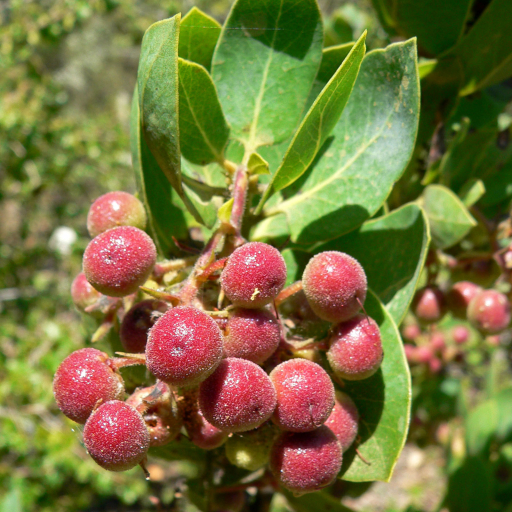
Known as the Bigberry Manzanita, this evergreen titan is a centerpiece of the California chaparral. Its striking contrast between smooth, chocolate-colored limbs and silvery-blue foliage makes it look more like a living sculpture than a common shrub. It is often considered the "king" of the manzanitas, growing larger and sturdier than many of its cousins.
🔍 How to Identify
- 🍃 Waxy Foliage: The leaves are stiff, oval, and a distinct "glaucous" (silvery-blue or pale green) color, coated in a waxy layer that helps the plant reflect intense sunlight and retain moisture.
- 🍷 Mahogany Bark: Its trunks are famous for their smooth, cool-to-the-touch, deep reddish-brown bark that eventually peels away in thin, papery strips during the summer.
- 🍓 The "Big" Berries: True to its name, it produces the largest fruit of any manzanita—sticky, brownish-red drupes that look like tiny, flattened apples.
- 🔔 Urn-Shaped Blooms: In late winter, it produces drooping clusters of white to pinkish flowers that resemble delicate, upside-down bells.
🏡 In Your Garden
- 🏜️ Drainage is Vital: This plant evolved on rocky, sun-drenched hillsides. It absolutely demands well-draining soil and will quickly succumb to root rot if sitting in heavy, wet clay.
- 🚫 Leave Me Be: Like many members of the Arctostaphylos genus, it develops a deep taproot. It is notoriously difficult to transplant once established, so choose its "forever home" carefully and avoid digging around its base.
- 💧 Summer Dormancy: Once established, it requires almost no supplemental water. In fact, watering it during the peak of a hot summer can introduce soil pathogens that may kill the plant.
⚠️ Safety & Toxicity
- ✅ Safe Profile: The Bigberry Manzanita is generally considered non-toxic to humans, dogs, and cats.
- 🥧 Edibility: The berries are technically edible and were historically used by Indigenous tribes to make a tart, refreshing cider or ground into meal. However, the seeds are very large and stone-like, making the fruit quite "bony" to eat raw.
✨ Fun Fact
The Bigberry Manzanita is an "obligate seeder." Unlike some other shrubs that regrow from their roots after a wildfire, this plant dies completely in a fire. However, its seeds are encased in such a thick, stony coat that they require the intense heat of a fire to crack them open and trigger germination, allowing a whole new forest to rise from the ashes.

Detailed Care Instructions
To grow Arctostaphylos glauca, also known as Bigberry Manzanita, follow these steps:
- Climate and location: Arctostaphylos glauca is native to California and requires a Mediterranean climate. It can tolerate a wide range of soil types but prefers well-draining soil. Choose a sunny spot for planting.
- Propagation: Arctostaphylos glauca can be propagated from seeds, cuttings, or by layering. Seeds can be collected from ripe berries and sown in a seedling tray filled with a mix of soil and sand. Keep the soil moist and the tray in a cool place until germination occurs. Cuttings can be taken from semi-hardwood shoots during late spring or early summer. They should be dipped in rooting hormone and planted in a well-draining soil mix.
- Planting: Once the seedlings or cuttings have developed roots, transplant them into larger pots or directly into the ground. Dig a hole slightly larger than the root ball, place the plant in the hole, and cover the roots with soil. Water thoroughly after planting.
- Watering: Arctostaphylos glauca prefers moderate watering. Water the plants deeply once a week during the growing season, and reduce watering during winter. Avoid overwatering as it can lead to root rot.
- Mulching and weed control: Apply a layer of organic mulch around the base of the plant to conserve moisture, regulate soil temperature, and suppress weeds. Keep the area around the plant free from weeds as they can compete for nutrients.
- Pruning: Arctostaphylos glauca doesn't require much pruning. Remove any dead, damaged, or diseased branches. Lightly shape the plant to maintain an attractive form if desired. Prune in late winter or early spring before new growth appears.
- Fertilization: Arctostaphylos glauca can benefit from a light application of a balanced fertilizer in early spring. However, it generally doesn't require frequent fertilization.
- Pest and disease control: Arctostaphylos glauca is relatively pest and disease-resistant. However, keep an eye out for common plant pests such as aphids, spider mites, or scale insects. Treat infestations with organic pesticides if necessary.
- Ongoing care: Monitor the moisture levels of the soil regularly and adjust watering accordingly. Otherwise, Arctostaphylos glauca is a low-maintenance plant that should thrive with minimal intervention.
With proper care, Arctostaphylos glauca can grow into an attractive and hardy plant, with beautiful flowers and edible berries.

Place in a bright room that is sun drenched almost all day. Or directly in a south-facing window.

Arctostaphylos Glauca is a plant that requires moderate watering and should not be allowed to dry out completely. It is important to ensure that the soil is moist but not waterlogged. Water the plant deeply, allowing the water to soak in and reach the roots. Avoid frequent shallow watering, as this can lead to the plant developing shallow root systems.
Watering frequency will depend on the weather conditions and the specific needs of your plant. During hot and dry weather, you may need to water more often, while in cooler weather, you may need to water less frequently. A good rule of thumb is to check the soil moisture regularly by sticking your finger into the soil to a depth of an inch or two. If the soil feels dry at this depth, it is time to water.
When watering, aim to keep the leaves dry. Wet leaves can promote the growth of fungal diseases. One way to ensure that the leaves remain dry is to water the plant from the base, rather than from above.
Overall, Arctostaphylos Glauca is a relatively low-maintenance plant when it comes to watering. Pay attention to the soil moisture, and adjust watering frequency as needed based on weather conditions and the needs of your specific plant.
For optimal growth, apply a balanced fertilizer with equal amounts of nitrogen, phosphorus, and potassium in early spring. The fertilizer should be applied to the soil surrounding the plant, not on the foliage or stem. Use a low- or slow-release fertilizer to avoid over-fertilizing and burning the roots. Water the plant thoroughly after fertilizing to help the nutrients reach the roots. Avoid fertilizing during the plant's dormant period, typically in late fall and winter.
Arctostaphylos glauca is a shrub that grows best in well-drained, sandy soil with low to moderate fertility. The plant prefers a slightly acidic to neutral pH soil, which means that the soil should have a pH level of between 5.5 and 7.5. Additionally, the plant can tolerate slightly alkaline soil with a pH level of up to 8.0. It is essential to avoid soils with high levels of clay and water-logged soils as they can lead to root rot and other diseases that can damage the plant. To ensure that the soil is well-drained, it is recommended to mix in some coarse sand or gravel, especially if the soil is heavy in texture. Additionally, it is essential to avoid using high-nutrient soil mixes or fertilizers as they can damage the plant and stunt its growth. Instead, use a low-nutrient soil mix and fertilizer to help promote optimal growth.
Arctostaphylos Glauca can be propagated through softwood cuttings during the summer season. It is essential to select healthy and disease-free branches for propagation.
First, prepare the cutting by removing all buds, leaves, and flowers from the lower two-thirds of the stem. Cut off any branches or leaves that are near the base of the cutting. Dip the bottom of the cutting in rooting hormone to promote root growth.
After preparing the cutting, plant it in a container with well-draining soil. Keep the soil consistently moist and avoid over-watering. Place the container in a location with indirect sunlight and high humidity.
It is essential to monitor the cutting carefully for the first few weeks, as it may take some time for the roots to develop. Once the roots have formed, the plant can be transplanted into a larger container or directly into the ground.
It is important to note that Arctostaphylos Glauca may take several years to reach its full size, so patience is key when propagating this plant.








