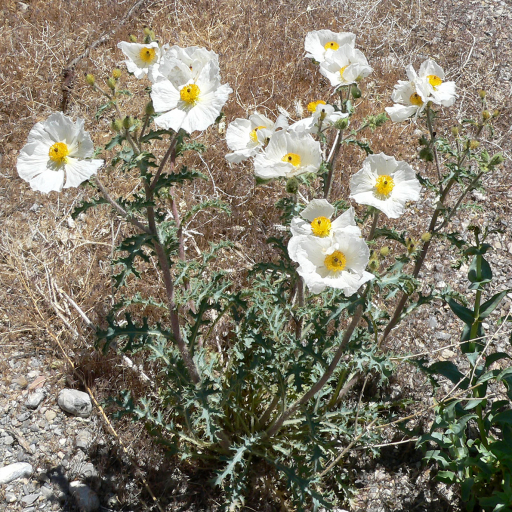
Plant Overview
Often called the "Fried Egg Plant" for its crinkly white petals and bright yellow center, Argemone munita is a resilient beauty of the American West. Despite its delicate, silk-like flowers, this plant is a fortress of sharp spines, thriving in harsh, sunny landscapes where other plants wither. It carries a certain "Wild West" charm, standing tall as a pioneer species in sandy washes and rocky slopes.
🔍 How to Identify
- 🍳 The "Fried Egg" Bloom: Large, showy flowers featuring six paper-thin, crinkled white petals surrounding a dense cluster of bright yellow-orange stamens.
- 🌵 Armed Foliage: The bluish-green leaves are deeply lobed and look similar to thistles, but they are covered in a formidable coat of stiff, needle-sharp prickles.
- 📏 Sturdy Stature: It grows as an upright, branching herb, often reaching three to four feet in height, with stems that are also heavily armored.
- 💧 Golden Sap: If a stem is broken, the plant exudes a thick, bright yellow or orange latex (sap), which is a classic trait of the poppy family.
🏡 In Your Garden
- 🏜️ The Ultimate Xeriscape Plant: This poppy thrives on neglect. It prefers poor, sandy, or gravelly soil and requires almost no supplemental water once established. It is the perfect choice for a "wild" corner of a drought-tolerant garden.
- 🚫 Look But Don't Touch: Due to a deep, sensitive taproot, the Prickly Poppy hates being moved. If you want it in your garden, it is best to sow seeds directly into the soil rather than trying to transplant a nursery specimen.
- 🐝 Pollinator Magnet: While the spines keep herbivores away, the nectar-rich flowers are a favorite for native bees and butterflies, making it a great addition to a conservation-focused landscape.
⚠️ Safety & Toxicity
- 🚫 Toxic Status: All parts of the plant are considered toxic if ingested. It contains isoquinoline alkaloids which can cause digestive distress or more serious heart and respiratory issues in high quantities.
- 🧤 Mechanical Injury: The spines are incredibly sharp and can easily pierce garden gloves. Always handle with extreme caution and keep it away from high-traffic paths where children or pets might brush against it.
- 🐾 Pet Warning: Most livestock and pets naturally avoid the plant because of the spines and bitter taste, but it should still be kept out of reach of curious chewers.
✨ Fun Fact
The genus name Argemone comes from the Greek word argema, which means "cataract." In ancient times, the sap from related species was used in traditional folk medicine to treat eye ailments—though modern science strongly advises against putting this caustic, alkaloid-rich sap anywhere near your eyes!

Detailed Care Instructions
- Choose a suitable location: Argemone munita plants prefer full sun and well-drained soil. Select a spot in your garden that receives at least 6-8 hours of sunlight per day.
- Prepare the soil: Before planting, ensure the soil is well-drained and nutrient-rich. You can amend the soil with organic matter such as compost or well-rotted manure to improve its quality.
- Planting: Sow Argemone munita seeds directly into the soil in the spring after the last frost date. Scatter the seeds thinly and cover lightly with soil. Water gently to keep the soil moist but not waterlogged.
- Watering: Water newly planted seeds regularly to keep the soil consistently moist until the plants are established. Once established, Argemone munita is drought-tolerant and only needs occasional watering.
- Mulching: Mulch around the base of the plants to help retain moisture, suppress weeds, and keep the roots cool.
- Pruning: Argemone munita may benefit from occasional deadheading to encourage more blooms and maintain a tidy appearance.
- Fertilizing: Argemone munita is a low-maintenance plant that generally does not require regular fertilization. However, you can feed it with a balanced fertilizer if growth appears stunted or the plant looks unhealthy.
- Pest and disease control: Argemone munita is resistant to most pests and diseases. However, keep an eye out for any signs of trouble, such as aphids or powdery mildew, and treat them promptly.
By following these steps, you can successfully grow Argemone munita in your garden and enjoy its beautiful yellow flowers.

Place in a bright room that is sun drenched almost all day. Or directly in a south-facing window.

To properly water **Argemone Munita** plant, it is important to follow a few guidelines to ensure its overall health and growth.
Firstly, it is important to check the soil moisture before watering. Insert your finger into the soil up to about 2 inches deep. If the soil feels dry at this depth, then it is time to water the plant.
When watering, try to water the plant at the base, avoiding getting the leaves wet. This can help prevent any potential fungal diseases from developing. Make sure to water thoroughly, allowing the water to reach the root zone of the plant.
It is generally recommended to water the **Argemone Munita** plant regularly but not excessively. Aim to keep the soil evenly moist, but not waterlogged. Overwatering can lead to root rot and other issues, so it is important to strike a balance.
In the hotter months or during periods of prolonged drought, you may need to increase the frequency of watering. However, in the cooler months, you can reduce the frequency of watering as the plant may not require as much water.
Overall, monitoring the soil moisture, watering at the base of the plant, and maintaining a consistent watering schedule are key to keeping your **Argemone Munita** plant healthy and thriving.
To fertilize the Argemone Munita plant, apply a balanced, slow-release fertilizer with an NPK ratio of 10-10-10 in the spring before new growth appears. Be sure to follow the manufacturer's instructions for application rates and frequency. Water the plant thoroughly after fertilizing to help the nutrients penetrate the soil and reach the roots. Avoid over-fertilizing as this can lead to nutrient imbalances and damage the plant. During the growing season, you can also supplement with a liquid fertilizer every 2-4 weeks to promote healthy growth and blooming.
Argemone munita plants thrive in well-draining soil that is sandy or loamy in texture. The soil should be slightly acidic to neutral in pH, with a range of 6.0 to 7.0 being ideal for optimal growth. A mix of organic matter, such as compost or aged manure, can be added to the soil to improve its fertility and nutrient content. It is important to avoid soils that are heavy or clayey as they can lead to poor drainage and waterlogged conditions, which can be detrimental to the plant's health. Additionally, regular irrigation and mulching can help to maintain the moisture levels in the soil and promote healthy growth of the Argemone munita plant.
Argemone munita can be propagated through both seeds and cuttings. To propagate through seeds, gather the seeds from mature plants in the fall and sow them in well-draining soil in a sunny location. Keep the soil consistently moist until the seeds germinate, which usually takes about 2-3 weeks.
For propagation through cuttings, select a healthy stem from the parent plant and cut it just below a leaf node. Remove the lower leaves and dip the cut end in rooting hormone before planting it in a pot with well-draining soil. Keep the soil consistently moist and place the pot in a warm, sunny location.
Regardless of the propagation method used, it is important to provide the young plants with consistent moisture and sunlight to encourage healthy growth. Once the new plants have established roots and are actively growing, they can be transplanted into their permanent growing location in the garden.








