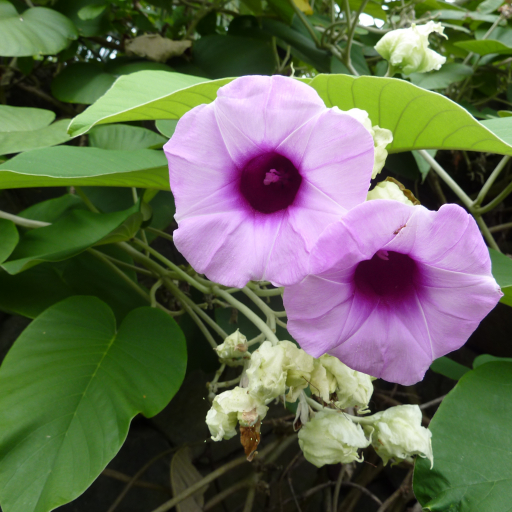
Plant Overview
Often called the "Elephant Creeper" or "Hawaiian Baby Woodrose," this vigorous perennial climber is a true showstopper for those with plenty of vertical space. While it shares a family tree with the common Morning Glory, this vine is far more substantial, known for its massive, velvety leaves and "woody" appearance. It creates an instant tropical privacy screen, though its rapid growth requires a watchful eye.
🔍 How to Identify
- 🍃 Velvety Foliage: Enormous heart-shaped leaves that can reach over a foot in diameter. The undersides are covered in soft, silvery-white hairs that feel like suede.
- 🌸 Trumpet Blooms: Large, funnel-shaped flowers that emerge in clusters, featuring a delicate lavender-pink exterior and a deep, wine-colored throat.
- 🪵 Wooden "Roses": After the flowers fade, they leave behind unique seed capsules surrounded by five dried sepals. These look like small, hand-carved roses made of light-brown wood.
🏡 In Your Garden
- 🧗 Structural Support: This is a "heavyweight" climber. It requires a very sturdy pergola or a thick fence, as the sheer weight of its massive leaves and woody stems can collapse lightweight plastic trellises.
- 🌱 Root Sensitivity: The plant develops a long, sensitive taproot very early. It hates being moved once planted, so choose its "forever home" in a sunny, well-draining spot to avoid transplant shock.
- ✂️ Vigorous Habit: In warm climates, it can become invasive if not pruned. Regular trimming helps manage its size and encourages more flower production rather than just leafy bulk.
⚠️ Safety & Toxicity
- 🚫 Highly Toxic: The seeds contain ergoline alkaloids (LSA) and are dangerous if ingested. They cause severe nausea, vomiting, and powerful hallucinogenic effects.
- 🐾 Risk Factor: This plant should be kept away from curious pets and children. Because the "wooden roses" are often used in dried floral arrangements, ensure they are displayed high out of reach.
✨ Fun Fact
Despite being called "Hawaiian Baby Woodrose," the plant is actually native to the Indian subcontinent! It earned its common name after being introduced to Hawaii, where its unique dried seed pods became a staple in the local craft and floral lei industry.

Detailed Care Instructions
| Lighting | Full Sun |
| Hardiness Zones | Min 12 |
To grow Argyreia nervosa, also known as Hawaiian baby woodrose, you can follow these steps:
- Purchase seeds: Obtain fresh seeds from a reputable source. Make sure they have not been treated with any chemicals or pesticides.
- Scarify the seeds: Gently rub or nick the outer seed coat without damaging the inner embryo. This helps the seeds absorb water and germinate more easily.
- Soak the seeds: Place the scarified seeds in a bowl of warm water and leave them to soak for 24 hours. This further aids in the germination process.
- Prepare the planting containers: Fill small pots or seed trays with well-draining potting soil. You can add some organic compost or vermiculite to improve drainage.
- Plant the seeds: Create a small hole in the soil about 1 inch deep. Place a single seed in each hole and cover it with soil. Pat the soil gently to ensure good seed-to-soil contact.
- Provide warmth: Argyreia nervosa seeds require warmth for germination. Keep the pots or trays in a warm location, ideally between 75-85°F (24-29°C). You can use a heating pad or a seedling heat mat to provide a consistent temperature.
- Water regularly: Keep the soil moist but not waterlogged. Water the plants regularly, ensuring the soil doesn't dry out completely between waterings.
- Provide light: Place the pots or trays in a location that receives bright, indirect sunlight. Gradually introduce the plants to direct sunlight, as too much direct light initially can stress the seedlings.
- Transplanting: Once the seedlings have developed a few sets of true leaves and are around 3-4 inches tall, they can be transplanted into larger pots or directly into the ground (if the climate allows).
- Outdoor cultivation: If you live in a suitable warm climate (hardiness zones 10-12), you can grow Argyreia nervosa outdoors. It prefers full sun to partial shade and well-draining soil. Provide support like a trellis or arbor for the vine to climb.
- Care: Water the plants regularly, especially during dry spells. Fertilize with a balanced liquid fertilizer every 2-4 weeks during the growing season. Prune the plants as needed to control their size and promote bushier growth.
Please note that the consumption of Argyreia nervosa seeds or plant parts can have hallucinogenic effects and should only be done responsibly and within legal restrictions.

Place in a bright room that is sun drenched almost all day. Or directly in a south-facing window.

Argyreia Nervosa is a plant that requires consistent watering to stay healthy and flourish. To water this plant effectively, you should ensure that the soil is consistently moist but not waterlogged. This can be achieved by watering the plant deeply once or twice a week, depending on the temperature and moisture levels in the air.
Before watering, it is important to check the soil's moisture content by sticking your finger into it up to the knuckle. If the soil feels dry, it's time to water your Argyreia Nervosa plant. When watering the plant, pour the water evenly around the base of the stem, avoiding the leaves as much as possible. This will help to prevent fungal growth and reduce the risk of disease.
In addition to regular watering, it's essential to ensure that the soil has adequate drainage. If the soil is heavy and doesn't allow water to drain through it easily, you may need to add some sand or perlite to improve drainage. Finally, it's important to avoid overwatering the plant, which can cause root rot and other issues.
To fertilize this plant, use a well-balanced fertilizer with equal amounts of nitrogen, phosphorus, and potassium. Apply the fertilizer every two to three months during the growing season, being careful not to over-fertilize. Water the plant thoroughly before fertilizing and apply the fertilizer evenly to the soil around the base of the plant. Avoid getting fertilizer on the foliage or stems of the plant. Monitor the plant's growth and adjust the fertilization schedule as needed.
When growing the plant known as Argyreia Nervosa, it is important to use a soil that is well-draining and rich in organic matter. A combination of loamy soil, sand, and perlite can be used to enhance drainage while retaining moisture. Additionally, the soil should have a slightly acidic pH level between 5.5 and 6.5. It is recommended to add compost or organic fertilizer to the soil to provide essential nutrients for the plant's growth. It is also important to ensure that the soil is not compacted, as this can prevent proper root development and lead to root rot. Overall, the soil used for Argyreia Nervosa should be loose, well-draining, and rich in organic matter to support healthy growth.
Propagation of this plant can be done through stem cuttings or by planting its seeds. For stem cuttings, choose a healthy stem and cut a section of around 4-6 inches long. Remove any leaves from the lower part of the stem, leaving only 2-3 leaves at the top. Dip the cut end of the stem in rooting hormone powder and plant it in well-draining soil. Water it regularly and keep it in a warm, humid place. Within a few weeks, roots should begin to form, and the plant should start to grow.
For seed propagation, collect mature seeds from the plant. Soak the seeds in water for a few hours to help with germination. Plant the seeds in a well-draining soil mixture and keep the soil moist. Place the container in a warm, sunny spot and wait for the seeds to germinate. Once the seedlings are large enough, you can transplant them into individual pots or into the ground.
It's important to note that this plant is a climbing vine and may need support as it grows taller. The plant prefers a warm, humid environment and can be sensitive to overwatering, so be sure not to let the soil stay too moist.
Common pests of the baby wood-rose include Spider mites, aphids, whiteflies, larvae. Make a habit of checking your baby wood-rose frequently for pests so that any infestations can be caught and managed early.








