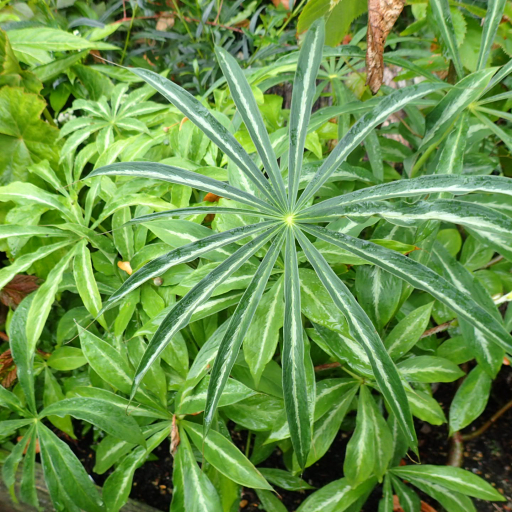
Plant Overview
Known as the Himalayan Cobra Lily, this plant looks like it stepped right out of a prehistoric forest or a dark fantasy novel. Native to the high-altitude woodlands of the Himalayas and China, it is celebrated by collectors for its architectural "umbrella" of leaves and its mysterious, hooded blooms. In some cultures, it is whispered to be a protector of the forest floor, standing tall like a sentry.
🔍 How to Identify
- 🌿 The Umbrella Foliage: A single, sturdy stalk rises from the ground, topped with a dramatic whorl of 10 to 20 narrow leaflets that radiate outward like the spokes of a spider-webbed umbrella.
- 🐍 The Striped Spathe: The "flower" is actually a modified leaf called a spathe. It forms a deep, elegant hood with vertical stripes of purple, brown, and green, curving over to protect the inner bloom.
- 👅 The Tapered "Tail": Both the tips of the leaflets and the tip of the flower hood end in long, thin, thread-like "tails" that can dangle several inches, giving the plant a wispy, elegant appearance.
🏡 In Your Garden
- ☁️ Woodland Preferences: This lily is a shade-lover through and through. It thrives in dappled light, mimicking the forest canopy. It requires "goldilocks" soil—rich in organic matter and moist, but never soggy, as the underground corm is prone to rot in standing water.
- 💤 The Vanishing Act: Don't panic if your plant disappears! The Cobra Lily goes completely dormant in late summer or autumn. It retreats into its tuber to survive the winter, so it’s helpful to mark its location with a stake so you don't accidentally dig it up during its long nap.
⚠️ Safety & Toxicity
- 🚫 Toxic Status: High. Like most members of the Arum family, the entire plant contains calcium oxalate crystals.
- 👶 Risk to Humans & Pets: If any part of the plant is chewed or swallowed, these microscopic "needles" cause intense burning and swelling of the mouth, throat, and tongue. Always wear gloves when handling the corms if you have sensitive skin, and keep it well out of reach of curious pets or children.
✨ Fun Fact
The Himalayan Cobra Lily is a master of "gender-bending." It is a sequential hermaphrodite, meaning it can change its sex from year to year. When the plant is young or under-nourished, it produces only male flowers. Once it grows large enough and stores enough energy in its tuber, it switches to producing female flowers to grow its bright red berries!

Detailed Care Instructions
To successfully grow Arisaema Consanguineum (Cobra Lily) plants, follow these steps:
- Select a suitable location: Choose a spot that receives partial to dappled shade throughout the day, as direct sunlight can scorch the leaves. The soil should be well-draining and rich in organic matter.
- Planting: Arisaema Consanguineum prefers to be planted in the spring or fall. Dig a hole that is about twice the size of the plant's root ball and place the plant in it. Ensure that the crown of the plant is at or slightly below the soil surface. Backfill the hole with soil and gently firm it around the roots.
- Watering: Provide regular watering during the growing season but avoid overwatering, as excess moisture can lead to rotting. Keep the soil consistently moist but not waterlogged. Mulching around the plant can help retain moisture.
- Fertilizing: Apply a balanced, slow-release fertilizer once a year in the spring. Alternatively, you can top-dress the soil with compost or well-rotted manure.
- Support: Arisaema Consanguineum plants usually require support to keep them upright. Place a staking or support structure near the plant to prevent it from bending or falling over.
- Pruning: Remove any dead or yellowing leaves as they occur. However, avoid cutting back the foliage until it has fully died back naturally, as the plant draws energy from the leaves to store for the next growing season.
- Protection: When winter approaches, add a thick layer of mulch around the plant to insulate the roots from freezing temperatures.
- Propagation: Arisaema Consanguineum can be propagated from division. Wait until the plant is dormant and has fully died back. Carefully lift the plant and gently separate the tubers, ensuring that each division has at least one bud or growth point. Replant the divisions at the same depth as the original plant, taking care not to damage the buds.
By following these guidelines, you can grow Arisaema Consanguineum successfully, enjoying its unique and fascinating features.

Place in a window with dappled sun or a spot in the middle of a room. Or directly in a window facing west or east.

To water this plant, first ensure that the soil is slightly dry to the touch before watering. Use room temperature water and pour enough to moisten the soil thoroughly. Avoid overwatering, as this can lead to root rot. It is best to water from the base of the plant, rather than pouring water directly onto the leaves. Monitor the soil moisture regularly and adjust the watering frequency based on the plant's needs and environmental conditions.
To fertilize this plant, use a balanced fertilizer with equal amounts of nitrogen, phosphorus, and potassium. Apply the fertilizer in the early spring when the plant is actively growing. Be sure to follow the instructions on the fertilizer package for the correct amount to use and how to apply it. Water the plant thoroughly after fertilizing to help distribute the nutrients. Avoid fertilizing in the fall or winter when the plant is dormant.
Arisaema Consanguineum plant prefers well-draining, fertile soil that is rich in organic matter. It needs soil that can hold moisture but also allows for proper drainage to prevent waterlogging. The soil should be slightly acidic with a pH between 5.5 to 6.5. Arisaema Consanguineum plant prefers a deep, loose, loamy soil that is free from weeds and other obstacles that could interfere with root growth. It is best to avoid using heavy, clay soils or soils with high salinity levels. Adding compost or other organic matter to the soil can help to improve its quality and fertility, leading to healthier, more vigorous growth of the plant.
Arisaema consanguineum is a plant that can be propagated through division of mature plants. This process involves carefully removing the plant from the soil and separating the root system into several smaller sections. Each section should have a healthy amount of roots and at least one bud or shoot. These sections can then be planted in new pots or garden locations. It is important to keep the soil moist and to avoid exposing the new plants to direct sunlight until they have established themselves. Propagation can be done in late winter or early spring when the plant is dormant.








