Plant Overview
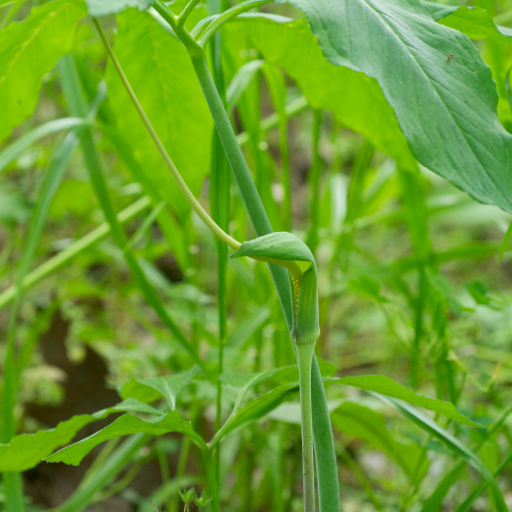
Known as the Green Dragon or Dragon-root, this plant looks like it stepped right out of a prehistoric forest. A close relative of the more famous Jack-in-the-Pulpit, it is prized by woodland gardeners for its architectural silhouette and its strangely long, protruding "tongue." In the wild, it haunts the damp, shaded corners of North American floodplains, emerging in late spring like a botanical serpent rising from the leaf litter.
🔍 How to Identify
- 🌿 The Horseshoe Leaf: Unlike most plants, it usually produces just one large leaf that branches out into a horseshoe shape, divided into 7 to 15 pointed leaflets.
- 🐉 The "Dragon’s Tongue": The most striking feature is the spadix—a long, slender, whip-like tail that can extend up to 6 inches beyond the green flower hood (spathe).
- 🍒 Late-Season Jewels: After the flower fades in early summer, it produces a dense, heavy cluster of berries that transform from green to a brilliant, waxy orange-red by autumn.
🏡 In Your Garden
- 💧 The "Muck" Factor: This isn't a plant for dry, sandy soil; it craves the "wet feet" of a swamp or a low-lying garden spot that stays consistently moist and rich in organic matter.
- ⏳ Patience is Key: The Green Dragon grows from a perennial corm and can be slow to establish. If it gets too much direct sun or the soil dries out, it will go dormant and vanish entirely until the following spring.
⚠️ Safety & Toxicity
- 🚫 High Toxicity: Every part of the Green Dragon is toxic. It contains calcium oxalate crystals, which act like thousands of tiny glass needles if bitten or chewed.
- 🐾 Pets and Kids: Ingestion causes immediate, intense burning of the mouth and throat, significant swelling, and digestive distress. The bright red berries are particularly tempting to children and should be handled with extreme caution.
✨ Fun Fact
- 🧬 Gender Fluidity: The Green Dragon can actually change its biological sex! Younger or stressed plants typically produce only male flowers. Once the plant grows large enough and stores enough energy in its root, it switches to producing female flowers so it can bear the heavy weight of the berry clusters.

Detailed Care Instructions
| Humidity | Normal |
| Lighting | Full Sun |
| Difficulty | Medium |
| Temperature | 18°C - 29°C |
| Hardiness Zones | Max 5A |
To grow Arisaema Dracontium plant, also known as Green Dragon or Dragon Arum, you can follow these steps:
- Choose a suitable location: Arisaema Dracontium plants prefer moist, shaded areas like woodland gardens or along streams or ponds. The soil should be rich in organic matter and well-draining.
- Prepare the soil: Amend the soil with compost or well-rotted manure to improve its fertility and moisture-holding capacity. Ensure it is well-draining to prevent waterlogging.
- Plant the tubers: Arisaema Dracontium plants grow from tubers, which should be planted in early spring or fall. Dig a hole about 3-4 inches deep and place the tuber horizontally with the shoot facing upward. Cover the tuber with soil, leaving the shoot exposed above the ground.
- Watering and care: Keep the soil consistently moist but not waterlogged, especially during hot and dry periods. Water deeply when needed, allowing the soil to dry slightly between waterings. Mulching around the plant can help retain moisture and suppress weeds.
- Provide shade: Arisaema Dracontium plants prefer partial to full shade. Plant them under the canopy of taller trees or provide shade using other structures like garden shade cloth or umbrellas.
- Fertilization: Apply a balanced, slow-release fertilizer in spring or use organic fertilizers like compost or well-rotted manure. Avoid excessive nitrogen fertilizers, as they may promote foliage growth at the expense of flower production.
- Protect from pests: Arisaema Dracontium plants are generally not heavily targeted by pests or diseases. However, you may need to protect them from slugs and snails. Use organic pest control methods like beer traps or diatomaceous earth to manage these pests.
- Winter care: Arisaema Dracontium plants are hardy and can withstand freezing temperatures. However, a layer of mulch around the base of the plant can provide extra protection during extreme cold spells.
- Propagation: Arisaema Dracontium plants can be propagated by dividing the tubers in early spring or fall. Carefully dig up the tubers and separate them, ensuring each division contains at least one shoot. Replant the divisions following the same planting instructions mentioned earlier.
Remember, Arisaema Dracontium plants are native plants, so ensuring that they have suitable growing conditions will greatly increase their chances of thriving.

Place in a window with dappled sun or a spot in the middle of a room. Or directly in a window facing west or east.

To water this plant, make sure to keep the soil consistently moist but not waterlogged. It is recommended to water it once a week or whenever the top inch of soil feels dry to the touch. When watering, pour water directly onto the soil, avoiding the plant's leaves as they are sensitive to water. Use room temperature water and avoid using hard water or water with high levels of chlorine or fluoride, as it can damage the roots. In winter, reduce watering frequency as the plant slows down its growth.
To fertilize this plant, use a balanced fertilizer with equal amounts of nitrogen, phosphorus and potassium. Apply the fertilizer in early spring before new growth appears and again in mid-summer. Do not over-fertilize as it can burn the roots and harm the plant. Water thoroughly after applying fertilizer.
Arisaema dracontium plants prefer well-draining soil that is rich in organic matter. A mix of loamy soil with plenty of compost or peat moss works well for these plants. It should have a slightly acidic to neutral pH level. Avoid soils that are too dense or compacted, as this can lead to poor drainage and root rot. Additionally, adding perlite or sand to the soil mix can help improve drainage and aeration for optimal growth of the Arisaema dracontium plant.
One way to propagate this plant is through seed. Collect the seeds from a mature plant and sow them in moist soil, covering them lightly. Keep the soil moist and warm, and the seeds should germinate within several weeks. Another way to propagate it is through division. Dig up a mature plant and carefully separate the small plants that have formed around the main plant's base. Replant the new plants in their own pots or directly in the ground. Make sure to keep the soil moist and provide the newly propagated plants with sufficient shade to prevent wilting.








