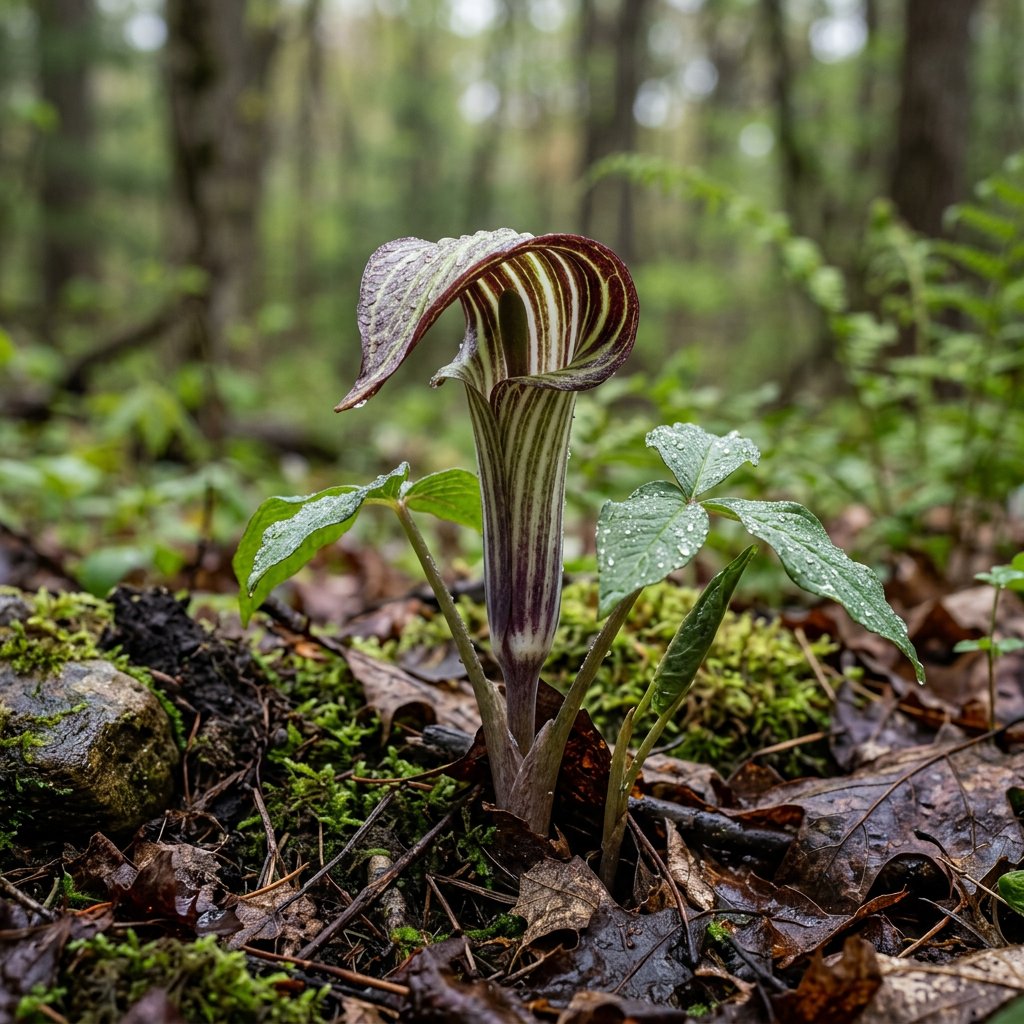
Plant Overview
Commonly known as Jack-in-the-Pulpit, this enigmatic North American wildflower looks like it stepped straight out of a botanical fairy tale. Named for its unique flowering structure—where a "preacher" (the spadix) stands inside a hooded "pulpit" (the spathe)—it is a master of the damp, shaded forest floor. Historically called "Indian Turnip," it was used by Native Americans for medicinal purposes, though only after careful and extensive preparation.
🔍 How to Identify
- 🌿 The Leaf Duo: Typically features one or two large, glossy leaves divided into three distinct leaflets. These leaves often tower over the flower, acting like a green umbrella.
- 🎭 The Pulpit: The "flower" is actually a specialized leaf called a spathe. It is usually green with deep purple or brownish-stripes, forming a graceful hood that curves over the center.
- 📍 The Preacher: Inside the hood sits the spadix, a smooth, club-like spike that houses the actual tiny, inconspicuous flowers.
- 🔴 Autumn Berries: In late summer, the hood withers away to reveal a dense cluster of berries that turn a brilliant, showy scarlet red.
🏡 In Your Garden
- 💧 The Moisture Lover: This isn't a plant for a dry rock garden. It craves the "woodland vibe"—moist, humic, and acidic soil. If you have a low-lying spot in your yard where water tends to linger, Jack will feel right at home.
- 🕰️ Patience is Key: It is a slow grower that spends its first few years just developing its underground corm (a bulb-like structure). It hates being moved once established because its root system is sensitive to disturbance; choose its "forever home" carefully.
- 🐌 Pollination Partners: Unlike many garden flowers, it doesn't wait for bees. It emits a faint fungal odor to attract tiny fungus gnats, which get trapped inside the "pulpit" to ensure pollination occurs.
⚠️ Safety & Toxicity
- 🚫 Status: Toxic/Irritant.
- 👅 The Needle Effect: The entire plant contains calcium oxalate crystals. If any part is bitten or eaten raw, these microscopic "needles" cause an immediate, intense burning sensation and swelling in the mouth and throat.
- 🐾 Pet Warning: Keep curious dogs and cats away, as ingestion can lead to severe drooling, difficulty swallowing, and digestive upset.
✨ Fun Fact
- ⚧️ The Gender Bender: Jack-in-the-Pulpit can change its biological sex! If the plant is young or the soil is nutrient-poor, it produces only male flowers to save energy. When it becomes large and well-nourished, it switches to female to produce berries. If conditions get tough again, it can switch back to male the following year!

Detailed Care Instructions
Jack-in-the-pulpit looks good when surrounded by a mass of low-growing shady ground cover such as (Impatiens walleriana). When Jack-in-the-pulpit goes dormant and leaves a hole in your shade garden in mid-summer, this is a good time to plug in some impatiens to fill those vacant spaces. It also is a good plant for woodland gardens, planted with other native shade-lovers, such as bleeding heart, Solomon's seal, or wild ginger. They can also work well beneath shade-loving viburnum shrubs, provided you keep them well watered.
How long does Jack-in-the-pulpit live?
In ideal conditions, Jack-in-the-pulpit will form small colonies and gradually spread to fill shady spaces. Once established, a colony can survive for many decades, but occasional division (every four or five years) will keep the plants vigorous.
What about wildlife?
Browsing animals such as rabbits and deer seem to understand the toxic nature of Jack-in-the-pulpit and generally leave it alone. The red berries, however, are eaten by birds and the flowers will attract a variety of pollinators.
| Color | Greenish-Purple |
| Soil Ph | Acidic |
| Humidity | Normal |
| Lighting | Part Sun |
| Toxicity | Poisonous |
| Soil Type | Moist, Humusy |
| Bloom Time | April To May |
| Difficulty | Medium |
| Plant Type | Herbaceous; Grows From A Corm |
| Hibernation | Cold Period |
| Mature Size | 1 To 2 Feet Tall, With A Similar Spread |
| Native Area | Eastern North America |
| Sun Exposure | Partial Shade To Full Shade |
| Hardiness Zones | 4 To 9 |
To grow Arisaema Triphyllum, also known as Jack-in-the-pulpit or Indian turnip, follow these steps:
- Planting location: Choose a shady or partly shady spot in your garden that has moist and well-drained soil. This plant prefers rich, organic, and slightly acidic soil.
- Planting time: Plant the bulbs or tubers in the spring, after the last frost has passed. They can also be planted in the fall, allowing them to establish their roots before winter.
- Prepare the soil: Dig a hole that is deep enough to accommodate the bulb or tuber. Add compost or well-rotted manure to enrich the soil and improve drainage.
- Planting depth: Place the bulb or tuber about 2-4 inches below the soil surface, with the pointed end facing up. Cover it with soil and gently firm it down.
- Watering: Keep the soil evenly moist but not waterlogged. Arisaema Triphyllum prefers consistently moist soil, so watering may be necessary during dry periods. Be careful not to overwater, as excessive moisture can lead to rotting.
- Mulch: Apply a layer of organic mulch around the plant to retain moisture and suppress weed growth. This will also help keep the soil cool and moist.
- Care and maintenance: Remove any weeds that may compete with the plant for nutrients and water. Ensure consistent moisture during the growing season, especially during hot and dry periods. Arisaema Triphyllum does not require fertilization if the soil is adequately enriched before planting.
- Winter care: In colder climates, add a layer of mulch in late fall to protect the plant from freezing temperatures. This will help insulate the bulbs or tubers and prevent frost damage.
- Propagation: Arisaema Triphyllum can be propagated by division in the early spring or late fall. Carefully dig up the clump of bulbs, separate them, and replant in a new location.
- Pests and diseases: This plant is generally resistant to pests and diseases. However, watch out for slugs and snails, as they may feed on young foliage. If necessary, use organic pest control methods or physical barriers to protect the plants.
By following these steps, you can successfully grow your own Arisaema Triphyllum plant and enjoy its unique flowers and foliage.

Place in a window with dappled sun or a spot in the middle of a room. Or directly in a window facing west or east.

1. Observe the soil moisture: Before watering the plant, it is important to observe the soil moisture level. Checking if the soil is dry to the touch is a good indication that it is time to water the plant.
2. Avoid Overwatering: Arisaema Triphyllum plants may be susceptible to root rot if overwatered. Therefore, it is important not to overwater the plant, as this can also contribute to nutrient deficiencies.
3. Water when necessary: Water the Arisaema Triphyllum plant when the soil is dry to the touch. It is important to maintain the balance between dry and moist conditions in the soil.
4. Use room temperature water: Use room temperature water to water the plant. Cold water can shock the plant's roots.
5. Water the soil, not the foliage: When watering the plant, avoid getting water on the foliage or flowers. This can cause fungal diseases to develop.
6. Test soil drainage: If the soil is not draining properly, it can cause root rot. Test the soil's drainage by pouring water into the soil. If it drains slowly, the soil may need to be amended or changed.
7. Monitor plant growth: Monitor the Arisaema Triphyllum plant's growth and adjust watering accordingly. As the plant grows, it may require more water.
8. Adjust watering in different seasons: During different seasons, the plant's water requirements may change. Adjust watering accordingly to ensure the plant stays healthy.
For optimal growth and health, fertilize the plant once every two weeks during its active growing season using a balanced, water-soluble fertilizer. Dilute the fertilizer to half-strength and apply it to the soil around the base of the plant, being careful not to get any on the foliage. Avoid fertilizing during the plant's dormant period.
To cultivate Arisaema Triphyllum effectively, one should use well-draining, moist soil that is rich in organic matter and provides adequate nutrition to support growth. The pH level of the soil should ideally range between 5.5 and 6.5 to ensure optimal growth and development of the plant. Additionally, the soil should not be compacted and should allow for sufficient air circulation to prevent waterlogging and root rot. It is also recommended to incorporate a slow-release fertilizer into the soil during planting and to periodically add compost or additional nutrients throughout the growing season to maintain soil fertility.
Propagation of this plant can be done through several methods, including seed propagation and division. For seed propagation, the seeds should be collected and sown immediately after the fruit ripens. The seeds should be planted in a soil mix that is moist and contains a lot of organic matter. They should be kept in a cool, dark place until germination occurs, which can take several months.
Division is also a common method of propagation for this plant. The bulb-like corms can be dug up and separated into smaller sections, each with at least one bud or growth point. These can then be planted in individual pots or in the ground, and should be kept moist until they are established.
Another method of propagation for this plant is through tissue culture. This involves taking small pieces of the plant and growing them in a laboratory under controlled conditions. This can be a more complicated method and is typically only used by professional growers.
Common pests of the jack-in-the-pulpit include Spider mites, thrips. Make a habit of checking your jack-in-the-pulpit frequently for pests so that any infestations can be caught and managed early.








