Plant Overview
Known affectionately as the Lace Aloe or the Guinea-fowl Aloe, this South African gem is the ultimate "tough cookie" of the succulent world. While it looks like a delicate piece of living lace, it is incredibly resilient, often surviving in rocky crevices where other plants would wither. It is the only species in its genus, making it a unique botanical loner with a personality all its own.
🔍 How to Identify
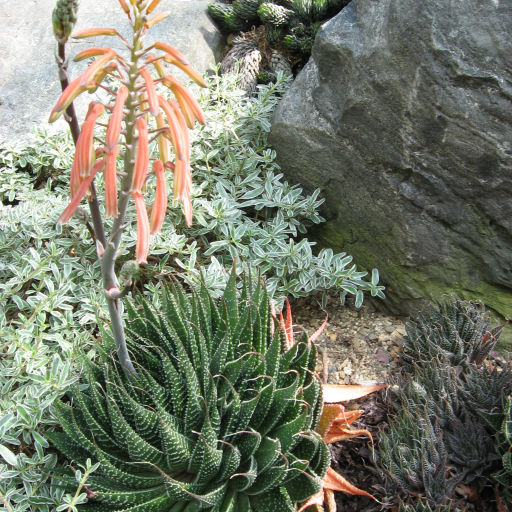
- 🌵 The Rosette: It grows in a tight, spherical rosette shape, often resembling a green sea urchin or a starburst.
- ⚪ White Tubercles: The dark green leaves are decorated with distinct, raised white bumps (tubercles) that give it a "polka dot" or snowy appearance.
- 🧶 Lacy Tips: Look closely at the leaf ends; each leaf finishes in a long, soft, hair-like bristle (an "arista"), which gives the plant its "Lace" nickname.
- 🔥 Torch Blooms: In early summer, it sends up a tall stalk topped with tubular, orange-red flowers that look like glowing torches.
🏡 In Your Garden
- ⛅ The Shade Exception: Unlike many succulents that demand blistering sun, the Lace Aloe actually prefers "bright shade" or filtered light. Too much direct afternoon sun can turn its deep green leaves a stressed, reddish-brown.
- 💧 Avoid the Crown: When watering, always aim for the soil, never the center of the rosette. Water trapped in the "cup" of the leaves is the fastest way to cause crown rot, which can kill the plant overnight.
- 🏔️ Cold Weather Warrior: It is surprisingly frost-hardy for a succulent. If kept dry, it can survive temperatures that would turn a common Aloe vera into mush, making it great for unheated sunrooms.
⚠️ Safety & Toxicity
- 🐾 Status: Mildly toxic to pets.
- 🤢 Details: While not usually life-threatening, the leaves contain saponins and anthraquinones. If chewed on by cats or dogs, it can cause vomiting, diarrhea, or lethargy. It is best kept on high shelves away from curious nibblers.
✨ Fun Fact
The Lace Aloe is a master of disguise! Before it was given its own genus (Aristaloe), it was frequently confused with Haworthia because of its white spots. However, once it blooms, its massive orange flowers reveal its true identity as a relative of the giant tree aloes.

Detailed Care Instructions
To grow an Aristaloe Aristata plant, also known as Lace Aloe, you can follow these steps:
- Choose the right location: Lace Aloe plants thrive in bright, indirect light. Find a spot in your home that receives enough sunlight, such as near a south or west-facing window.
- Prepare the soil: Use well-draining soil mix specifically formulated for succulents or cacti. You can also create your own mix by combining regular potting soil with sand or perlite to improve drainage.
- Watering: Lace Aloe plants are drought-tolerant, so it's important not to overwater them. Only water when the top inch of soil is dry. Use your finger to check the moisture level. Ensure you water directly into the soil rather than on the leaves to avoid rotting.
- Temperature and humidity: These plants prefer temperatures between 65°F to 80°F (18°C to 27°C). They can tolerate slightly lower temperatures but may suffer in extreme heat or frost. Normal room humidity is generally suitable for Lace Aloe plants.
- Fertilizer: Feed your plant during the growing season, which usually starts in spring and lasts until early fall. Use a balanced, water-soluble fertilizer diluted to half the recommended strength. Apply it every two to four weeks.
- Repotting: As the plant grows, you may need to repot it into a larger container. Choose a pot that has drainage holes and use fresh succulent or cactus soil. Repotting is typically done every two to three years.
- Propagation: Lace Aloe plants can be propagated through offsets, which are small plantlets that grow from the base of the mother plant. Gently remove the offset and let it dry for a day or two. Then, plant it in a separate pot with well-draining soil and care for it as you would with an adult plant.
- Pruning: Remove any yellow or dead leaves by cutting them off at the base. This helps improve the plant's appearance and overall health.
By following these steps and providing the appropriate care, your Aristaloe Aristata plant will thrive and grow successfully.

Place in a bright room that is sun drenched almost all day. Or directly in a south-facing window.

Aristaloe Aristata is a succulent plant that requires very little water because it is adapted to dry, arid climates. When watering, it's best to wait until the soil is completely dry before giving it a thorough soak. Overwatering can lead to root rot and other problems, so it's best to err on the side of caution. Make sure to use well-draining soil and a pot with drainage holes to prevent water from accumulating in the roots. Additionally, avoid getting water on the leaves of the plant, as this can cause damage or disease. Finally, during the winter months, it's important to reduce watering even further since the plant's growth slows down significantly.
- Choose a fertilizer that is specially formulated for succulent plants such as Aristaloe Aristata.
- Dilute the fertilizer according to the manufacturer's instructions.
- Only fertilize during the plant's active growing season, typically in the spring and summer months.
- Apply the fertilizer sparingly, as succulent plants prefer drier soil conditions and can be susceptible to over-fertilization.
- Avoid getting fertilizer on the leaves or stem of the plant, as this can cause damage.
- Water the plant thoroughly after fertilizing to distribute the nutrients throughout the soil.
When planting an Aristaloe Aristata plant, it is important to use a well-draining soil. A good option is a soil mix specifically designed for succulent plants, or a mixture of equal parts sand, peat moss, and perlite. The soil should be light and airy, with good drainage to prevent the roots from becoming waterlogged. Additionally, it is recommended to use a pot with drainage holes to allow excess water to escape. It is important to avoid over-watering the plant, as this can lead to root rot.
To propagate this plant, you will need to first choose a healthy and mature plant with strong stems and roots. Then, carefully remove the offsets that grow at the base of the plant using a sharp, sterile knife. You will want to make sure that each offset has its own set of roots.
After separating the offsets, allow them to dry for a day or two before planting them in a well-draining soil mix. You can also use a rooting hormone to encourage root growth.
Place the newly potted offsets in a bright, indirect light and keep the soil consistently moist but not overly wet. It is important not to overwater, as this can lead to rot.
Within a few weeks, you should start to see new growth, which indicates that the propagation was successful. Once the new plant has established roots and is growing well, you can transplant it into a larger pot or into the garden.








