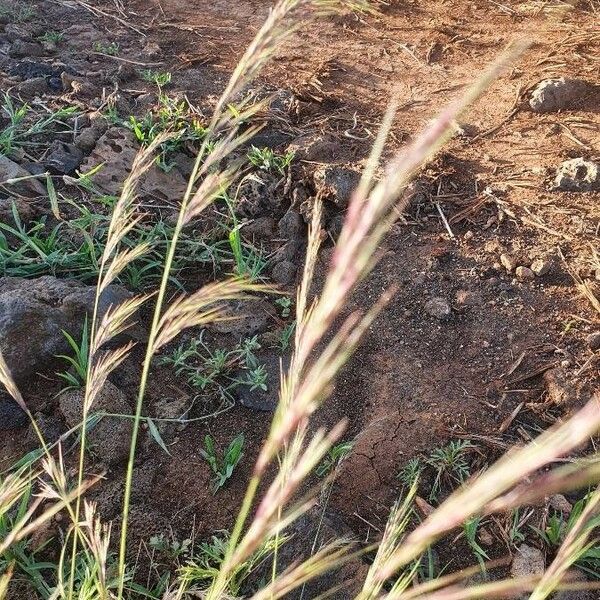
Plant Overview
Commonly known as the Kenyan Three-awn, this resilient grass is a survivor of the vast East African savannas. Often seen swaying in the highland breeze, it belongs to a group of grasses famous for their "spear-like" seeds that can hitchhike on clothing and fur. While it may look like a simple pasture grass, it plays a vital role in stabilizing soil in semi-arid regions.
🔍 How to Identify
- 🌾 The "Three-Awn" Feature: The most distinct characteristic is the seed head, where each grain ends in three long, needle-like bristles (awns) that spread out like a tiny tripod.
- 🌱 Growth Habit: It forms dense, wiry tufts or "bunches" (technically a perennial bunchgrass) that can reach up to 60-80 centimeters in height.
- 🍃 Blade Texture: The leaves are narrow, often rolled inward to conserve water, and feel slightly rough or "scabrous" to the touch.
🏡 In Your Garden & Landscape
- ☀️ Drought Specialist: In a landscape setting, this plant is the definition of "set it and forget it." It has evolved to thrive in poor, rocky soils where other plants would wither, making it excellent for xeriscaping.
- 🐑 Grazer's Dilemma: While young shoots are palatable for livestock, the grass becomes very tough as it matures. The sharp, hardened seeds are designed to drill into the ground, but they can be a nuisance for gardeners during the seeding season.
⚠️ Safety & Toxicity
- 🟢 Chemical Safety: Aristida kenyensis is generally non-toxic and contains no known poisons that affect humans or pets if touched or accidentally brushed against.
- 🐕 Mechanical Injury: The "spear" seeds are the real concern. These sharp awns can get stuck in a dog’s fur, ears, or between paw pads. If you have long-haired pets, it is best to keep them away from this grass when it is in seed to avoid painful irritations or infections.
✨ Fun Fact
The three long bristles on the seeds aren't just for show; they act like a tiny parachute and a drill combined. When they fall to the ground, changes in humidity cause the awns to twist and move, literally "walking" the seed into a crack in the soil where it can safely germinate!

Detailed Care Instructions








