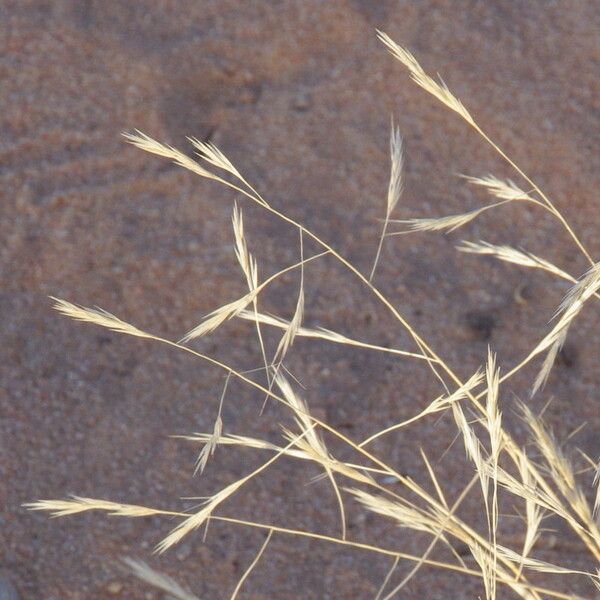
Plant Overview
Known as the Spread Three-awn, this wiry traveler is a master of the arid plains. Often found dancing across the dry savannas of Africa, the Middle East, and India, its name mutabilis hints at its "changeable" nature, shifting from a fresh, dusty green to a shimmering gold as the seasons turn. It is a pioneer of the sands, often the first to reclaim bare ground after a disturbance.
🔍 How to Identify
- 🌾 The "Three-Awn" Signature: The most iconic feature is the seed structure; each grain ends in three delicate, hair-like bristles (awns) that spread outward like a tiny pitchfork.
- 🌿 Narrow Foliage: Its leaves are exceptionally thin and often tightly rolled inward, a clever evolutionary trick to prevent water loss in scorching heat.
- 🎨 Color Transition: Look for a tufted, clumping growth habit that starts as a pale bluish-green and matures into a bleached, straw-colored tan.
🏡 In Your Garden
- 🏜️ The Ultimate Survivor: This grass thrives in sandy, nutrient-poor soils where most plants would wither. It is an excellent choice for "wilding" a dry patch of land or for xeriscaping in regions with minimal rainfall.
- 💨 Soil Stabilizer: Because it establishes quickly in loose earth, it plays a vital role in preventing wind erosion. It prefers "neglect"—over-watering or rich fertilizers will actually cause it to grow too weak to stand.
⚠️ Safety & Toxicity
- 🟢 Non-Toxic: Aristida mutabilis is not chemically toxic to humans or animals.
- 🐕 Mechanical Irritant: The sharp "needles" (awns) are designed to hitch a ride on fur. Be cautious if you have long-haired pets, as the seeds can become entangled in coats or occasionally irritate sensitive paws, ears, and noses during the dry season.
✨ Fun Fact
The awns of this grass are actually "self-drilling." They are hygroscopic, meaning they move in response to humidity. As they wet and dry, they twist and untwist, effectively "walking" the seed across the ground and screwing it into the soil to ensure successful germination!

Detailed Care Instructions








