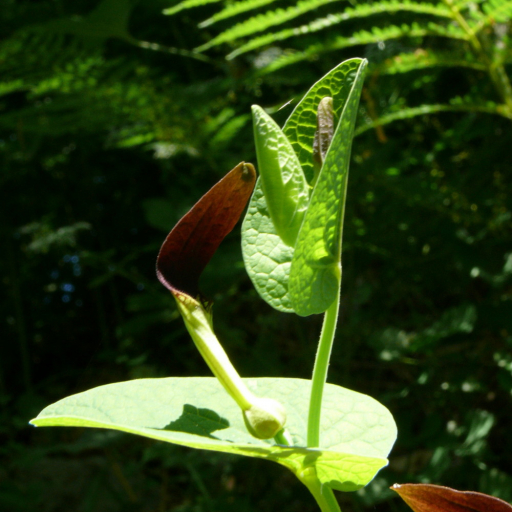
Plant Overview
Often called the Round-leaved Birthwort, this Mediterranean native is famous for its curious, pipe-like flowers and its deep connection to ancient medicine. Its name, derived from the Greek words for "best" and "birth," stems from a historical (and dangerous) belief that its flower shape resembled a birth canal, aiding in childbirth. Today, it is more valued by butterfly enthusiasts than herbalists, serving as a vital host for rare European swallowtails.
🔍 How to Identify
- 🍃 The Leaves: Unlike its cousins, this species features distinct, heart-shaped leaves that have no stalk (sessile); they appear to "clasp" or hug the winding green stem directly.
- 🎷 The Flowers: The blooms are tubular and curved, resembling a miniature saxophone or a Dutchman’s pipe. They are typically a yellowish-green on the outside with a dark, brownish-purple "flap" or tongue at the top.
- 🥔 The Tuber: Beneath the soil lies a distinct, spherical or "rotund" root tuber, which gives the plant its species name rotunda.
🏡 In Your Garden
- 🦋 The Butterfly Magnet: If you live in Southern Europe, this plant is the primary nursery for the Spanish Festoon butterfly. The caterpillars eat the leaves to ingest toxins, making themselves unpalatable to predators.
- 🌤️ Preferred Niche: In a garden setting, it thrives in "edge" environments—think of the dappled shade under a deciduous tree or the cracks of a dry-stone wall. It prefers well-drained, slightly alkaline soil and hates "wet feet" during the winter.
- 🌱 Growth Habit: It is a deciduous perennial, meaning it will die back completely in the winter and re-emerge from its underground tuber when the spring sun warms the soil.
⚠️ Safety & Toxicity
- 🚫 Status: Highly Toxic & Carcinogenic.
- ⚠️ The Danger: Every part of the plant contains Aristolochic acid, a potent toxin that causes irreversible kidney damage and various forms of cancer if ingested.
- 🐾 Pets & Kids: Keep this plant out of reach of curious pets and children. Even historical medicinal use is now strictly discouraged by health organizations worldwide due to its extreme nephrotoxicity.
✨ Fun Fact
The Aristolochia genus is famous for its "pitfall pollination" strategy. The flowers emit a scent that mimics decaying organic matter to lure small flies inside. The flies are trapped by downward-pointing hairs until the flower is pollinated; only then do the hairs wither, releasing the dust-covered insects to find another bloom!

Detailed Care Instructions
To grow Aristolochia rotunda (also known as round-leaved pipevine or Dutchman's pipe), follow these steps:
- Choose the right location: Plant it in a spot that receives partial shade or full shade. The plant prefers indirect sunlight or dappled light rather than direct sunlight.
- Soil preparation: The soil should be rich, well-draining, and slightly acidic to neutral pH. Add organic matter like compost or aged manure to improve soil fertility and drainage if necessary.
- Propagation: Aristolochia rotunda can be propagated using seeds or stem cuttings. Seeds should be sown in spring, while cuttings can be taken in spring or summer.
- Seeds: Soak the seeds in warm water for 24 hours before sowing. Sow the seeds in a seed-starting mix and keep them moist until germination, which usually takes around 2-4 weeks. Transplant the seedlings into individual pots once they are large enough to handle.
- Stem cuttings: Take stem cuttings that are about 4-6 inches long and remove the leaves from the lower half. Dip the cut end into rooting hormone powder and plant it in a well-draining potting mix. Keep the soil slightly moist and place the cutting in a warm, humid environment with bright indirect light. After a few weeks, roots should start to form, and you can gradually acclimate the cutting to outdoor conditions.
- Seeds: Soak the seeds in warm water for 24 hours before sowing. Sow the seeds in a seed-starting mix and keep them moist until germination, which usually takes around 2-4 weeks. Transplant the seedlings into individual pots once they are large enough to handle.
- Planting: Whether you're planting from seeds or cuttings, wait until all danger of frost has passed before transplanting the seedlings or cuttings to their permanent location in the garden. Dig a hole slightly larger than the root ball and place the plant in it, making sure the soil level matches the original planting depth. Backfill the hole with soil and firm it gently around the plant. Water thoroughly.
- Watering and maintenance: Keep the soil consistently moist but not waterlogged. Provide regular watering during dry periods, especially during the first year to establish a strong root system. Mulching around the base of the plant will help retain moisture and suppress weeds. Prune the plant as needed to control its size and shape.
- Support: Aristolochia rotunda is a climbing vine. Provide a trellis, obelisk, or other support structure for it to climb. The plant wraps its tendrils around the support and can reach heights of 10-15 feet.
- Monitoring pests and diseases: While relatively resistant to pests and diseases, occasionally, aphids, spider mites, or powdery mildew can affect the plant. Regularly inspect the leaves for any signs of infestation or disease, and treat accordingly to prevent further complications.
By following these steps, you should be able to grow Aristolochia rotunda successfully.

Place in a bright room that is sun drenched almost all day. Or directly in a south-facing window.

1. Soil Moisture: Aristolochia Rotunda should be watered regularly to keep the soil moist but not waterlogged. You can check the soil's moisture level by inserting your finger into the soil and feeling the level of moisture.
2. Watering Schedule: The plant needs to be watered at least once a week during the growing season, and less frequently during the winter. During periods of extreme heat, the plant may require more frequent watering.
3. Watering Method: Water should be directed towards the base of the plant, and not the leaves or flowers. Avoid getting water on the leaves, as this can lead to fungal diseases.
4. Drainage: Ensure good drainage by planting the Aristolochia Rotunda in a pot with drainage holes. If the plant is in a location where water tends to accumulate, consider moving it to a higher location.
5. Water Quality: Use clean, fresh water that is free of impurities or chemicals. If tap water is chlorinated, let it sit out for a day before using it to water the plant.
6. Soil Type: The plant prefers well-draining soil that does not hold too much water. Amend heavy soil with sand or compost to improve drainage.
7. Rainwater: Aristolochia Rotunda loves rainwater, so you can collect reservoirs of rainwater for use during dry periods. Rainwater is free of impurities and chemicals, which makes it an ideal source of water for plants.
To fertilize Aristolochia Rotunda, simply follow these instructions:
- Choose a balanced, water-soluble fertilizer, preferably one formulated for flowering plants. Avoid products high in nitrogen, as it can promote leaf growth over flower production.
- Dilute the fertilizer according to the package instructions, usually at a rate of 1 tablespoon per gallon of water.
- Water the Aristolochia Rotunda thoroughly before fertilizing to ensure the soil is moist.
- Pour the diluted fertilizer around the base of the plant, avoiding contact with the plant's leaves or stems.
- Apply the fertilizer once every four to six weeks during the growing season, typically from spring to early autumn.
- Monitor the plant for any signs of over-fertilization, such as yellowing leaves or wilting. If this occurs, reduce the frequency or strength of the fertilizer.
- Remember to always follow the specific instructions on the fertilizer packaging for best results.
The best soil to use for Aristolochia Rotunda is a well-draining, nutrient-rich soil that is slightly acidic. It should be a mix of organic matter like compost, mulch, or leaf mold. The soil should be moist but not waterlogged, as the plant doesn't tolerate waterlogged roots. Additionally, the pH level of the soil should be between 5.5 and 6.5. It is important to avoid soils that are too alkaline for the plant to thrive. Using potting soil, enriched with peat moss or perlite can also help in creating an adequate environment for Aristolochia Rotunda.
Aristolochia rotunda is a plant that can be propagated through various methods. Here's a detailed guide on how to propagate this plant:
- Propagation from seed:
a. Collect mature seeds from a healthy and established plant. They are typically formed in a capsule-like structure.
b. Soak the seeds in warm water for 24 hours to help with germination.
c. Prepare a seed tray or small pots with well-draining soil mix. You can use a mixture of potting soil, perlite, and sand.
d. Sow the seeds on the surface of the prepared soil, gently pressing them into the soil without burying them.
e. Keep the soil consistently moist, either by misting or watering lightly.
f. Place the seed tray or pots in a warm and bright location, away from direct sunlight.
g. Germination usually takes several weeks to a few months. Once the seedlings develop 2-3 true leaves, they can be transplanted into individual pots.
- Propagation from cuttings:
a. Select a healthy stem from the parent plant that is at least a few inches long and has several nodes.
b. Using a clean and sharp pruning shear, make a clean cut just below a node. This will be the base of your cutting.
c. Remove any leaves from the lower portion of the cutting, leaving only a few leaves on the top.
d. Optionally, you can dip the base of the cutting in a rooting hormone powder or gel to promote root development.
e. Fill a small pot with a well-draining soil mix, such as a mixture of potting soil and perlite.
f. Create a hole in the soil mix with a pencil or finger and gently insert the base of the cutting, ensuring it stands upright.
g. Firmly press the soil around the cutting to provide stability.
h. Place the pot in a bright location with indirect sunlight.
i. Mist the cutting regularly to keep the environment humid and prevent it from drying out.
j. Within a few weeks, roots should start forming. You can gently tug on the cutting to check for resistance, indicating root development.
k. Once the cutting is well-rooted, usually in 6-8 weeks, it can be transplanted into a larger pot or the desired growing location.
Remember to provide proper care and maintenance to your propagated Aristolochia rotunda plants, such as regular watering, well-draining soil, and the appropriate amount of sunlight for their healthy growth.








