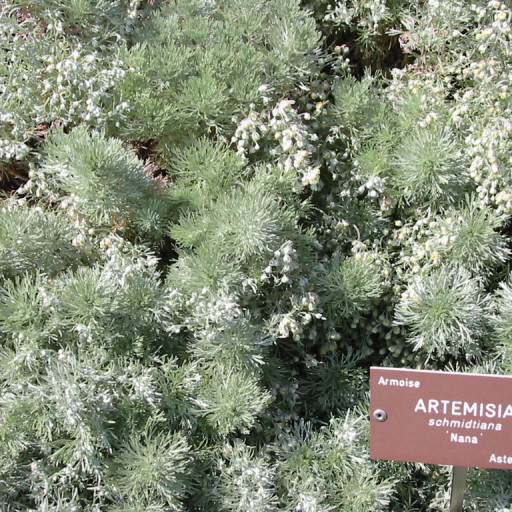
Plant Overview
Often called the "Silvermound" or "Angel's Hair," this Japanese native looks like a shimmering, soft cloud resting on the garden floor. It is prized by landscapers for its incredible "pet-able" texture and its ability to act as a cooling visual anchor in colorful flower beds. Its luminous, metallic foliage seems to glow during the twilight hours, earning it a mystical reputation in moonlight gardens.
🔍 How to Identify
- 🌿 Foliage: Features incredibly fine, thread-like leaves that are deeply divided, giving the plant a feathery, lace-like appearance.
- 🎨 Color: The entire plant is covered in tiny, silky white hairs, which create a distinctive silver or pewter-green sheen that reflects sunlight.
- 🧶 Growth Habit: It naturally forms a low, tight, symmetrical dome or "mound," typically staying under 12 inches tall but spreading wide.
🏡 In Your Garden
- ☀️ Sun & Drainage: This plant is a true "dry-land" specialist. It thrives in poor, sandy soil and will actually lose its beautiful silver color and tight shape if the soil is too rich or stays too wet.
- ✂️ The Mid-Summer Haircut: In high humidity, the mound may "split" or flop open in the center. Don't worry—simply shear the foliage back by half to encourage a fresh, tight flush of new growth for the autumn.
⚠️ Safety & Toxicity
- 🐾 Status: Generally considered non-toxic to humans and common household pets like cats and dogs.
- 🌾 Sensitivities: While safe, the plant belongs to the Asteraceae family; individuals sensitive to ragweed or daisies may experience mild skin irritation if handling the plant extensively without gloves.
✨ Fun Fact
Although it looks delicate and ornamental, Silvermound is a close cousin to Wormwood, the bitter herb used to flavor Absinthe. Unlike its "Green Fairy" relative, however, Silvermound is grown purely for its heavenly looks rather than its chemistry!

Detailed Care Instructions
To grow Artemisia Schmidtiana, also known as Silver Mound or Silver Sage, you can follow these steps:
- Choose a suitable location: Artemisia Schmidtiana prefers full sun to partial shade. Ensure the selected spot has well-draining soil with good air circulation.
- Prepare the soil: Before planting, amend the soil with organic matter like compost or aged manure to improve drainage and nutrient content. Artemisia Schmidtiana is tolerant of various soil types but prefers slightly alkaline conditions.
- Planting: Dig a hole in the prepared soil that is slightly larger than the plant's root ball. Place the plant in the hole, backfill with soil, and gently firm it around the roots. Space multiple plants around 18 inches apart to allow enough room for their growth.
- Watering: Water the plant deeply immediately after planting to help establish its roots. After that, Artemisia Schmidtiana is drought-tolerant and doesn't require frequent watering. Allow the soil to dry between waterings, as overwatering can lead to root rot.
- Mulching: Apply a layer of organic mulch, such as wood chips or straw, around the base of the plant to help retain moisture and suppress weed growth.
- Pruning: Trim back the plant in early spring or late winter before new growth emerges. This will encourage bushiness and maintain a compact form. Additionally, you can prune it throughout the growing season to prevent it from becoming too leggy.
- Fertilizing: Artemisia Schmidtiana generally doesn't require much fertilization. However, if you feel the need to boost growth, you can apply a balanced, slow-release fertilizer in the early spring.
- Pests and diseases: Artemisia Schmidtiana is relatively resistant to pests and diseases. However, keep an eye out for aphids, spider mites, or powdery mildew. Regularly inspect the plant and take appropriate measures if any issues arise.
By following these guidelines, you can successfully grow Artemisia Schmidtiana and enjoy its beautiful silvery foliage in your garden or landscape.

Place in a window with dappled sun or a spot in the middle of a room. Or directly in a window facing west or east.

Artemisia Schmidtiana plant should be watered deeply and consistently to ensure healthy growth. In general, it is best to water the plant deeply once a week or whenever the soil feels dry to the touch. It is important to water at the base of the plant to avoid getting the leaves wet, which can lead to disease and damage. Overwatering should be avoided as it can cause root rot and other issues. When watering, it is best to use room temperature water to prevent shock to the roots. Additionally, it is important to ensure proper drainage to avoid waterlogging the plant.
- Choose a well-draining soil mixture for your Artemisia plant.
- Apply fertilizer to the soil in spring, using a slow-release nitrogen-rich fertilizer.
- Fertilize again in mid-summer using a balanced liquid fertilizer diluted to half strength.
- Do not over-fertilize, as too much nitrogen can cause your plant to become leggy and weak.
- Water your plant thoroughly after fertilizing to help distribute the nutrients evenly throughout the soil.
Artemisia Schmidtiana prefers well-draining soil with a pH level between 6.0 to 7.5. The soil should be rich in organic matter and should not retain too much water as the plant is susceptible to rotting. A mix of sand, loam, and peat moss can be used to create a well-draining soil. It is also recommended to add fertilizer to the soil during the growing season to promote healthy growth.
Artemisia Schmidtiana plant can be propagated using various methods such as stem cutting, division, and seed propagation. Stem cutting is the simplest way to propagate the plant. To propagate through stem cutting, cut a healthy stem from the parent plant, ensuring it is about 4 to 6 inches long. Remove all the leaves from the lower two-thirds of the stem. Insert the stem into a pot filled with well-draining soil and water it. Make sure the soil stays moist, but not too wet. Within a few weeks, the cutting will develop roots and can be transplanted into a larger pot or in the ground.
Division is another method of propagation. It is best to divide the plant in the spring or early fall. Dig up the plant and carefully separate it into sections, ensuring each section has healthy roots and leaves. Replant the sections in well-draining soil and water them. Keep the soil moist until new growth appears.
Seed propagation is a bit more complicated and requires a bit more patience. Collect the seeds from the plant when they are mature and dry. Sow the seeds in well-draining soil and cover them with a thin layer of soil. Water the soil and place it in a warm, sunny location. Keep the soil moist and in a few weeks, you will notice new seedlings sprouting up. Wait until the seedlings are large enough to be transplanted.








