Plant Overview
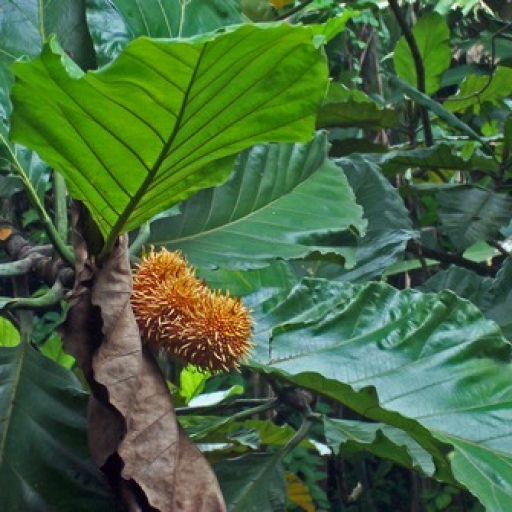
Often called the Benda or Wild Breadfruit, Artocarpus elasticus is a majestic giant of the Southeast Asian rainforests. A close relative of the famous Jackfruit, it is prized for its prehistoric-looking, oversized leaves and its remarkably sticky, elastic sap. In its native lands, this tree has been a vital "forest supermarket" for centuries, providing everything from edible seeds to durable clothing fibers.
🔍 How to Identify
- 🍃 Leaf Transformation: Young trees produce massive, deeply lobed leaves that look like giant green hands. As the tree matures, the new leaves become simpler, smooth ovals, a common "growing up" trick in the rainforest.
- 🧶 Velvety Twigs: The young branches and the undersides of the leaves are covered in stiff, brownish hairs, giving the tree a coarse, fuzzy texture that distinguishes it from its smoother cousins.
- 🦔 Bristly Fruit: The fruit is smaller than a Jackfruit and is covered in soft, yellowish-brown "furry" spines. When it ripens and opens, it reveals small seeds embedded in a white, oily pulp.
- 🥛 The Latex Leak: If you nick the bark or pull a leaf, the tree immediately "bleeds" a thick, creamy white sap that is incredibly tacky and dries into a rubbery consistency.
🏡 In Your Garden
- 🌳 Space for a Giant: This is not a plant for a small backyard or a patio pot. It is a massive canopy tree that can reach heights of over 40 meters. Its aggressive, wide-reaching root system means it must be planted far away from house foundations, pipes, or pavements.
- 💧 Tropical Requirements: It demands high humidity and deep, fertile soil to thrive. Because it develops a long, sensitive taproot very early, it hates being transplanted; if you move it once it’s established, it will likely go into severe shock.
⚠️ Safety & Toxicity
- 🧪 Skin Irritant: The milky white latex is a known skin irritant. If the sap gets on your hands, it can be very difficult to wash off and may cause a red, itchy rash (contact dermatitis) for those with sensitive skin.
- 🐾 Pet Precautions: While the fruit pulp is technically edible, the sticky sap and the fibrous rind are not. If a pet chews on the branches or unripe fruit, the latex can cause mouth irritation and digestive upset.
- 👀 Eye Safety: Always wear gloves when pruning, and be extremely careful not to touch your eyes if you have the sap on your fingers, as it can cause painful inflammation.
✨ Fun Fact
The species name elasticus is a tribute to the tree's historical use as a "living cloth." For generations, the inner bark was stripped, beaten, and processed into a durable, felt-like fabric used to make traditional clothing and strong ropes!

Detailed Care Instructions
To grow an Artocarpus Elasticus plant (also known as the jackfruit tree), follow these steps:
- Climate: Determine if your climate is suitable for growing jackfruit trees. They thrive in tropical or subtropical climates with temperatures between 60-100°F (15-38°C). They can tolerate brief temperature drops, but prolonged cold can damage the tree.
- Soil: Choose well-draining soil that is rich in organic matter. The pH level should be slightly acidic to neutral (around 6-7 pH).
- Propagation: There are two common methods of propagation: seed germination and grafting.
- Seed Germination: Collect fresh ripe seeds from a mature jackfruit. Soak the seeds for 24 hours in water, and then plant them in nursery pots filled with well-draining soil. Maintain a warm and humid environment, and water regularly. Seedlings will emerge in 2-6 weeks.
- Grafting: Purchase a young jackfruit tree sapling from a reputable nursery to ensure a particular variety. Graft the young sapling onto a compatible rootstock, ensuring a successful union between the scion and rootstock.
- Planting: Choose a sunny location for planting the young jackfruit sapling or grafted tree. Dig a hole slightly larger than the pot size and backfill it with the soil mixed with organic matter. The planting hole should be deep enough to accommodate the root ball, but avoid planting it too deep or burying the trunk.
- Watering: Keep the soil consistently moist, but not waterlogged. Young jackfruit trees require frequent watering, especially during dry spells.
- Fertilization: Apply well-balanced organic fertilizer every few months during the growing season to promote healthy growth. Follow the instructions on the fertilizer package for the appropriate amount for your tree's size.
- Pruning: Prune your jackfruit tree regularly to maintain its shape, remove dead or diseased branches, and encourage air circulation. Trim lower branches to promote upward growth.
- Pest and Disease Control: Monitor your tree regularly for pests like aphids, mealybugs, and fruit flies. Apply organic insecticides if necessary and follow recommended practices for disease prevention.
- Harvesting: Jackfruits take several years to mature and bear fruit. Depending on the variety, it can take four to eight years or more. Harvest the fruit when it gives a dull sound when tapped and when the fruit stalk's sap is milky white. Cut the fruit from the tree using a sharp knife or pruning shears.
Remember that growing jackfruit trees can be a long-term commitment, requiring patience and care.

To water this plant, you should make sure to check the soil moisture level before watering. Insert your finger into the soil up to the second knuckle, and if it feels dry, it's time to water. When you water, make sure to do it deeply, allowing the water to fully penetrate the root zone. Avoid letting the soil dry out completely, as the plant prefers consistently moist but well-draining soil. During periods of heavy rainfall or high humidity, you may need to adjust your watering schedule accordingly. Additionally, avoid getting water on the leaves and try to water at the base of the plant to prevent fungal growth.
To fertilize this plant, it is recommended to use an all-purpose fertilizer with a balanced N-P-K ratio, applied once every two months during the growing season. Avoid over-fertilizing as it may lead to salt buildup and damage to the plant's roots. Water the plant well before and after fertilizing to prevent fertilizer burn. Additionally, incorporating organic matter such as compost or manure into the soil can also provide nutrients over time.
The recommended soil for Artocarpus Elasticus plant is a well-draining soil with a pH range of 6.0 to 7.5. It should also be rich in organic matter, such as compost or aged manure, to provide the necessary nutrients for the plant's growth. A soil mix that is formulated for tropical plants is usually ideal. It should not be waterlogged as the plant can be prone to root rot. Additionally, it is important to ensure good drainage and to prevent compaction of the soil, which can inhibit the plant's root growth.
Artocarpus Elasticus is a plant that can be propagated through various methods, such as cutting, grafting, and air-layering. In cutting propagation, a branch or shoot is cut from the mother plant and rooted in a suitable medium. The cutting should be taken from a healthy mother plant, and the leaves should be trimmed to reduce transpiration. The cutting should then be dipped in rooting hormone and planted in a well-draining media. After planting, the cutting should be kept moist and protected from direct sunlight until roots have formed.
Grafting is another propagation method that involves attaching a young plant, called a scion, onto a mature plant, called a rootstock. This method is often used to propagate fruit trees, and it allows for the combination of desirable traits from two different plants. The scion is a small shoot or bud taken from the mother plant and attached to the rootstock through a process called grafting.
Air-layering is a propagation method that involves creating a wound on a stem or branch of the mother plant and then wrapping it with moist sphagnum moss or another rooting medium. Once roots have formed, the stem or branch can be cut and planted as a new plant. This method is particularly useful for plants that are difficult to root from cuttings.
Regardless of the propagation method chosen, it is important to provide the new plant with the appropriate growing conditions, including adequate water, nutrients, and light. With proper care, Artocarpus Elasticus plants can be successfully propagated and grown into healthy, mature plants.








