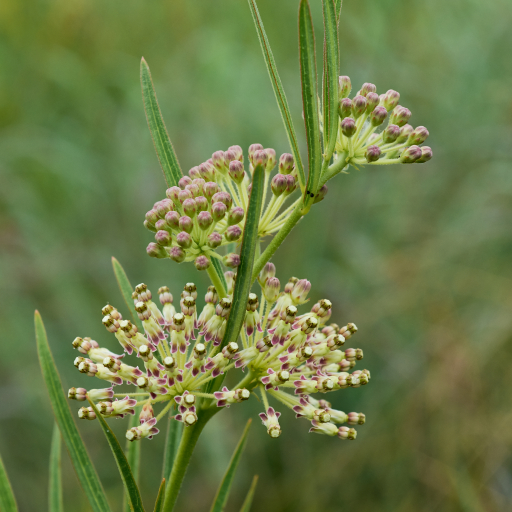
Plant Overview
Known as the Tall Green Milkweed or Prairie Milkweed, Asclepias hirtella is the understated architect of the American prairie. Unlike its flashy pink or orange cousins, this species opts for a sophisticated, monochromatic look with globes of pale green flowers that seem to glow at dusk. It is a resilient survivor, often found standing tall in tallgrass prairies where other plants might be crowded out.
🔍 How to Identify
- ☁️ Flower Clusters: It produces unique, golf-ball-sized spheres (umbels) of tiny, creamy-green to white flowers that emerge from the axils of the upper leaves rather than just the top of the stem.
- 📏 Linear Leaves: The leaves are exceptionally long, narrow, and sword-shaped. Unlike many other milkweeds with opposite leaves, these are often arranged alternately and crowded along the stem.
- 🌵 The "Hairy" Stem: The species name hirtella translates to "short-haired," referring to the fine, velvety fuzz that covers the sturdy, upright stems.
🏡 In Your Garden
- ⚓ The Taproot Rule: This plant develops a deep, wandering taproot designed to find water during droughts. Because of this, it absolutely hates being moved once planted. Choose its "forever home" in a sunny spot with well-draining soil carefully.
- 🦋 A Quiet Hero: While it isn't as "loud" as Butterfly Weed, it is a vital host plant for Monarch butterfly caterpillars. It tends to be less aggressive and "weedy" than Common Milkweed, making it a better choice for structured native perennial borders.
⚠️ Safety & Toxicity
- 🚫 Status: Toxic to ingest.
- 🧪 Details: Like all members of the Asclepias genus, the plant contains cardiac glycosides. If eaten in large quantities, it can cause heart rhythm issues, nausea, and salivation. The "milky" white sap can also cause mild skin irritation or intense discomfort if it gets into the eyes. Keep it away from curious pets and livestock.
✨ Fun Fact
Unlike most milkweeds that rely on a wide variety of butterflies for pollination, the Tall Green Milkweed has a special relationship with large bees and wasps. Its floral structure is so specific that it often requires the strength of a heavy bumblebee to successfully pull the pollen sacs (pollinia) out of the flower!

Detailed Care Instructions
To grow Asclepias hirtella, also known as tall green milkweed or Hirtella's milkweed, follow these steps:
- Choose the right location: Asclepias hirtella prefers full sun to light shade. Select a spot in your garden that receives 6-8 hours of sunlight daily.
- Prepare the soil: Milkweeds prefer well-draining soil. Amend heavy clay soil with organic matter like compost or well-rotted manure to improve drainage.
- Sow seeds indoors or direct sow: Asclepias hirtella can be grown from seeds. You can start seeds indoors 8-10 weeks before the last frost date or directly sow them in the garden after the danger of frost has passed.
- Start seeds indoors (optional): Fill seedling trays or small pots with a well-draining seed-starting mix. Sow the seeds on the surface, lightly pressing them into the soil. Mist the soil surface lightly with water. Maintain a temperature of around 70°F (21°C) for germination, which usually takes 2-3 weeks.
- Transplant seedlings (if started indoors): Once the seedlings have developed a few sets of true leaves, transplant them into larger pots or a prepared garden bed, spacing them at least 12-18 inches apart.
- Direct sow outdoors: If you choose to sow seeds directly in the garden, prepare a weed-free bed by removing any grass or weeds. Lightly scratch the soil surface and sow the seeds, spacing them at least 12-18 inches apart. Cover the seeds with a thin layer of soil, and water gently.
- Watering and care: Keep the soil consistently moist but not waterlogged until the plants are established. Established plants have good drought tolerance and require minimal watering. Water them during extended dry periods.
- Mulching: Apply a layer of organic mulch around the plants to help conserve soil moisture and suppress weed growth. Avoid placing mulch directly against the stems.
- Support and staking: If the plants become tall and the stems are prone to bending or breaking, consider staking them to provide support. Use plant stakes or cages to prevent damage.
- Pruning and maintenance: Asclepias hirtella generally does not require pruning, except for removing dead or damaged stems. However, leaving some dried seedpods on the plant can provide food for wildlife.
- Leave the plant undisturbed during winter: Tall green milkweed is perennial and forms underground rhizomes. Allow the plant to die back naturally in winter, and avoid removing the dried stems until spring.
- Monitor for pests and diseases: While Asclepias hirtella is generally resistant to pests and diseases, keep an eye out for common issues like aphids or milkweed bugs. Handpick them or use appropriate organic pest control methods to manage them if necessary.
Remember, Asclepias hirtella is a native plant, and growing it helps support pollinators like butterflies and bees.

Place in a bright room that is sun drenched almost all day. Or directly in a south-facing window.

Asclepias Hirtella plant should be watered deeply and thoroughly once per week, ensuring that the soil becomes moist but not waterlogged. Monitor soil moisture levels regularly, especially during hot, dry weather, and adjust watering frequency as needed. Avoid overhead watering, which can damage the delicate foliage and flowers. Instead, water at the base of the plant, directing the flow of water onto the soil rather than the leaves. Allow the soil to dry out slightly between waterings to prevent root rot. Consider using a well-draining soil mix or adding organic matter to improve soil structure and water retention. Mulch around the base of the plant to help retain moisture and regulate soil temperature.
To fertilize this plant, choose a slow-release, balanced fertilizer with equal parts nitrogen, phosphorus, and potassium. Apply the fertilizer at a rate of 1 tablespoon per square foot of soil, or according to the manufacturer's instructions. Spread the fertilizer evenly around the base of the plant, being careful not to get it on the leaves. Water the plant thoroughly after fertilizing to help the nutrients soak into the soil. Fertilize once in the spring and again in early summer for best results.
The recommended soil for Asclepias Hirtella plant is a well-draining, loamy soil with a slightly acidic pH level. This type of soil should be rich in organic matter and have good moisture retention properties, but should not be waterlogged. It is important to avoid heavy or compacted soils, as these can restrict the plant's root growth and cause drainage problems. Additionally, the plant prefers full sun to partial shade and requires moderate watering during its growing season. Regular fertilization may also be necessary to support healthy growth and blooming.
To propagate this plant, start by taking cuttings from healthy, mature stems in the spring or summer. Use clean, sharp scissors or a knife to make a clean cut just below a leaf node.
Remove any leaves from the lower half of the cutting, leaving only a few at the top. Dip the cut end in rooting hormone powder to encourage root growth.
Fill a small pot with a well-draining potting mix and insert the cutting into the soil. Water thoroughly and place in a bright, but indirect light. Keep the soil moist but not wet.
After a few weeks, check for root growth by gently tugging on the cutting. If it resists, roots have formed. Wait until the cutting has established roots and new growth before transplanting into a larger container or outside in a well-draining area with plenty of sunlight.
It's important to note that this plant is toxic to animals if ingested, so keep away from pets and children.








