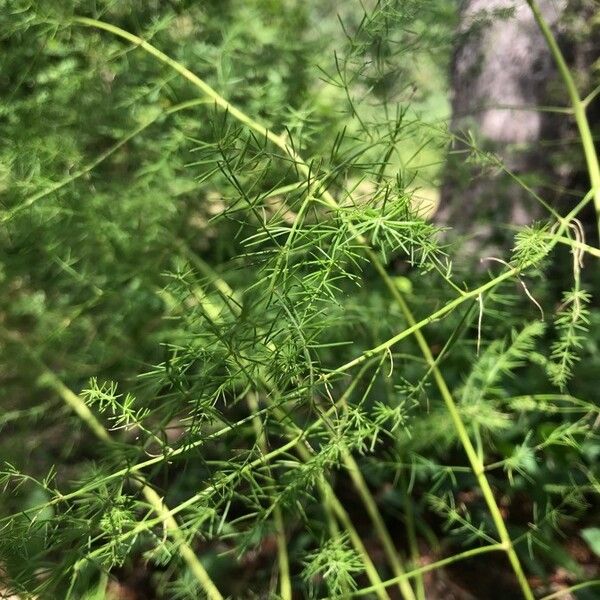
Plant Overview
Often called the East Asian Asparagus, this elegant perennial brings a soft, misty texture to any landscape. Native to the shaded woodlands of China, Japan, and Korea, it is a hardy relative of the common garden asparagus. While it lacks the thick, edible spears of its famous cousin, it is highly prized by collectors for its cloud-like foliage and architectural stems.
🔍 How to Identify
- 🌿 Feathery "Leaves": What appear to be delicate needles are actually modified stems called cladodes. They are fine, bright green, and grow in tufts that give the plant a soft, blurred silhouette.
- 🎋 Zig-Zag Stems: The primary stalks are slender and often grow in a subtle zig-zag pattern, reaching heights of 1 to 3 feet depending on the soil richness.
- 🍒 Autumn Berries: In late summer, tiny greenish-white flowers appear, eventually giving way to small, round berries that transition from green to a striking, glossy red.
🏡 In Your Garden
- 🪵 Woodland Roots: This plant mimics its forest home by preferring "dappled light" rather than harsh, direct afternoon sun. It is a fantastic choice for those tricky partially-shaded corners where other plants might struggle.
- 💧 Drainage is Key: While it enjoys consistent moisture, it hates "wet feet." It possesses a fleshy root system that stores water, making it surprisingly drought-tolerant once it has had a season to settle into your garden.
⚠️ Safety & Toxicity
- 🚫 Toxic Berries: The bright red berries are not edible. They contain saponins which can cause significant digestive distress if swallowed.
- 🐾 Pet & Child Safety: Keep this plant away from curious pets and toddlers. Ingesting the berries can cause vomiting or diarrhea, and in some individuals, the sap may cause mild skin irritation or "sap-rash."
✨ Fun Fact
💡 The Great Pretender: Those needle-like "leaves" are a clever evolutionary trick! Because true leaves lose a lot of water through evaporation, this plant reduced its leaves to tiny, invisible scales and turned its stems into leaf-mimics to stay hydrated during dry spells.

Detailed Care Instructions
To grow Asparagus Schoberioides plant, you can follow these steps:
- Choose a suitable location: Asparagus Schoberioides thrives in full sun or partial shade, so select a spot that receives at least 6 hours of direct sunlight each day.
- Prepare the soil: The plant requires well-drained soil, so amend the soil with compost or organic matter to improve drainage and fertility. Asparagus Schoberioides prefers slightly acidic to neutral soil pH.
- Planting: Dig a trench about 12 inches deep and 6 inches wide. Space the crowns (young plants) about 18 inches apart within the trench. Gently spread out the roots and cover them with soil, allowing the top of the crown to be around 2 inches beneath the soil surface.
- Watering: Asparagus Schoberioides needs consistent moisture, especially during the growing season. Water the plants deeply once or twice a week, providing approximately 1 inch of water per week. Avoid overwatering, as it can cause root rot.
- Mulching: Apply a layer of organic mulch, such as straw or wood chips, around the plants to help retain moisture, suppress weed growth, and regulate soil temperature.
- Fertilizing: Asparagus Schoberioides requires regular fertilization to ensure healthy growth. Give a balanced fertilizer, such as a 10-10-10 or 20-20-20, in early spring and again in mid-summer. Follow the recommended application rate on the fertilizer packaging.
- Weed control: Keep the area around the Asparagus Schoberioides plants free from weeds, as they can compete for nutrients and water. Regularly pull out any weeds manually or use a shallow hoe to prevent damaging the plant's shallow roots.
- Harvesting: Most varieties of Asparagus Schoberioides can be harvested after two or three years of establishment. Harvest the spears by cutting them at or slightly below ground level when they reach around 6-8 inches in height. Allow some spears to grow into fern-like foliage, which will promote energy storage for next year's crop.
- Plant care: Remove any dead or dying foliage from the plant in late fall or early winter. In colder regions, provide a layer of mulch or straw over the plants during winter to help insulate them.
By following these steps and providing proper care, you should be able to successfully grow Asparagus Schoberioides plant in your garden.

Place in a window with dappled sun or a spot in the middle of a room. Or directly in a window facing west or east.

To properly water this plant, it is important to consider the soil moisture level and the surrounding environment. Watering should be done only when the soil is dry to the touch. Overwatering can lead to root rot and other damage to the plant. When watering, it is important to thoroughly saturate the soil, allowing the water to reach the roots. However, be careful not to let water collect on the surface or in trays under the pot, as this can also lead to root rot. The plant should be placed in a location with good drainage and allowed to dry out slightly between waterings.
To fertilize this particular plant, it is important to choose a balanced fertilizer with equal amounts of nitrogen, phosphorus, and potassium. Apply the fertilizer in the spring, before new growth appears, and again in the fall after the plant has died back. Be sure to follow the manufacturer's instructions on the amount of fertilizer to apply, and avoid over-fertilizing as this can harm the plant. Additionally, it is recommended to supplement the fertilizer with organic matter, such as compost or aged manure, to improve soil health and increase nutrient uptake.
Asparagus Schoberioides plants thrive in well-draining soil with a pH level between 6.5 and 7.5. The soil should be rich in organic matter and provide adequate moisture without being too saturated. A mix of sand, perlite, and peat moss can be added to improve drainage and aeration. Fertilizer should also be added to the soil to provide essential nutrients for the plant's growth and development. It is important to ensure that the soil is free from any pests or diseases that may harm the plant. Regular soil testing is recommended to monitor the pH level and nutrient content of the soil.
To propagate this plant, you will need to first locate some mature, healthy stems. Cut the stems at a 45 degree angle to create a clean cut. Place the stems in water or in a well-draining potting soil mix. If using water, change the water every few days to prevent stagnation. Place the cuttings in a warm, bright location out of direct sunlight and mist with water daily. After a few weeks, roots should begin to grow and new growth will emerge from the stems. Once the roots are well-established, the plant can be transplanted into soil or left in water.








