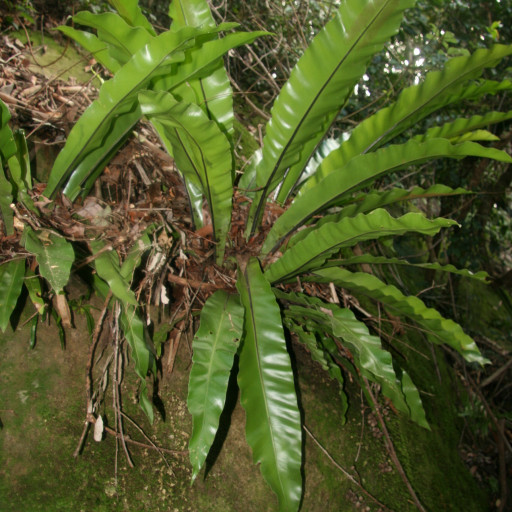
Plant Overview
Often called the Crow’s Nest Fern or the Australian Bird’s Nest Fern, this lush, structural beauty looks like something straight out of a prehistoric rainforest. In the wild, it is an "epiphyte," meaning it grows high up on tree branches or rock faces, reaching out its elegant fronds to catch falling leaves and rainwater. It is a favorite for designers who want to add a bold, architectural green statement to a room or a shaded patio.
🔍 How to Identify
- 🌿 The Rosette: It grows in a perfect circular shape, with fronds radiating from a central "nest" that looks like a bundle of fuzzy brown fibers.
- 🍃 The Fronds: Unlike many delicate ferns, these leaves are thick, leathery, and sword-shaped with wavy edges, reaching up to several feet in length.
- 📏 The Midrib: Look for a prominent, dark-colored central rib (rachis) on the underside of each leaf; in this species, it is usually keeled (V-shaped) rather than rounded.
🏡 In Your Garden
- 💧 The "Nest" Rule: While it loves humidity, avoid pouring water directly into the center of the "nest" during cold weather, as this can trap moisture and cause the crown to rot.
- 🪴 Soil and Drainage: Because it naturally grows on trees, its roots hate being suffocated in heavy mud. Use a very loose, orchid-like bark mix or high-quality potting soil to keep the roots "breathing."
- 🍃 Natural Composter: In its natural habitat, the bowl-like shape is designed to catch falling forest debris. As these leaves decay, the fern feeds on the nutrients—you can mimic this by occasionally using a liquid seaweed fertilizer.
⚠️ Safety & Toxicity
- ✅ Safe for All: This fern is non-toxic and is generally considered safe for households with curious cats, dogs, and children.
- ☁️ Spores: Mature plants develop brown, stripe-like spore cases (sori) on the underside of the leaves. These are perfectly natural and are not a sign of pests or disease, though they can be a bit messy if they drop on a white carpet!
✨ Fun Fact
In the Australian rainforest, these ferns can grow so large and heavy (sometimes weighing over 100 pounds!) that they have been known to occasionally pull down the tree branches they are perched on!

Detailed Care Instructions
To grow Asplenium Australasicum, also known as the bird's nest fern, follow these steps:
- Choose the right location: These ferns prefer indirect or filtered light, so place them in a spot with bright, but not direct sunlight. Avoid locations with drafts or extreme temperature changes.
- Soil requirements: Bird's nest ferns prefer moist and well-draining soil. Use a mixture of peat moss, potting soil, and perlite to create a well-draining medium.
- Planting the fern: Select a pot or hanging basket with good drainage holes. Place a layer of small stones or broken pottery at the bottom of the pot for additional drainage. Spread the plant's root ball gently and then plant it in the pot, ensuring that the crown is slightly above the soil level.
- Watering: Keep the soil evenly moist, but not waterlogged. Avoid letting the soil completely dry out between waterings. Water the plant thoroughly, allowing the excess water to drain freely from the pot. Empty the saucer or tray underneath to prevent water from pooling.
- Humidity: Bird's nest ferns prefer high humidity. To provide the required humidity, you can place the pot on a tray filled with pebbles and water, mist the leaves regularly, or use a humidifier nearby.
- Temperature: These ferns thrive in temperatures between 60-75°F (15-24°C). Avoid exposing them to temperatures below 50°F (10°C) or above 85°F (29°C).
- Fertilization: Use a balanced, water-soluble houseplant fertilizer diluted to half strength, and feed the fern every two to four weeks during the growing season (spring and summer). Reduce or stop fertilizing during the winter months.
- Pruning: Trim any brown or yellowing fronds at the base of the plant to maintain its appearance. Remove any dead or damaged leaves regularly.
- Repotting: Bird's nest ferns generally prefer to be a bit root-bound. However, if the plant outgrows its pot or becomes root-bound, you can repot it in a slightly larger container using fresh potting mix.
- Pests and diseases: These ferns are generally resistant to pests and diseases. However, watch out for common houseplant pests like mealybugs, scale insects, or spider mites. If infested, treat the fern with appropriate insecticidal soap or oil.
By following these guidelines, you should be able to grow a healthy and vibrant Asplenium Australasicum plant.

Place in a bright room that is sun drenched almost all day. Or directly in a south-facing window.

To water this particular plant, you should make sure that the soil is slightly moist but not overly saturated. To achieve this, you can water it once a week or whenever the top inch of soil feels dry to the touch. When watering, try to avoid getting water on the leaves as this can lead to the growth of mold or fungus. Instead, water the soil directly and allow the excess water to drain out of the bottom of the pot. If your plant is planted in a container without drainage holes, you should be extra careful not to overwater it as this can lead to root rot. Finally, make sure that the plant is placed in a location with sufficient light and humidity for it to thrive.
To fertilize this plant, use a balanced, water-soluble fertilizer with equal parts of nitrogen, phosphorus, and potassium. Apply the fertilizer once every two months during the growing season from spring to fall. Mix the fertilizer with water according to the package instructions and pour it on the soil around the base of the plant. Avoid getting the fertilizer on the fronds as it may cause burns. In winter, reduce the frequency of fertilizer application to once every three months or stop fertilizing altogether.
The best soil for Asplenium Australasicum is well-draining, fertile, and slightly acidic soil with a pH between 5.5 and 7.0. It should be rich in organic matter and have good moisture retention. A soil mix consisting of potting soil, peat moss, and perlite or sand in a 2:1:1 ratio is recommended. The plant should be planted in a pot with drainage holes to prevent waterlogged soil. Regular watering should be done to keep the soil consistently moist but not overwatered. Fertilizing once a month with a balanced fertilizer during the growing season can promote healthy growth.
Propagation of this plant is typically done through dividing the rhizomes or spores. When dividing the rhizomes, choose a healthy plant with several healthy fronds and carefully remove it from the soil. Gently separate the rhizomes into smaller sections, making sure each section has some healthy roots and fronds. Plant each section separately in a pot with fresh potting mix.
Propagation from spores begins by collecting the spores from the underside of the fronds. Place the spores on a moist potting mix in a tray or container with a lid to create a humid environment. Allow the spores to germinate and grow into small ferns before transplanting them into individual pots.
Both methods require a warm, humid environment to encourage growth. Keep the soil moist but not waterlogged and place in dappled shade or indirect sunlight until they establish themselves. After establishment, the plants can be moved to their final location depending on their light and moisture preferences.








