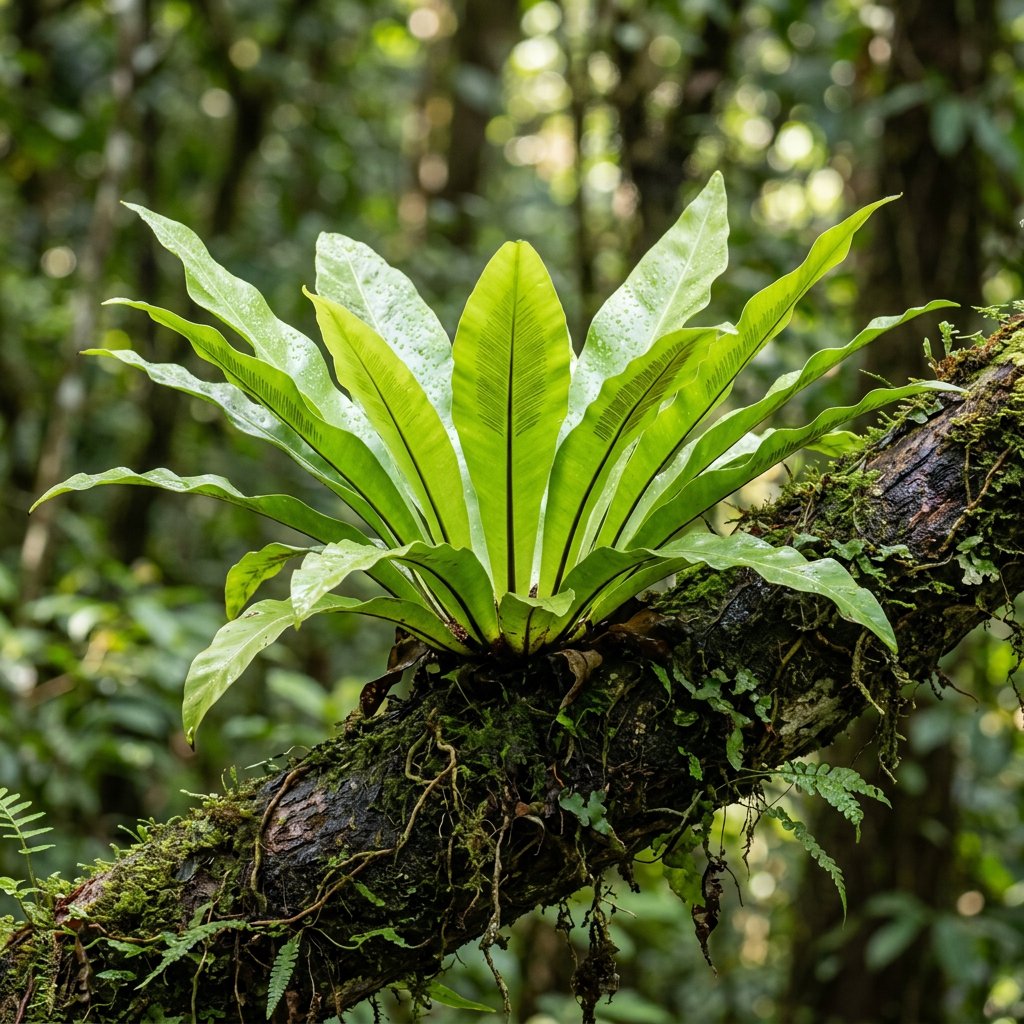
Plant Overview
Often called the Bird's Nest Fern, this tropical beauty breaks the mold of what we usually expect from a fern. Instead of lacy, delicate fronds, it produces bold, banana-like leaves that radiate from a central core. In its native rainforests of Southeast Asia and Polynesia, it lives high up in the crooks of trees, acting as a lush, green crown for the jungle canopy.
🔍 How to Identify
- 🌿 The Fronds: Large, bright green, sword-shaped leaves that are "entire" (meaning they aren't divided into smaller leaflets). They often have charmingly wavy or "crinkled" edges.
- 🪹 The Rosette: The leaves emerge from a central, fuzzy brown clump that looks remarkably like a bird’s nest. This is where the plant gets its common name.
- 📏 The Midrib: Each leaf features a prominent, dark brown or black central vein (midrib) that runs all the way to the tip, providing a striking color contrast.
🏡 In Your Garden
- ☁️ Humidity over Soil: Because this plant is naturally an epiphyte (it grows on trees rather than in ground soil), it is very sensitive to air quality. It thrives in high-humidity environments like bathrooms, where the steam mimics a tropical cloud forest.
- 🚫 The "No-Splash" Zone: Never pour water directly into the center "nest" of the plant. Trapped water in the crown leads to rot, which can kill the fern quickly. Always water the soil around the perimeter of the pot.
- 🍃 Gentle Handling: The new, emerging fronds are incredibly delicate. Avoid touching the center of the plant or moving it frequently, as the "baby" leaves can easily become deformed or turn black from the oils on human skin.
⚠️ Safety & Toxicity
- 🐾 Pet-Safe: This is an excellent choice for pet owners! The Asplenium nidus is non-toxic to cats and dogs.
- 👶 Safe for Humans: It is non-poisonous to humans, though the leaves are fragile and should be kept out of reach of curious toddlers to prevent damaging the plant's growth.
✨ Fun Fact
In the wild, the "nest" shape serves a brilliant evolutionary purpose: it acts as a literal trash can. The bowl-shaped center catches falling organic debris and rainwater, which decompose into a rich "compost" that feeds the fern high up in the trees where soil is scarce!

Detailed Care Instructions
| Color | No Flowers, Lush Green Foliage |
| Soil Ph | 5 To 5.5 |
| Humidity | High |
| Lighting | Part Sun |
| Toxicity | Non-Toxic |
| Soil Type | Peat-Based Potting Mix |
| Bloom Time | Growth Can Be Rapid During The Spring And Summer; Year Round If Conditions Are Ideal |
| Difficulty | Medium |
| Plant Type | Perennial In Warm Climates |
| Mature Size | Fronds Grow To 20 To 59 Inches Long And 4 To 8 Inches Broad. |
| Native Area | East Tropical Africa And Tropical Asia |
| Temperature | 20°C - 30°C |
| Sun Exposure | Filtered Or Indirect Light |
| Hardiness Zones | 11 And 12 For Outdoor Growth |
To grow an Asplenium Nidus plant, also known as the bird's nest fern, consider the following steps:
- Choose the right location: The plant prefers bright, indirect light. Avoid direct sunlight, as it can scorch the leaves. Find a location near a window with filtered light or a room with bright, indirect light.
- Provide the right temperature and humidity: Asplenium Nidus thrives in temperatures between 60-80°F (15-27°C). It enjoys high humidity, so misting the plant occasionally or placing a humidifier nearby can be beneficial.
- Use the correct pot and soil: Choose a pot with good drainage to prevent waterlogging the roots. A well-draining potting mix that retains some moisture but doesn't stay soggy is ideal. A mix of peat moss, perlite, and orchid bark could work well.
- Water properly: Aim to keep the soil evenly moist but not overly wet. Water when the top 1-2 inches of soil feels dry. Avoid allowing the soil to dry out completely or sitting in standing water, which can lead to root rot.
- Fertilize regularly: Use a balanced houseplant fertilizer at half the recommended strength every 2-4 weeks during the growing season (spring and summer). Reduce or stop fertilization during the winter months.
- Prune and clean: Remove any dead or dying fronds by cutting them off at the base. Wipe the leaves occasionally with a damp cloth to remove dust and maintain their shine.
- Propagation: Asplenium Nidus can be propagated through spores or by division. Spores can take time and patience, while division involves separating the plant into smaller sections and repotting them.
- Pay attention to pests: Monitor for common houseplant pests like spider mites, mealybugs, and scale insects. If spotted, address the issue promptly with appropriate measures (e.g., insecticidal soap, neem oil).
Remember that growing plants can sometimes be a trial-and-error process, so observe your plant closely, adjust care as needed, and enjoy the journey of nurturing your Asplenium Nidus plant.

Place in a window with dappled sun or a spot in the middle of a room. Or directly in a window facing west or east.

Watering for this species should be done regularly but with caution so as not to overwater. It is advised to check the soil's moisture level before watering, and to only water when the top inch of soil is dry. When watering, it is important to water evenly around the base of the plant and avoid getting water on the foliage. Drainage holes should be present in the pot to ensure excess water does not accumulate and cause root rot. In addition, the plant prefers slightly acidic soil and should be fertilized once a month during its active growing season.
To fertilize this plant, use a balanced, water-soluble fertilizer that contains equal parts nitrogen, phosphorus, and potassium. Dilute the fertilizer in water according to the package instructions and apply it to the soil once a month during the growing season. Be sure to avoid getting any fertilizer on the leaves, as this can cause damage. Water the plant thoroughly after fertilizing to ensure that the nutrients are properly absorbed.
Asplenium Nidus plant is a type of fern that requires well-draining soil with good aeration. It prefers soil that is rich in nutrients and organic matter, as it needs a constant supply of water and nutrients to thrive. Sandy loam soil mixed with peat moss or coco coir provides an ideal growing medium for Asplenium Nidus plant. The soil's pH level should be slightly acidic, around 6.0-7.0, which helps the plant to absorb nutrients more effectively. The plant also requires good drainage to prevent waterlogging that may cause root rot. It can also benefit from occasional fertilization with a balanced liquid fertilizer to ensure proper growth and development.
Asplenium Nidus plant can be propagated through spores or through dividing the plant. Spores should be collected from a mature plant by cutting fronds that have already developed sori containing the spores. The fronds should then be placed in a paper bag for a few days until the spores dry out and are released from the sori. The spores can then be planted in a moisture-retaining soil mix and kept in a humid and warm location.
To propagate through division, the plant should be carefully removed from its pot and separated into smaller sections. Each section should have a healthy root system and several fronds. The divided sections can be potted in a well-draining soil mix and kept in a humid and warm location until new growth appears.
Common pests of the bird's-nest fern include Scale insect, mealybugs, spider mites, aphids, thrips. Make a habit of checking your bird's-nest fern frequently for pests so that any infestations can be caught and managed early.








