Plant Overview
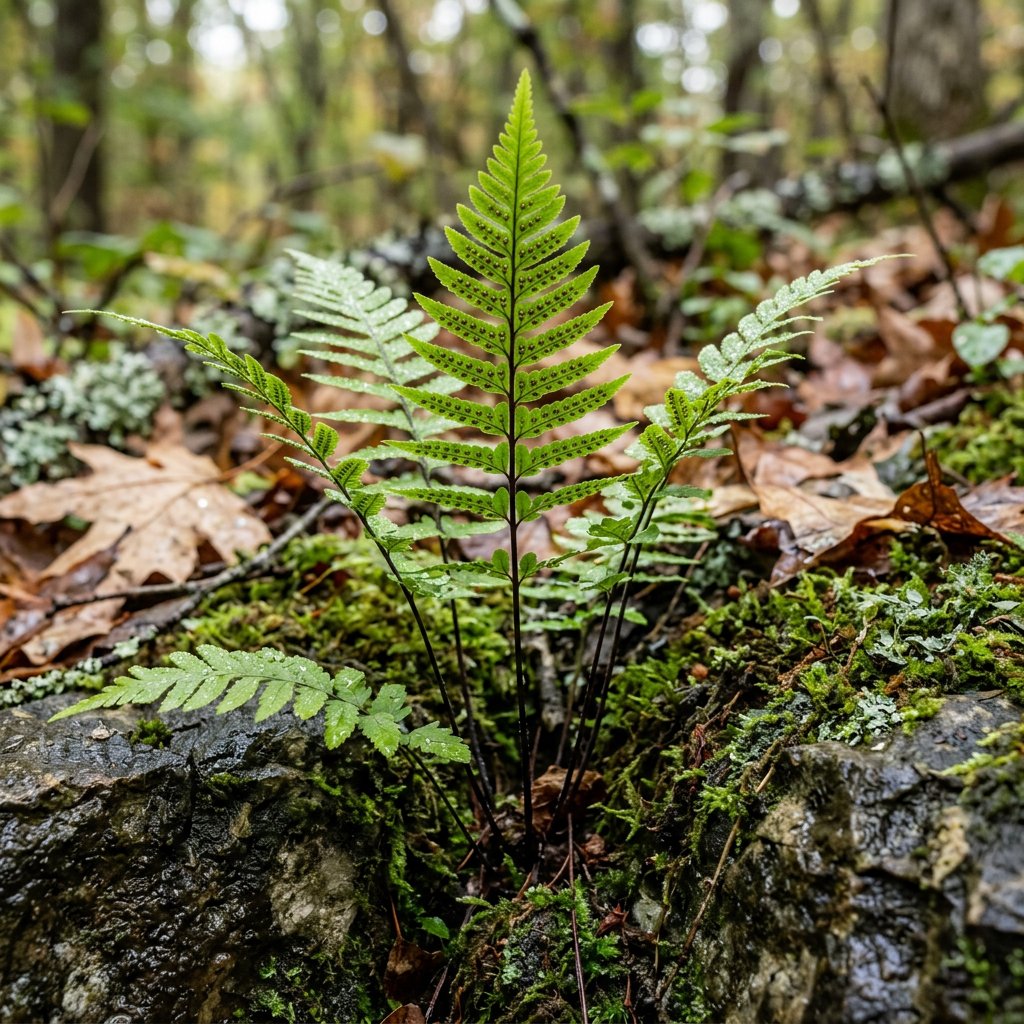
Often called the Ebony Spleenwort, this dainty fern is a master of the rocky crevices and woodland edges across North America. Unlike many of its delicate cousins that wilt at the first sign of dry air, this little survivor is known for its stiff, dark stems and its ability to thrive where other greenery might struggle. It is a favorite among rock gardeners for its architectural "ladder-like" appearance.
🔍 How to Identify
- 🖤 The Ebony Stem: The central stalk (rachis) is famously dark—ranging from deep mahogany to a glossy black—which provides a striking contrast to the bright green leaflets.
- 👂 Ear-like Leaflets: If you look closely at where each leaflet (pinna) meets the stem, you’ll see a tiny lobe pointing upward, resembling a small ear or an "auricle."
- 📏 Tall & Short Fronds: This plant plays a double game; it grows short, evergreen leaves that stay flat against the ground during winter, while its tall, fertile fronds stand proudly upright in the summer.
🏡 In Your Garden
- 🪨 Rock Star: This fern doesn't need deep, rich soil; it actually prefers "lean" environments like rocky ledges, stone walls, or sandy slopes. It is one of the few ferns that thrives in alkaline (lime-rich) conditions.
- ☀️ Surprising Resilience: While most ferns demand deep shade and constant moisture, the Ebony Spleenwort is remarkably tolerant of dappled sunlight and can handle occasional dry spells once its roots are tucked into a cool crevice.
⚠️ Safety & Toxicity
- ✅ Safe Status: This plant is considered non-toxic to humans and common household pets like cats and dogs.
- 🌿 Low Irritant: Unlike some ferns that produce irritating spores or hairs, the Ebony Spleenwort is gentle to the touch and safe for households with curious children.
✨ Fun Fact
🏛️ Ancient Medicine: The name "Spleenwort" comes from the "Doctrine of Signatures," an old belief that a plant's appearance hinted at its medicinal use. Because the linear spore cases on the back of the leaves resembled the shape of a human spleen, ancient herbalists believed it could cure various "splenetic" ailments.

Detailed Care Instructions
| Humidity | Dry |
| Lighting | Part Sun |
| Hardiness Zones | 5 - 9 |
To grow an Asplenium Platyneuron plant, also known as ebony spleenwort, follow these steps:
- Choose a suitable location: Ebony spleenwort plants prefer partial to full shade. Select a location with indirect or filtered sunlight, such as under a tree canopy or near a north-facing window.
- Prepare the soil: Ebony spleenwort prefers moist and well-draining soil. Prepare the soil by adding organic matter, such as compost or peat moss, to improve drainage and fertility.
- Planting: The best time to plant ebony spleenwort is in spring or early fall. Dig a hole slightly larger than the root ball of the plant. Place the plant in the hole, ensuring that the top of the root ball is level with the surrounding soil. Backfill the hole and gently firm the soil around the plant.
- Watering: Keep the soil consistently moist but not waterlogged. It is essential to maintain proper moisture levels to prevent drying out or overwatering, as both can harm the plant. Water deeply and avoid watering during periods of heavy rain.
- Mulching: Apply a layer of organic mulch around the base of the plant to help retain moisture, regulate soil temperature, and deter weed growth. Avoid piling mulch against the plant's stem.
- Fertilization: Ebony spleenwort does not require frequent fertilization. However, you can apply a balanced slow-release fertilizer once a year in spring to provide essential nutrients.
- Maintenance: Remove any dead or damaged fronds (leaves) as needed to improve the plant's appearance. Ebony spleenwort is generally pest and disease resistant.
- Propagation: Propagate ebony spleenwort through spore division or spore propagation. Collect mature, dark brown spores and sow them on moist, well-drained soil. Keep the spores consistently moist and warm for successful germination.
- Provide proper care: Monitor the plant regularly for signs of stress or disease. If you notice any issues, address them promptly to maintain the plant's health.
With proper care and suitable growing conditions, your Asplenium Platyneuron plant should thrive and grow well.

Place in a window with dappled sun or a spot in the middle of a room. Or directly in a window facing west or east.

Asplenium Platyneuron is a type of plant that requires regular watering in order to stay healthy. When watering this plant, it is important to avoid getting water on the leaves, as this can lead to rot. Instead, water the plant at the base, being sure to thoroughly saturate the soil. During periods of hot weather, it may be necessary to water the plant more frequently in order to prevent it from drying out. However, be careful not to over-water the plant, as this can also lead to problems. Ideally, the soil should be moist but not waterlogged, and it is important to ensure that the plant is not sitting in a pool of water. Overall, when watering Asplenium Platyneuron, it is important to strike a balance between ensuring that it has enough moisture to grow but also avoiding the risk of over-watering.
When fertilizing this plant, it is important to use a fertilizer that is specifically formulated for ferns and is high in nitrogen. Apply the fertilizer every two weeks during the growing season, which is typically spring and summer. Be sure to dilute the fertilizer to one-half the recommended strength to avoid over-fertilizing. Avoid fertilizing during the winter months when the plant is dormant. Water the plant thoroughly before and after applying fertilizer.
Asplenium Platyneuron plant prefers well-draining and fertile soil that is rich in organic matter. The soil should be slightly acidic with a pH range of 5.5 to 7.0. It is important to avoid using heavy clay soil or soil that retains too much moisture as this can lead to root rot. A good soil mix for this plant can include a combination of peat moss, perlite, compost and coarse sand to ensure good drainage and aeration. It is also important to provide adequate water drainage, so it is recommended to use a pot with drainage holes when planting this plant in a container.
To propagate this plant, you can use spores or divide the rhizomes.
- To use spores, collect the ripe spores from the fronds and place them in a plastic bag to dry. Once dried, sprinkle them onto a soil mixture of peat moss and perlite. Cover the pot with clear plastic or a plastic bag to maintain humidity and place it in a warm and bright area but not in direct sunlight. After a few weeks, the spores will germinate and tiny plants will appear. Once they grow bigger, transplant them into individual pots.
- To divide the rhizomes, gently dig up the plant and separate the rhizomes with a clean, sharp knife. Each section should have healthy fronds and roots. Plant each divided section into a pot or a new location in the garden with moist soil. Water thoroughly and keep in a warm and shaded area until new growth appears.
Common pests of the ebony spleenwort include Scale insect, mealybugs, spider mites, aphids, thrips. Make a habit of checking your ebony spleenwort frequently for pests so that any infestations can be caught and managed early.








