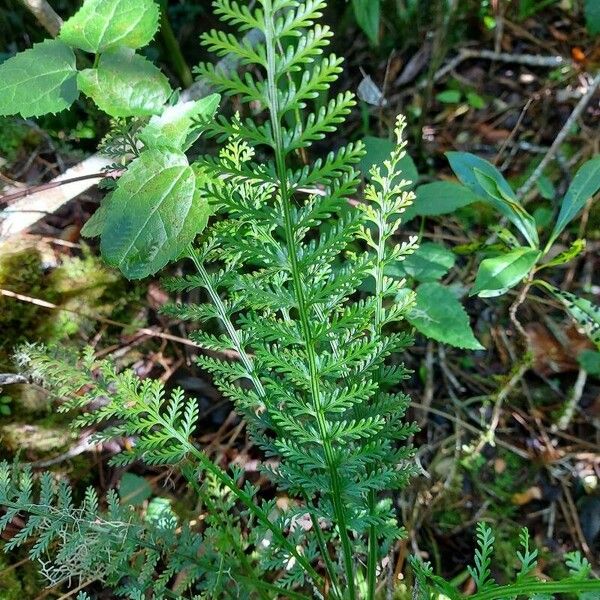
Plant Overview
Known affectionately as the Carrot Fern, Asplenium rutifolium looks like a delicate spray of garden greens tucked into the crook of a mossy tree. Native to the cool, misty forests of Southern and Eastern Africa, this fern brings a texture so fine and lacy it is often mistaken for Rue or even a wild carrot top. It is a master of the "air-life," frequently found perching on branches or rocky ledges rather than growing in heavy soil.
🔍 How to Identify
- 🌿 The Fronds: Deep green and remarkably lacy. They are "tri-pinnate," meaning the leaves are divided multiple times into tiny, narrow segments that give the plant its characteristic "feathery" appearance.
- 🌱 Growth Habit: It typically forms arching, graceful clumps. In the wild, it can be found as an epiphyte (on trees) or a lithophyte (on rocks), with fronds reaching up to 50 centimeters in length.
- 🔍 The Sori: If you flip a mature leaf over, you’ll notice linear, brown spore cases (sori) tucked neatly along the veins—a classic "fingerprint" of the Spleenwort family.
🏡 In Your Garden
- ☁️ Humidity is Queen: Because this fern naturally lives in misty montane forests or near waterfalls, it struggles in dry indoor air. It thrives best in a humid bathroom or a terrarium where it can "breathe" moisture constantly.
- 🪨 The "Air" Mix: Do not plant it in dense, heavy garden soil. Because of its epiphytic nature, it prefers a "chunky" potting medium—think orchid bark, perlite, and a little peat. This ensures the roots stay moist but never "drown" in stagnant water.
⚠️ Safety & Toxicity
- ✅ Pet Friendly: The Carrot Fern is generally considered non-toxic to cats, dogs, and humans, making it a wonderful choice for a safe indoor jungle.
- 🧤 Delicate Nature: While it won't hurt you, you might hurt it! The fronds are physically fragile; frequent handling or high-traffic areas can cause the tips to brown and break, so it is best kept in a quiet corner.
✨ Fun Fact
The genus name Asplenium comes from the Greek word asplenon, which translates to "spleen remedy." In ancient times, healers believed that because the spore patterns on the back of the leaves resembled the human spleen, the plant could be used to treat various internal ailments—a philosophy known as the "Doctrine of Signatures."

Detailed Care Instructions

Place in a dark room with little light, like a dark bedroom or a spot far away from a window or directly in a north-facing window.

Water-loving plants flourish in wet or sloppy soil and near ponds. The extensive root system enables these plants to absorb plenty of water. The surface of the soil should be kept moist at all times. Place your pot in a container filled with water to guarantee that plants get enough water. If the ground becomes dry, it is recommended that you water it well. Plants in smaller pots will need to be watered more frequently. Water the soil in which the plant is standing thoroughly using a watering can.








