Plant Overview
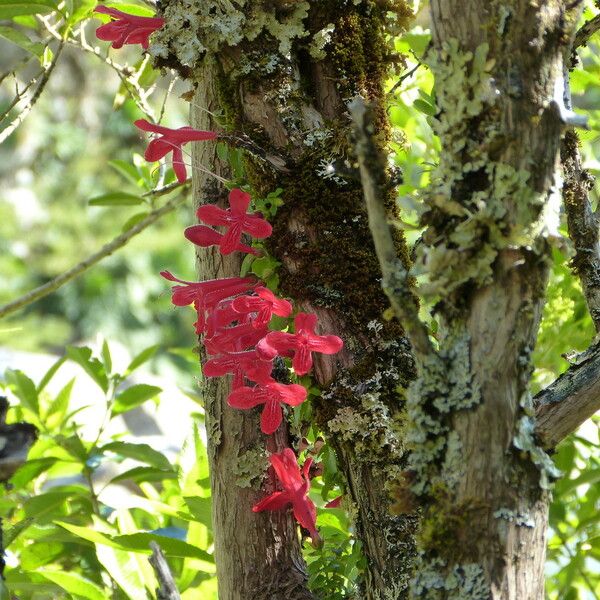
Known as the Estrellita or "Little Star," this stunning climber hails from the ancient, mist-drenched Valdivian rainforests of Chile and Argentina. Unlike many of its flashy tropical cousins, this plant thrives in cool, damp shadows, often found draped over mossy logs like a living velvet carpet. It is a rare treasure for collectors who enjoy recreating the moody, humid atmosphere of a temperate rainforest.
🔍 How to Identify
- 🌸 The Bloom: Features large, tubular flowers that are a brilliant scarlet or crimson, typically opening into five petals with white and yellow stripes hidden deep inside the "throat."
- 🍃 Leaf Texture: Small, rounded (ovate) leaves with slightly toothed edges, often covered in fine, delicate hairs that give them a soft, matte appearance.
- 🧗 Growth Style: A scrambling evergreen vine that uses tiny aerial roots to cling to damp bark or stones, allowing it to "walk" up tree trunks in search of filtered light.
🏡 In Your Garden
- 🌧️ Humidity is King: This plant "breathes" the forest mist; it requires very high humidity and will quickly wilt or "crisp" in dry, air-conditioned indoor environments.
- ❄️ Cooler Roots: Unlike most houseplants, it despises high heat. It prefers the "refrigerator-cool" dampness of a coastal forest and thrives in acidic, well-draining soil rich in leaf mold or peat.
⚠️ Safety & Toxicity
- 🟢 Non-Toxic: Asteranthera ovata is generally considered safe and is not known to be poisonous to humans, cats, or dogs.
- 🚫 Not for Nibbling: While it lacks aggressive toxins, it is an ornamental plant and should not be consumed. The fine hairs on the foliage can occasionally cause very mild mechanical irritation to sensitive skin if handled roughly.
✨ Fun Fact
Despite its exotic, tropical appearance, this plant is a "Gesneriad"—the same family as the common African Violet—but it is one of the few members that has adapted to survive in the chilly, southern-most reaches of South America!

Detailed Care Instructions
To grow Asteranthera Ovata, also known as the pink sapphire plant, you can follow these steps:
- Location: Find a suitable location for your plant. It requires bright indirect sunlight or partial shade. Keep it away from direct sunlight, as it can damage the leaves.
- Soil: Use well-draining soil, preferably a mixture of potting soil and perlite or sand. A slightly acidic soil with a pH level between 5.5 and 6.5 is ideal.
- Container: Choose a pot or container with drainage holes to allow excess water to escape. Make sure it's large enough to accommodate the plant's roots comfortably.
- Planting: Before planting, soak the roots of the plant in water for a few minutes until they become moist. Then, gently place the plant in the prepared container, making sure the roots are spread out and covered with soil.
- Watering: Water the plant thoroughly after planting and keep the soil consistently moist but not waterlogged. Check the soil moisture levels regularly and adjust the watering accordingly.
- Humidity: The pink sapphire plant prefers a humid environment. You can increase humidity by placing a tray filled with water near the plant or misting the leaves regularly.
- Temperature: Keep the temperature between 60°F (15°C) and 75°F (24°C). Avoid exposing the plant to extreme temperature fluctuations.
- Fertilization: Use a balanced liquid fertilizer once a month during the growing season (spring and summer). Follow the instructions on the fertilizer packaging for proper dosage.
- Pruning: Prune the plant lightly to shape it and remove any dead or damaged foliage. This will help maintain its overall appearance and promote new growth.
- Propagation: Asteranthera Ovata can be propagated by stem cuttings. Take a cutting with at least two nodes, remove the lower leaves, and plant it in moist soil or water until roots develop.
- Pests and diseases: Check the plant regularly for any signs of pests like spider mites or mealybugs. Treat them promptly with appropriate organic or chemical insecticides if necessary.
With proper care and attention, your Asteranthera Ovata should grow into a healthy and attractive plant.
To water this plant, you should first check the soil moisture level by sticking your finger into the soil up to the second knuckle. If the soil feels dry, it's time to water. Use room temperature water and pour it slowly over the soil until it starts to drain out the bottom of the pot. Be careful not to overwater, as this plant is sensitive to root rot. Allow the top inch of soil to dry out before watering again. If the plant is in a location with low humidity, it may need to be watered more frequently.
To fertilize Asteranthera Ovata, use a balanced fertilizer with an equal ratio of nitrogen, phosphorous, and potassium. Apply the fertilizer during the plant's active growing season, which is typically spring and summer. Dilute the fertilizer in water according to the manufacturer's instructions and apply it to the soil around the base of the plant. Be sure not to over-fertilize, as this can damage the plant.
When planting Asteranthera Ovata, you should choose a soil that is well-drained, loose, and fertile. The soil should ideally have a pH level that falls between 6.0 and 7.0. You can mix a bit of compost or organic matter into the soil to improve its texture and provide nutrients for the plant. Avoid soils that are compact or heavy with too much clay, as this can lead to poor drainage and root rot. Additionally, choose a location for planting that receives full to partial sun exposure, as this plant requires plenty of light to thrive.
To propagate this plant, first select a healthy stem cutting with at least 2-3 nodes. Use a clean pair of pruning shears to make a clean cut just below a node.
Remove any leaves from the bottom 1/3 of the stem, and dip the cut end into rooting hormone powder.
Prepare a well-draining potting mix of equal parts perlite and peat moss, and moisten it thoroughly.
Make a hole in the potting mix and insert the cutting. Gently firm the soil around the stem to ensure good contact.
Cover the pot with a plastic bag or a clear plastic dome to increase humidity and retain moisture.
Place the pot in a bright, warm location, but out of direct sunlight as this can scorch the leaves.
After a few weeks, gently tug on the cutting to see if it has rooted. If there is resistance, the roots have formed and the plant can be gradually acclimated to lower humidity and brighter light.
Once the plant has established itself, it can be transplanted into a larger pot or planted directly into the ground.








