Plant Overview
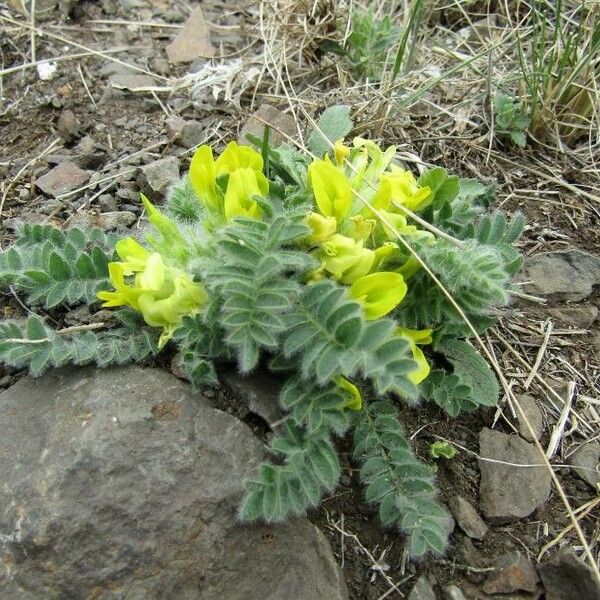
Known as the Stemless Milk-vetch, this hardy perennial looks like a cluster of golden jewels tucked directly into the sun-baked earth. Native to the rugged steppes of Central and Eastern Europe, it is a master of minimalism, ditching the traditional tall stem to protect itself from harsh winds and grazing animals. It has a storied history in old European folk medicine, where it was often associated with resilience and survival in the most difficult soils.
🔍 How to Identify
- 🌼 The Flowers: Large, bright yellow pea-like blooms that appear to sit directly on the ground in dense clusters, lacking a visible central stalk.
- 🌿 The Foliage: Long, elegant leaves arranged in a rosette; each leaf is "pinnate" (resembling a feather) and covered in fine, silvery-white hairs that give the plant a shimmering, soft texture.
- 🌱 Growth Habit: Extremely low-profile and prostrate. It forms a compact "cushion" of green and gold that rarely rises more than a few inches above the soil surface.
🏡 In Your Garden
- 🏗️ The Taproot Trap: This plant develops an incredibly deep and sturdy taproot to find water in dry climates. Because of this, it absolutely hates being moved; choose its "forever home" carefully, as transplanting usually results in the plant failing.
- ☀️ Steppe Conditions: To thrive, it requires "lean" soil—avoid heavy fertilizers. It craves full sun and rocky or gravelly soil with excellent drainage, mimicking the dry, calcareous hillsides of its native home.
⚠️ Safety & Toxicity
- 🐾 Potential Risk: While not as famous as its North American "Locoweed" cousins, many species in the Astragalus genus can accumulate selenium or contain alkaloids that are toxic to livestock and pets if consumed in large quantities.
- 👶 General Caution: It is best kept as an ornamental curiosity rather than a culinary one. Keep it out of reach of curious pets or small children who might be tempted by its bright yellow flowers.
✨ Fun Fact
In the 18th and 19th centuries, Astragalus exscapus was so highly regarded in some parts of Europe for its supposed medicinal properties that it was nicknamed "Root of the Holy Ghost," believed by some to be a powerful tonic for various ailments.

Detailed Care Instructions

Place in a bright room that is sun drenched almost all day. Or directly in a south-facing window.

Some plants require more regular watering than others, which should be done every few days. It's critical to maintain the soil moist all of the time. The water requirements of the same plant placed in pots with varying sizes will differ. Because the water in the smaller pot evaporates faster than the water in the larger pot, it will require more watering. Regardless of pot size, the surface should constantly be maintained moist.








