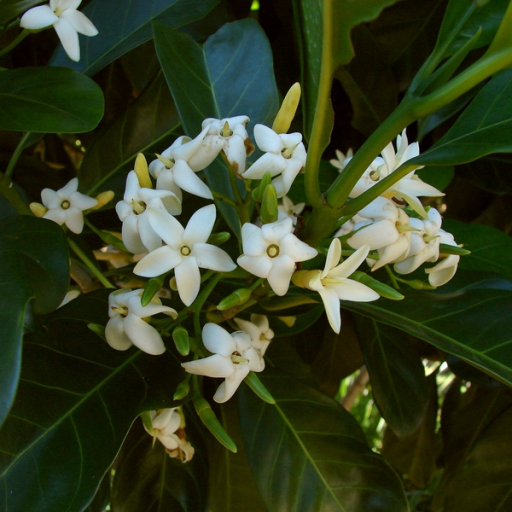
Plant Overview
Known as the Brown Gardenia or Yellow Mangosteen, this Australian rainforest treasure is a sensory delight for any tropical or subtropical landscape. Often found gracing the shaded paths of coastal resorts, it is prized for its intoxicating, sweet fragrance that can perfume an entire garden on a warm evening. Despite its "Mangosteen" nickname, it is actually a member of the coffee family (Rubiaceae), blending lush, architectural foliage with traditional bush tucker heritage.
🔍 How to Identify
- 🍃 Lush Foliage: Features large, broad, and incredibly glossy leaves that are a deep "forest green," providing a perfect backdrop for its blooms.
- 🌸 Starry Blooms: Produces clusters of creamy-white, five-petaled flowers that look like waxy stars tucked among the leaves.
- Fruit Woody Fruit: The fruit is round and hard-shelled, transitioning from a vibrant green to a dull yellow or brownish-orange as it matures.
🏡 In Your Garden
- 🐌 Slow & Steady: This is a slow-growing species, making it an excellent choice for gardeners who want a "set and forget" feature tree that won't quickly outgrow its space.
- 💧 Rainforest Roots: Because it originates from the rainforest, it craves high humidity and protection from harsh, drying winds which can tatter its beautiful leaves.
- ⛅ Sun Dappled: While it can tolerate full sun once established, it truly thrives in filtered light or "morning sun only" positions, which keeps the foliage from scorching.
⚠️ Safety & Toxicity
- ✅ Status: Generally considered non-toxic to humans and pets.
- 🍽️ Details: The fruit is historically recognized as "bush tucker" (edible), though the texture is often described as woody or mealy rather than juicy. While safe, it is always best to keep curious pets from chewing on the dense foliage to avoid minor stomach upset.
✨ Fun Fact
🌊 In its native habitat of North Queensland, the Brown Gardenia is so hardy to salt spray that it can often be found growing right up to the edge of the beach, mere meters from the Pacific Ocean!

Detailed Care Instructions
To grow Atractocarpus Fitzalanii (also known as Black Apple or Bush Apple), follow these steps:
- Climate and conditions: Atractocarpus Fitzalanii plants are native to tropical and subtropical regions, so it requires warm temperatures and bright, indirect sunlight. It prefers a humid environment with temperatures around 20-30°C (68-86°F). It can be grown indoors in a pot or outdoors in a garden in suitable climates.
- Soil: Use a well-draining potting mix that is rich in organic matter. The soil should be slightly acidic to neutral with a pH range of 5.5-7.0.
- Planting: If you are starting from seeds, soak them in water for 24 hours before planting to enhance germination. Plant the seeds in pots or seed trays, burying them about 1 cm deep. Keep the soil consistently moist but not waterlogged. Germination can take 2-4 weeks.
- Transplanting: Once the seedlings have grown 2-3 pairs of true leaves, they can be transplanted into individual pots or a larger container if growing indoors. If planting outside, choose a location with well-drained soil and adequate sunlight.
- Watering: Keep the soil evenly moist, but avoid overwatering as it can cause root rot. Water when the top inch of soil feels dry. Mist the leaves occasionally to increase humidity.
- Fertilizing: Feed the plant with a balanced, slow-release fertilizer every 2-3 months during the growing season. Follow the instructions on the fertilizer packaging for the appropriate dosage.
- Pruning: Atractocarpus Fitzalanii may require some pruning to maintain its shape and promote bushy growth. Remove any dead, damaged, or overcrowded branches. Pruning can be done after flowering or during the early spring.
- Pests and diseases: Monitor the plant regularly for pests like aphids or scale insects. Treat the infestation with insecticidal soap or neem oil. Avoid overwatering to prevent fungal diseases.
- Pollination: Atractocarpus Fitzalanii flowers require cross-pollination to produce fruit. To ensure pollination, consider planting multiple plants in close proximity or manually transferring pollen from one flower to another using a small brush or cotton swab.
- Harvesting: The plant typically starts producing fruit after 2-3 years. The fruit should be harvested when fully ripe, which is indicated by its dark purple or black color. The fruit is edible and often used in jams, jellies, and desserts.
Remember to research specific care requirements for your growing zone and adjust the care accordingly.

Place in a window with dappled sun or a spot in the middle of a room. Or directly in a window facing west or east.

To properly water the Atractocarpus Fitzalanii plant, it is essential to focus on its specific watering needs. Here are some guidelines to follow:
1. Understanding the plant's moisture requirements: Atractocarpus Fitzalanii prefers consistent, moderate watering. It is important to strike a balance; the soil should be well-drained but not too dry or waterlogged.
2. Observe the soil moisture: Before watering, check the moisture level by inserting your finger about an inch into the soil near the plant's base. If it feels dry, it's time to water. If it feels slightly moist, it is better to wait.
3. Watering frequency: Water the plant regularly, typically once every 5-7 days during the growing season. Adjust the frequency based on environmental conditions such as humidity and temperature.
4. Watering method: To provide sufficient hydration, use a gentle watering technique. Avoid forceful streams of water that may disturb the roots or cause erosion. A good approach is to use a watering can with a narrow spout or a hose with a soft spray nozzle.
5. Watering amount: Aim to moisten the soil to a depth of about 4-6 inches during each watering session. This ensures that the water reaches the plant's root zone and encourages healthy root growth.
6. Watering time: Ideal timing is early morning or late afternoon when the temperature is cooler. Watering during these periods reduces evaporation and allows the plant to absorb moisture effectively.
7. Avoid overwatering: Ensure proper drainage by using a well-draining potting mix and a container with drainage holes. Overwatering can lead to root rot and other harmful conditions.
8. Monitor plant response: Observe how the plant responds to watering. If it looks droopy or the leaves start turning yellow, it may be a sign of overwatering or underwatering. Adjust the watering frequency accordingly.
Remember, these instructions are general guidelines, and it is beneficial to become familiar with the specific needs and preferences of the Atractocarpus Fitzalanii plant to ensure its optimal growth and health.
Here are the fertilizing instructions for the Atractocarpus Fitzalanii plant:
- Choose a balanced, water-soluble fertilizer for foliage plants.
- Dilute the fertilizer according to package instructions, typically using half or quarter strength.
- Apply the fertilizer during the plant's active growing season, which is usually spring and summer.
- Water the plant thoroughly before applying the fertilizer to prevent burning the roots.
- Slowly pour the diluted fertilizer onto the soil around the base of the plant.
- Avoid getting the fertilizer on the foliage or stems to prevent potential damage.
- Repeat the fertilization every four to six weeks during the growing season.
- Monitor the plant for any signs of fertilizer burn, such as brown or wilted leaves. If observed, reduce the fertilizer concentration or frequency.
- Always follow the dosage instructions provided on the fertilizer package.
- Additionally, consider supplementing the soil with organic matter, such as compost, to provide long-term nutrients.
Remember, it's important to always follow specific instructions provided by the manufacturer or consult a local horticulturist for precise fertilization guidelines for your Atractocarpus Fitzalanii plant.
The Atractocarpus Fitzalanii plant thrives best in well-draining soil with a slightly acidic to neutral pH level. The ideal soil type for this plant would be loamy soil. Loam is a balanced soil type that consists of a mixture of sand, silt, and clay, which allows for both good drainage and moisture retention.
When selecting soil for this plant, it is recommended to use a high-quality potting mix that contains organic matter, such as peat moss or compost. The organic matter provides nutrients, improves soil structure, and aids in retaining moisture without becoming waterlogged.
To ensure good drainage, it is advised to add some perlite or vermiculite to the soil mix. These additives help to create air pockets and prevent soil compaction, allowing roots to access oxygen more efficiently.
While the Atractocarpus Fitzalanii plant can tolerate a range of soil conditions, it generally prefers slightly acidic to neutral pH levels. Aim for a pH range between 5.5 to 7.0 to promote healthy growth and nutrient availability.
Overall, a well-draining, loamy soil enriched with organic matter and slightly acidic to neutral pH is ideal for the optimal growth and development of the Atractocarpus Fitzalanii plant.
Atractocarpus fitzalanii is a plant that can be propagated through several methods. One common method is propagating through seeds. Here is a detailed guide on how to propagate this plant without mentioning its common names:
- Start by collecting ripe fruits from a mature Atractocarpus fitzalanii plant. These fruits are usually orange or red when fully mature.
- Remove the flesh and pulp surrounding the seeds by gently squeezing the fruits. Rinse the seeds thoroughly with water to ensure all the pulp is removed.
- Fill a planting tray or pot with a well-draining potting mix. A recommended potting mix is a blend of equal parts perlite, peat moss, and sterile potting soil.
- Place the seeds on top of the potting mix, spacing them a few inches apart. Lightly press the seeds into the soil, ensuring they are in good contact with the mixture.
- Cover the seeds with a thin layer of potting mix, about 1/8 to 1/4 inches deep. Gently pat down the surface to ensure good seed-to-soil contact.
- Water the potting mix thoroughly until it is evenly moist but not soaking wet. Make sure not to overwater, as excessive moisture can cause the seeds to rot.
- Place the tray or pot in a warm location with indirect sunlight. A temperature range of 70 to 80°F (21 to 27°C) is ideal for seed germination.
- Keep the potting mix consistently moist by misting it regularly or using a spray bottle. Avoid letting the soil dry out completely, but also prevent waterlogging.
- Germination may take anywhere from a few weeks to a few months, depending on the conditions and freshness of the seeds. Be patient and check the tray/pot regularly for any signs of germination.
- Once the seedlings have grown to a sufficient size and have developed several sets of true leaves, they can be transplanted into individual pots with a similar potting mix.
- Continue to provide the seedlings with adequate water, indirect sunlight, and a warm environment. As they mature, gradually increase their exposure to direct sunlight.
- When the seedlings have established a strong root system and reached a suitable size (6-12 inches tall), they can be gradually acclimated to outdoor conditions if desired.
By following these steps, you can successfully propagate Atractocarpus fitzalanii from seeds and grow new plants without relying on its common names.








