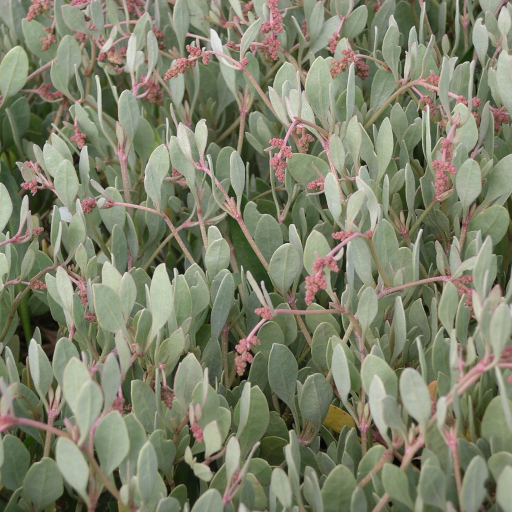
Plant Overview
Known as Sea Purslane, Atriplex portulacoides is the ultimate coastal survivor. Cloaked in a shimmering coat of silvery-grey, this hardy perennial shrub thrives in salt marshes and estuaries where most other plants would wither. It is often celebrated by coastal foragers for its naturally salty, crunchy leaves that taste like a breath of sea air.
🔍 How to Identify
- 🌿 Fleshy Leaves: The leaves are narrow, lance-shaped, and distinctively succulent. They grow in opposite pairs along the stems, providing a thick, cushioned appearance.
- 🌫️ Silvery Sheen: Both the leaves and stems are covered in a fine, mealy powder that gives the plant a beautiful metallic or blue-grey hue. This isn't dust; it's a specialized adaptation to reflect intense coastal sunlight.
- 🌾 Inconspicuous Flowers: From mid to late summer, it produces tiny, yellowish-green flowers arranged in terminal spikes. They aren't showy, as the plant relies on the wind for pollination rather than attracting insects.
🏡 In Your Garden & Habitat
- 🌊 Salt Specialist: This plant is a "halophyte," meaning it loves salt. It uses specialized glands on its leaves to excrete excess salt, which is why you will often see tiny crystals sparkling on its surface.
- 🌱 Erosion Expert: In its natural habitat, Sea Purslane plays a vital role in stabilizing mudflats and salt marshes. Its sprawling, woody base helps trap sediment, preventing the coastline from washing away during high tides.
- 🏖️ Gardening Nuance: If you try to grow this at home, it requires incredibly well-drained, sandy soil. It hates "wet feet" in stagnant fresh water; it prefers the rhythmic ebb and flow of tidal environments or very gritty coastal soils.
⚠️ Safety & Toxicity
- 🍽️ Status: Generally considered edible and safe for humans. It is a popular "wild food" often tossed into salads or pickled.
- 🛑 Environmental Warning: Because it grows in estuaries, it can act as a bio-accumulator. If the water in the area is polluted with heavy metals or runoff, the plant may absorb these toxins. Only forage from clean, protected coastlines.
- 🐾 Pets & Livestock: While not specifically toxic, the high salt content can be an issue for small pets or livestock if consumed in very large quantities.
✨ Fun Fact
Sea Purslane is a master of "living on the edge." The silvery scales on its leaves are actually tiny "salt bladders." Once these bladders fill up with too much salt from the ocean spray, they burst or fall off, effectively "excreting" the salt to keep the plant from dehydrating!

Detailed Care Instructions
Atriplex Portulacoides, also known as Sea Purslane, is a salt-tolerant, coastal plant that grows well in sandy or saline soils. Here are some tips on how to grow Atriplex Portulacoides:
- Location: Choose a sunny location with well-draining soil. Atriplex Portulacoides thrives in coastal regions or areas with high salt content in the soil.
- Soil: Atriplex Portulacoides prefers sandy or saline soils. If your soil is not naturally saline, you can add some sea salt or seawater to mimic its natural habitat.
- Planting: Plant Atriplex Portulacoides seeds or seedlings in the spring after the last frost. Sow the seeds directly into the ground or start them indoors and transplant them once they are established.
- Watering: Atriplex Portulacoides is drought-tolerant and does not require much water once established. Water sparingly, especially during the hot summer months.
- Fertilizing: Atriplex Portulacoides does not require much fertilization, as it is adapted to poor, salty soils. Avoid using heavy fertilizers, as they may harm the plant.
- Maintenance: Atriplex Portulacoides is a low-maintenance plant and does not require much care. However, you may need to weed around the plant to prevent competition for nutrients.
- Propagation: Atriplex Portulacoides can be propagated by seeds or cuttings. Collect seeds from mature plants and sow them in the spring. You can also take stem cuttings and root them in a well-draining soil mix.
By following these tips, you can successfully grow Atriplex Portulacoides in your garden or landscape. Enjoy the unique beauty and salt-tolerance of this coastal plant!

Place in a bright room that is sun drenched almost all day. Or directly in a south-facing window.

Atriplex portulacoides plants should be watered thoroughly and deeply at the base of the plant to ensure proper hydration. It is important to water the plant regularly, especially during hot and dry periods, as they have a high tolerance for salt and can thrive in coastal environments. Avoid watering from overhead as this can lead to the development of fungal diseases. Additionally, allow the soil to dry out slightly between waterings to prevent root rot. Use well-draining soil to ensure that excess water does not collect around the roots.
To fertilize this plant, apply a balanced fertilizer with an N-P-K ratio of 10-10-10 in the early spring before new growth appears. Use a slow-release fertilizer to provide nutrients over time. Avoid over-fertilizing, as this can lead to nutrient imbalances and damage the plant. Water the plant thoroughly after fertilizing to help the nutrients penetrate the soil and reach the roots. Repeat fertilization once or twice during the growing season, following the same guidelines. It is also recommended to conduct a soil test to determine any deficiencies and adjust fertilization accordingly.
A suitable soil for Atriplex portulacoides should be well-draining and sandy to mimic its natural habitat. It should have a pH level ranging from neutral to slightly alkaline. The soil should also be low in nutrients, as this plant can thrive in poor soil conditions. Adding some organic matter, such as compost, can help improve the soil structure and fertility. Overall, the goal is to provide a gritty, well-drained soil that allows for good root aeration and moisture retention.
To propagate Atriplex Portulacoides, you can start by collecting seeds from mature plants. Before planting, scarify the seeds by gently scratching the seed coat to help with germination.
Next, plant the seeds in a well-draining soil mix and keep them consistently moist until they sprout. You can also propagate Atriplex Portulacoides through stem cuttings by taking a healthy cutting from a mature plant and placing it in a rooting hormone before planting it in a pot with well-draining soil.
Make sure to keep the cutting consistently moist and provide it with indirect light until roots develop. Once the plant has established roots, it can be transferred to a larger pot or directly into the garden. With proper care and maintenance, Atriplex Portulacoides plants will grow vigorously and thrive in a variety of conditions.








