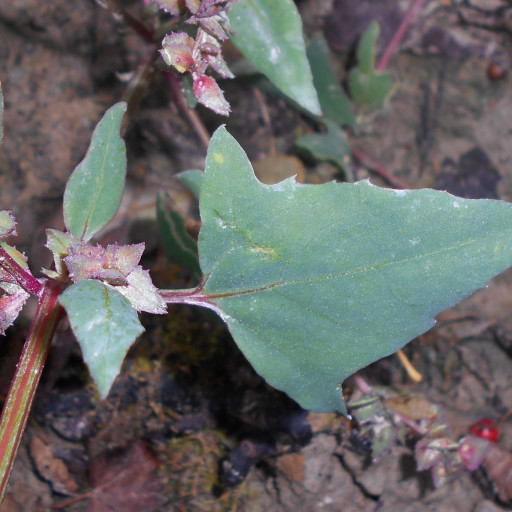
Plant Overview
Known as the Spear-leaved Orache, this rugged coastal survivor is often mistaken for a common garden weed. A close relative of spinach and quinoa, it has a long history of being used as a "famine food" during lean times. Its ability to thrive in salty, harsh environments makes it a fascinating example of botanical resilience.
🔍 How to Identify
- 🌿 The Leaves: Look for distinct spear-shaped (hastate) leaves. They are triangular with two prominent lobes at the base that point horizontally or slightly upward.
- ❄️ Mealy Texture: The foliage often looks like it has been dusted with flour. This "scurfy" white coating is actually tiny salt-filled glands that help the plant manage its internal water balance.
- 🌱 Growth Habit: While it can grow upright, it often lives up to its name (prostrata) by sprawling across the ground in a tangled, mat-like fashion.
🏡 In Your Garden
- 🧂 A Salt Specialist: If you live near the coast or in an area where road salt is used heavily in winter, this plant will thrive where others wither. It is exceptionally salt-tolerant.
- 🌾 Soil Indicator: It loves nitrogen-rich soil. If it suddenly appears in your garden beds, it is often a signal that your soil is high in nutrients or perhaps slightly compacted and moist.
⚠️ Safety & Toxicity
- 🟢 Status: Generally non-toxic and historically edible, but with a major catch.
- 🧪 The Danger: Atriplex species are "hyperaccumulators," meaning they soak up whatever is in the soil. If grown near busy roads or industrial sites, the plant can concentrate heavy metals or nitrates, making it unsafe to touch or consume. Like spinach, it is also high in oxalates, which can be an issue for those with certain health conditions.
✨ Fun Fact
Spear-leaved Orache is a master of "bet-hedging." It produces two different types of seeds on the same plant: small black ones that sprout immediately, and larger brown ones that can stay dormant in the soil for years, waiting for the perfect moment to grow!

Detailed Care Instructions
To grow Atriplex prostrata, also known as the creeping saltbush, you can follow these steps:
- Choose the right location: Atriplex prostrata prefers full sun but can tolerate partial shade. It grows well in well-drained soil, including sandy or rocky soils.
- Prepare the soil: Before planting, prepare the soil by removing any weeds or grass. Loosen the soil to a depth of about 6 inches and incorporate organic matter, such as compost or aged manure, to improve fertility.
- Sow the seeds: Atriplex prostrata can be propagated from seeds. Sow the seeds directly in the prepared soil at a depth of about ¼ inch. Space the seeds about 12-18 inches apart to allow for spreading.
- Watering: After planting, water the seeds gently but thoroughly to keep the soil evenly moist. Once the plants are established, Atriplex prostrata is drought-tolerant and requires minimal watering.
- Maintenance: Atriplex prostrata is a low-maintenance plant. However, some regular care is necessary, especially in the initial stages. Keep the area free from weeds and provide water during dry periods until the plants are well-established.
- Pruning: Atriplex prostrata may benefit from occasional pruning to maintain its shape and encourage healthy growth. Prune back any dead or damaged branches and remove any plants that are spreading too far or becoming invasive.
- Fertilization: Generally, Atriplex prostrata does not require fertilization, as it can adapt to poor soils. However, if the plant appears weak or lackluster, applying a balanced slow-release fertilizer once or twice a year can help boost growth.
- Propagation: Atriplex prostrata can also be propagated through stem cuttings. Take 4-6 inch cuttings from healthy plants during the early summer and place them in well-draining soil. Provide consistent moisture until the cuttings root.
By following these steps, you can successfully grow Atriplex prostrata plant in your garden or landscape.

Place in a bright room that is sun drenched almost all day. Or directly in a south-facing window.

To water this plant, you should first identify the soil type in which it is planted. If the soil is sandy or quickly draining, you will need to water more frequently- typically every 2-3 days. Alternatively, if the soil is clay-heavy or slow-draining, you may only need to water once a week.
When watering, it is important to water at the base of the plant and avoid getting water on the leaves and stems, as this can increase the risk of disease. Aim to water the plant deeply, but do not overwater to the point where the soil becomes waterlogged.
It is best to water in the early morning or late evening, when the sun is not as strong, to prevent the water from evaporating too quickly. Additionally, during periods of high heat or drought, you may need to increase watering frequency to ensure the plant remains hydrated.
To fertilize this plant, you will need to mix a balanced fertilizer into the soil around the base of the plant. Apply the fertilizer according to the package instructions, being careful not to over-fertilize as this can damage the plant. You should fertilize the plant once or twice a year, ideally in early spring or late summer. Additionally, it is important to water the plant regularly, providing it with plenty of moisture to support its growth and health.
Atriplex prostrata prefers well-draining soil with moderate fertility. It can tolerate saline or alkaline soil, but will also thrive in non-saline soil. A mixture of sand, loam, and gravel is recommended. The pH level of the soil should be between 6.0 to 8.0. The soil should be kept moderately moist, but not waterlogged, as excess moisture can lead to root rot. Adding organic matter, such as compost or leaf litter, can also improve soil structure and fertility for this plant.
To propagate this particular plant, you may start by collecting its mature seeds. Ensure that they are fully ripe and dry before harvesting them from the parent plant. Once you have the seeds, you should prepare the soil mix that is suitable for them. This mix should be well-draining, containing sand, loam, and perlite.
Plant the seeds a few millimeters deep into the prepared soil and water them well. Place the container in a warm, well-lit area, but away from direct sunlight. Keep the soil moist at all times and wait for the seeds to germinate, which should take around two to four weeks.
Once the seedlings have several true leaves, you can thin them out and transplant them into individual pots. Water them regularly and make sure they receive plenty of light, but not direct sunlight. As the plants grow, you can gradually reduce the frequency of watering, allowing the soil to slightly dry out before watering again.
About six months after germination, the plants should have grown considerably. At this point, you can transplant them into larger pots or directly into the ground if conditions are suitable. Make sure the new location has well-draining soil and receives plenty of sunlight. Water the plants regularly until they are fully established.








