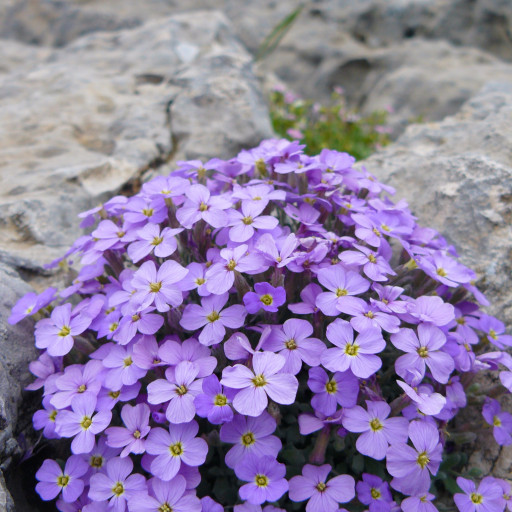
Plant Overview
Often called "Purple Rockcress," this resilient perennial creates a breathtaking "floral waterfall" over stone walls and rocky crevices. Originating from the sun-drenched hillsides of Europe and Central Asia, it is the quintessential spring herald for rock gardeners. Its dense mats of foliage stay evergreen in many climates, waiting for the first hint of spring warmth to explode into a vivid sea of violet, pink, or lilac.
🔍 How to Identify
- 🌸 Cross-Shaped Blooms: Tiny, four-petaled flowers that appear in such density they often completely hide the foliage during their peak spring performance.
- 🍃 Hirsute Foliage: Small, oval or spatula-shaped leaves that are slightly hairy and grey-green, providing a soft, felt-like texture even when not in bloom.
- 🧗 Mounding Habit: Grows in low, spreading cushions that rarely exceed six inches in height but can trail gracefully over garden ledges and stairs.
🏡 In Your Garden
- 🪨 The Rock Star: It thrives in poor, gritty soil and specifically loves tucking its roots into the alkaline environment of limestone walls or mortar joints.
- ✂️ Post-Bloom Haircut: To keep the plant from getting "leggy" or developing a woody, dead center, it is best to shear it back by half immediately after the flowers fade to encourage fresh, compact growth.
- ☀️ Sun Seeker: While it can tolerate very light shade, it produces the most intense floral display when it basks in full, direct sunlight; too much shade makes it "stretch" and lose its dense carpet look.
⚠️ Safety & Toxicity
- ✅ Pet & Child Friendly: Aubrieta is generally considered non-toxic to humans, dogs, and cats, making it a worry-free choice for low-level groundcover along garden paths.
- 🤚 Mild Irritation: While not poisonous, the tiny hairs on the leaves can occasionally cause very mild skin irritation for those with highly sensitive skin during heavy pruning sessions.
✨ Fun Fact
This plant was named in honor of Claude Aubriet, a legendary 18th-century French botanical painter. He was the royal artist for King Louis XIV and famously traveled the Middle East to document the very plants that now decorate our garden walls!

Detailed Care Instructions

Place in a window with dappled sun or a spot in the middle of a room. Or directly in a window facing west or east.

Watering this plant involves moistening the soil around its roots. This can be achieved by either watering the plant's soil directly or by lightly misting its foliage. It is important to avoid over-watering this plant as it prefers well-drained soil and can be susceptible to root rot if left in standing water. In general, the soil around this plant should be allowed to dry slightly between waterings to promote healthy growth and prevent disease. When watering, it is best to aim the water at the base of the plant to avoid wetting its leaves unnecessarily.
Without the need of fertilizer, these plants can thrive and bloom. If a plant requires fertilization, it will display indicators of nutrient insufficiency, such as yellowing leaves. It is safe to apply slightly diluted fertilizers in these circumstances. Over fertilizing, on the other hand, should be avoided because excess nutrients might cause plant mortality. Slow-release fertilizers are therefore advised for these plants.
You may use Flower Fertilizer for your Aubrieta
The best soil to use for this plant should have good drainage and should be slightly acidic. It should also have good nutrient content with a pH level of around 6.0 to 6.5. A sandy loam soil with a good amount of organic matter is ideal for this plant. The pH level is important as it helps to ensure that the plant can absorb all the essential nutrients required for growth. It is also important to ensure that the soil is well-fertilized in order to ensure that the plant has access to all the essential nutrients required for healthy growth. Regular watering is also necessary to keep the soil moist and to ensure that the plant does not dry out. In addition, it is recommended to apply a layer of mulch around the base of the plant to help retain moisture and to prevent weeds from growing.







