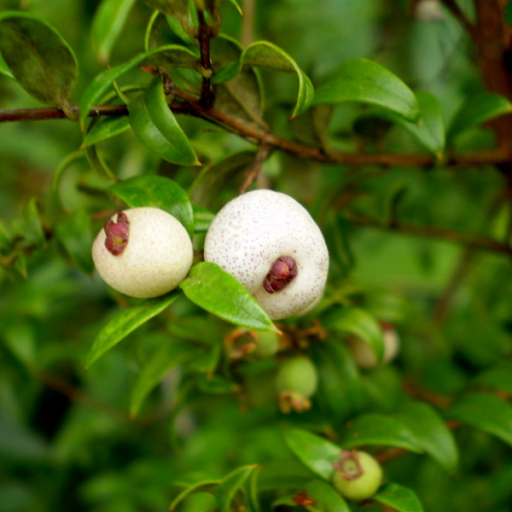
Plant Overview
Known affectionately as the "Midgen Berry" or "Midyim Berry," this delightful Australian native is a favorite among bush food enthusiasts and suburban gardeners alike. Often described as one of the most delicious "bush tuckers" in existence, it produces berries that look like tiny, speckled bird eggs. In its natural habitat, it hugs the sandy coastal dunes of Eastern Australia, but its hardy nature makes it a versatile choice for almost any landscape.
🔍 How to Identify
- 🌿 The Foliage: Small, lance-shaped leaves that are glossy green on top with a beautiful, silky-burgundy tint on new growth. The undersides are covered in fine silvery hairs.
- 🌸 The Flowers: Dainty, five-petaled white blossoms appear in spring and summer, looking like tiny stars scattered across the shrub.
- 🫐 The Fruit: The most distinct feature—round, pale white berries heavily dappled with tiny purple-grey spots. They are soft and burst easily when ripe.
🏡 In Your Garden
- 🏖️ Coastal Resilience: Because its ancestors evolved on sand dunes, it is incredibly salt-tolerant and thrives in light, well-draining soils. It’s a perfect "front-line" plant for seaside gardens.
- ✂️ Growth Habit: Naturally a low, spreading shrub, it makes an excellent groundcover or a soft, informal hedge. If you want a higher yield of berries, a light "haircut" after the fruiting season encourages denser growth.
- 🌳 The Taproot Factor: While it is a hardy survivor, it dislikes having its roots disturbed once established. It’s best to choose its permanent "forever home" in your garden right from the start.
⚠️ Safety & Toxicity
- 🍴 Status: Completely edible and highly sought after by humans. The skin is thin, and the flesh is soft and melting.
- 🐾 Pets & Kids: It is generally considered non-toxic to dogs and cats. However, as with any ornamental plant, keep an eye on toddlers to ensure they don't overindulge in the raw fruit, which could lead to a minor tummy ache.
- 🛑 Look-alikes: Always ensure you have correctly identified the plant before eating, as some unrelated white-berried wild plants can be toxic.
✨ Fun Fact
The Midgen Berry is often called the "Spice Berry" because it doesn't just taste sweet; it has a complex flavor profile that hints at ginger, cinnamon, and nutmeg—making it a favorite for gourmet jams and pies!

Detailed Care Instructions
To grow Austromyrtus dulcis, also known as Midgen Berry or Midyim berry, you can follow these steps:
- Climate: It is important to note that Austromyrtus dulcis is native to the coastal regions of eastern Australia where it grows in sandy soils. Therefore, it prefers a warm, temperate climate. If you live in a colder region, you may need to grow it in a greenhouse or bring it indoors during winter.
- Soil: This plant thrives in well-draining soil, preferably sandy or loamy soil. Ensure that the soil is fertile with organic matter and slightly acidic with a pH between 5.5 and 6.5. If your soil is heavy or clayey, improve it by adding sand and organic compost to increase drainage.
- Site selection: Choose a sunny spot in your garden that receives at least 6-8 hours of direct sunlight daily. Austromyrtus dulcis requires ample sunlight for optimum growth and fruit production.
- Planting: You can either start from seeds or purchase young plants from a nursery. If using seeds, sow them in pots or trays filled with a well-draining seedling mix. Place the pots in a warm location with indirect sunlight and keep the soil moist. Once the seedlings have developed a few sets of true leaves, they can be transplanted into the garden, spaced about 1-2 meters apart.
- Watering: Provide regular watering, especially during dry periods, to keep the soil consistently moist but not waterlogged. Avoid overwatering as it can lead to root rot.
- Mulching: Apply a layer of organic mulch, such as straw or bark chips, around the base of the plant to conserve moisture, suppress weeds, and maintain an even soil temperature.
- Fertilizing: Feed the plant with a balanced slow-release fertilizer according to the instructions provided. Apply the fertilizer in early spring and late summer to promote healthy growth and fruiting.
- Pruning: Austromyrtus dulcis is a low-growing shrub that benefits from regular pruning to maintain shape and encourage bushiness. Prune any dead, damaged, or crossing branches, and remove any suckers or low-lying growth to improve airflow and light penetration.
- Pests and diseases: Watch out for common pests like aphids, scale insects, and mites. Treat them with organic insecticides if necessary. Also, keep an eye out for fungal diseases like root rot and powdery mildew. Ensure good air circulation around the plant and avoid overwatering to minimize the risk of diseases.
- Harvesting: Midgen berries are typically ready for harvest in late summer or early autumn. The berries should be plump, glossy, and easily detachable from the branches. Gently pluck them by hand when they reach this stage of maturity.
By following these guidelines, you can successfully grow Austromyrtus dulcis and enjoy its delicious berries.
To water this plant, it is important to ensure that the soil remains consistently moist but not waterlogged. The frequency of watering will depend on factors such as the environment, humidity, and temperature. As a general rule, it is recommended to water this plant once a week but it is best to check the moisture level of the soil before watering. This can be done by sticking a finger about an inch into the soil. If it feels dry, it is time to water the plant. When watering, ensure that the water is well-distributed throughout the soil and avoid getting water on the leaves as this can lead to disease and pests. To achieve this, it is recommended to water the plant slowly using a watering can or a drip irrigation system. Additionally, it is important to ensure that the plant is not exposed to excess water as this can lead to root rot.
To fertilize this plant, use a balanced fertilizer with an N-P-K ratio of 10-10-10, preferably in liquid form. Apply the fertilizer once every three months during the growing season, which typically runs from spring to fall. Be sure to follow the manufacturer's instructions for dosage and application. Avoid fertilizing during the winter when the plant is dormant. Additionally, do not apply fertilizers to dry soil, always water the plant before fertilizing and avoid over-fertilizing, which can lead to foliar burn and other problems.
Austromyrtus Dulcis, which belongs to the Myrtaceae family, prefers moist, well-drained soil that is acidic to neutral in pH. The soil should be rich in organic matter and loamy in texture, allowing for good drainage and water retention. It is recommended to use a mixture of peat moss, pine bark, and sand in equal proportions to achieve the desired soil texture. Additionally, it is important to avoid using soil that is alkaline or clay-like in texture, as it may lead to poor growth and nutrient uptake by the plant.
To propagate this plant, you will need to take semi-hardwood cuttings from a healthy and mature plant. Choose a stem that has at least three nodes, and cut it with a clean and sharp pair of pruning shears. Remove the lower leaves from the stem, leaving only the top two or three. Dip the bottom end of the cutting into rooting hormone powder, and plant it in a pot filled with a mix of sand and peat moss. Water the cutting thoroughly and place it in a warm and humid spot, out of direct sunlight. Cover the pot with a plastic bag to create a miniature greenhouse. Mist the cutting with water regularly, but avoid overwatering as it can cause the cutting to rot. After a few weeks, the cutting should start to root and produce new growth. Once the roots are well-established, transplant the new plant into a larger pot or into the ground, being careful not to damage the new roots.








