Plant Overview
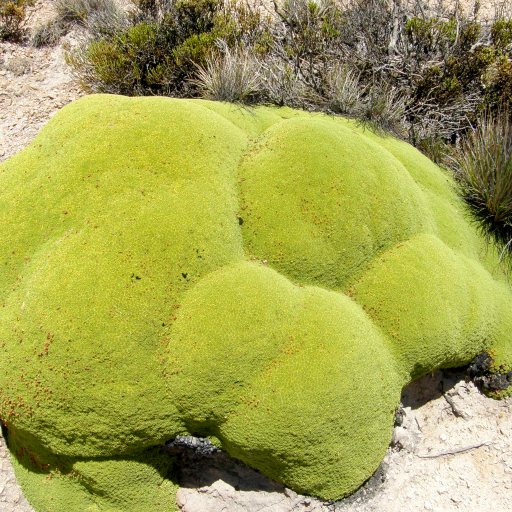
Known as the "Yareta" or "Llareta," this extraordinary plant looks less like a living thing and more like a moss-covered boulder. Native to the high-altitude Puna grasslands of the Andes, it is a master of survival, growing in alien-looking mounds that can live for over 3,000 years. In the thin, freezing air of the mountains, the Yareta has evolved a unique "cushion" strategy to trap heat and resist the wind.
🔍 How to Identify
- 🟢 Growth Habit: It forms incredibly dense, rounded cushions that can grow several meters wide. The surface is so firm that a person can actually stand on it without sinking.
- 🍃 The Leaves: If you look closely, the "rock" is actually made of thousands of tiny, waxy, evergreen rosettes. These leaves are packed tight to minimize water loss.
- 🌼 Flowers: In the summer, the mound may be dotted with tiny, inconspicuous greenish-yellow flowers that blend into the foliage.
🏔️ Care Context & Ecology
- ☀️ UV Resilience: Because it lives at altitudes where UV radiation is intense, the Yareta produces a thick, resinous sap. This resin acts as a natural "sunscreen" and also makes the plant highly flammable, which led to its historical use as a fuel source.
- 💧 Extreme Patience: Do not expect quick results if trying to cultivate alpine relatives; the Yareta grows at a glacial pace of about 1.5 centimeters per year. It invests all its energy into a deep, sturdy taproot to find moisture in the arid mountain soil.
- 🌬️ Thermal Mass: The cushion shape isn't just for show—the interior of the mound stays several degrees warmer than the biting mountain air, creating a micro-environment that protects its sensitive core.
⚠️ Safety & Toxicity
- ✅ Status: Generally considered non-toxic to humans and animals.
- 🌵 Physical Texture: While not "poisonous," the plant is extremely tough and resinous. It is not something a pet would find palatable, and the dense structure can be quite hard and abrasive to the touch.
✨ Fun Fact
The Yareta is one of the oldest living organisms on Earth. Some of the larger mounds found in the Chilean desert are estimated to be over 3,000 years old, meaning they were already centuries old when the Roman Empire was at its height!

Detailed Care Instructions
To grow an Azorella Compacta plant, follow these steps:
- Choose the right location: Azorella Compacta prefers areas with full sun to partial shade. Ensure the location has well-draining soil as the plant does not tolerate soggy conditions.
- Prepare the soil: The soil should be loose, fertile, and slightly acidic. If the soil in your area is heavy or clayey, add organic matter like compost or peat moss to improve its texture and drainage.
- Planting: You can either sow seeds or transplant the seedlings into the garden. If starting from seeds, sow them indoors 6-8 weeks before the last frost date, then transplant them after the danger of frost has passed. If transplanting seedlings, make sure to space them about 12-18 inches apart.
- Watering: Azorella Compacta prefers moderate watering, so water the plant regularly but do not overwater. Make sure the soil is evenly moist but not waterlogged.
- Fertilization: Azorella Compacta doesn't require heavy fertilization. Before planting, incorporate a slow-release fertilizer into the soil. Additionally, you can opt for a balanced, water-soluble fertilizer once a month during the growing season.
- Mulching: Apply a layer of organic mulch around the plant to help retain soil moisture, suppress weed growth, and regulate soil temperature.
- Pruning: Trim the plant after flowering to maintain its compact shape and promote bushy growth. Remove any dead or diseased branches as necessary.
- Winter care: Azorella Compacta is quite hardy, but it may benefit from protection during extremely cold winters. Consider covering the plant with a frost cloth or providing some other form of winter protection if needed.
- Pests and diseases: Azorella Compacta is generally resistant to pests and diseases. However, keep an eye out for aphids, mealybugs, or snails. Treat any infestations promptly with an appropriate insecticide or by handpicking the pests.
By following these steps, you can successfully grow and maintain an Azorella Compacta plant.

Place in a bright room that is sun drenched almost all day. Or directly in a south-facing window.

Azorella Compacta plant requires regular watering to keep it hydrated and healthy. However, it is essential to ensure that the plant is not overwatered, as it can lead to root rot and other issues. To water the plant, fill a watering can or spray bottle with room temperature water and aim the nozzle at the base of the plant. Avoid wetting the leaves or stem too much.
Before watering, check the soil moisture level by inserting your finger into the soil up to a depth of one inch. If it feels dry to the touch, it's time to water the plant. Water the plant until you see water seeping out of the bottom drainage holes in the pot. Allow the excess water to drain off and discard it.
It's advisable to water Azorella Compacta early in the morning or late in the evening when the sun isn't too harsh. This will prevent water from evaporating too quickly or scorching the plant's leaves. Avoid watering the plant during the hottest part of the day when the sun is at its peak.
During the winter season, reduce the frequency of watering and allow the soil to dry out a little before watering. This will prevent the plant from sitting in waterlogged soil for long periods.
Overall, it's essential to strike a balance between watering and letting the soil dry out to avoid overwatering and root rot. By following these simple tips, you can ensure that your Azorella Compacta plant thrives and remains healthy.
To fertilize this plant, use a balanced fertilizer with equal parts nitrogen, phosphorus, and potassium. Apply the fertilizer to the soil around the plant, being careful not to get any on the leaves or stems. Water the plant immediately after fertilizing to ensure that the nutrients are absorbed. Repeat this process once every four to six weeks during the growing season, which is typically spring and summer.
The ideal soil mixture for the plant is well-draining, porous, and has good aeration. It should be rich in organic matter, slightly acidic, and have a pH level ranging from 6.0 to 7.0. A mixture of peat moss, perlite, and sand is recommended for optimum growth and development. In addition, the plant prefers moist soil but it is important not to over water as this can lead to root rot.
To propagate this plant, first locate healthy and mature stems that are not blooming. Take cuttings that are about four to six inches in length, making sure to make a clean cut just below a leaf node. Strip the lower leaves from the cutting and dip the cut end into a rooting hormone powder.
Prepare a potting mix that is well-draining and has a good balance of sand and peat. Insert the cutting into the potting mix and lightly tamp the soil around it. Cover the pot with a clear plastic bag to maintain humidity and place it in bright, indirect light.
Water the cutting every few days, but do not overwater it. Keep the soil slightly moist, but not waterlogged. Within a few weeks, the cutting should root and begin to produce new growth.
Once the cutting has established roots and new growth, transplant it into a larger pot with more permanent potting mix. Keep the soil slightly moist and place the plant in a spot with bright, indirect light. Over time, the plant will continue to grow and thrive.








