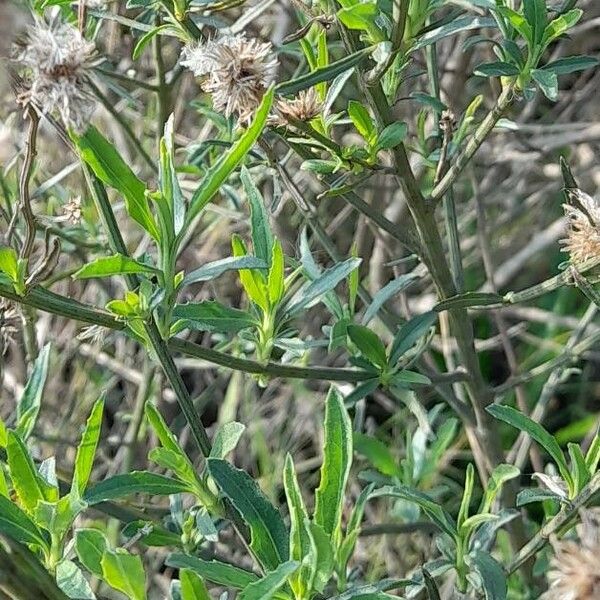
Plant Overview
Often called the Button Broom or Vassoura-de-botão in its native South America, Baccharis spicata is a resilient, woody shrub that embodies the rugged beauty of the pampas and grasslands. While it might look like a simple wildflower to the untrained eye, it is a "pioneer species," often being the first to reclaim disturbed soil and provide a vital nectar source for local honeybees. In folk traditions, it is respected for its hardy nature and its role in traditional herbal decoctions.
🔍 How to Identify
- 🌿 The Foliage: Unlike its cousins with "winged" stems, B. spicata features slender, upright stems crowded with small, narrow, lance-shaped leaves that give it a "broom-like" appearance.
- 🌼 The Flowers: It produces dense, terminal clusters of small, creamy-white or yellowish flower heads that look like tiny, fuzzy buttons clustered at the tips of the branches.
- 📏 Growth Habit: This is an erect, multi-branched shrub that typically reaches waist-height, maintaining a stiff, architectural silhouette even in windy conditions.
🏡 In Your Garden
- 🌱 Tough Love Required: This plant thrives on neglect. It prefers well-draining, sandy, or rocky soil and is highly resistant to drought once established. It’s the perfect candidate for a "wild" corner of the garden where other plants might struggle.
- 🐝 Pollinator Magnet: If you want to support local biodiversity, this is a powerhouse. During its blooming season, it becomes a buzzing hub for butterflies, hoverflies, and bees, providing essential late-season forage.
⚠️ Safety & Toxicity
- 🟢 General Status: Baccharis spicata is generally considered non-toxic to humans and is used in various regional folk medicines.
- 🐾 Pet & Livestock Note: While not high-risk, some species in the Baccharis genus contain resins that can cause digestive upset in grazing livestock or curious pets if consumed in very large quantities.
- 🧴 Skin Sensitivity: Sensitive individuals may experience mild skin irritation when handling the woody stems or sap; wearing gloves during pruning is always a good practice.
✨ Fun Fact
The genus name Baccharis is named after Bacchus, the Roman god of wine. While this specific plant won't give you a vineyard harvest, the name was originally applied by the Greeks to certain plants with fragrant roots that reminded them of spiced wine!

Detailed Care Instructions
To grow Baccharis spicata, also known as False Willow, follow these steps:
- Obtain seeds or young plants from a nursery or online supplier. Baccharis spicata is native to North America, particularly the eastern and southern parts of the United States.
- Choose a suitable planting location with well-draining soil and full sun to partial shade. False Willow can tolerate a variety of soil types, including sandy or clay soils.
- Prepare the soil by removing any weeds or grass and loosening it with a garden fork or tiller. This will ensure good root development.
- Sow the seeds or plant the young Baccharis spicata plants in the prepared soil. If planting seeds, lightly cover them with a thin layer of soil.
- Water the seeds or plants thoroughly after planting, and then water regularly to keep the soil moist but not waterlogged. False Willow prefers slightly moist conditions.
- Mulch around the base of the plants with a 2 to 3-inch layer of organic mulch, such as wood chips or straw. This will help retain soil moisture and suppress weed growth.
- Monitor the growth of the Baccharis spicata plants and provide additional water during dry spells, especially during the first growing season.
- Prune the plants in early spring to remove any dead or damaged branches and shape the plant as desired. Baccharis spicata is usually low-maintenance and only requires occasional pruning to maintain its shape.
- Protect the plants from pests and diseases. Baccharis spicata is generally not prone to significant issues. However, if you notice any insect damage or fungal issues, consult with a local gardening expert for suitable treatments.
- Enjoy the beautiful display of Baccharis spicata's delicate white flowers that typically bloom in late summer and early fall. These flowers are attractive to pollinators, such as bees and butterflies.
Remember to check with your local gardening center or extension office for specific guidance on growing Baccharis spicata in your specific region, as climate and soil conditions can vary.
To properly water this particular plant, it is important to first ensure that the soil is dry to the touch before watering. When watering, it is best to water at the base of the plant using a watering can or hose with a gentle stream to avoid over-soaking the soil. It is recommended to water this plant once a week during its growing season and less frequently during the winter months. Additionally, it is important to avoid getting water on the foliage of the plant as this can lead to fungal growth and other diseases.
- Choose a balanced, slow-release fertilizer with equal parts nitrogen, phosphorus, and potassium.
- Follow the instructions on the fertilizer package for the amount of fertilizer to apply per square foot of soil.
- Apply the fertilizer evenly around the root zone of the plant, avoiding the stem and foliage.
- Water the plant thoroughly after fertilizing to help the nutrients penetrate the soil.
- Repeat fertilizing every 6-8 weeks during the growing season (spring and summer).
- Do not fertilize during the dormant season (fall and winter).
Baccharis Spicata plant has specific soil requirements that need to be fulfilled for optimal growth. The soil must not be sandy or clayey, but should be loamy and well-draining. It should be rich in organic matter and nutrients, with a pH ranging from neutral to slightly alkaline. The plant can tolerate some degree of soil salinity and is adapted to drought conditions. However, the soil should not be waterlogged, as this can lead to root rot. Adding compost or mulch to the soil can help improve its quality and retain moisture. It is also recommended to avoid using fertilizers high in nitrogen as it may lead to excessive leaf growth at the expense of flowering.
To propagate this particular plant, you can start by collecting healthy cuttings from the mother plant. Use a sterilized pair of pruning scissors to ensure that you don't contaminate the cuttings with any diseases. Choose cuttings that are about 4-6 inches long and have at least 3-4 leaves.
Next, strip off the bottom 1/3 of the leaves from each cutting and make a clean cut on the stem at a 45-degree angle. This will help increase the surface area for rooting.
Fill a clean pot with a well-draining soil mix and moisten it slightly. Use a pencil or a skewer to create a hole in the soil and insert the cutting into it, making sure that the bottom leaves are above the soil level.
Water the cutting gently and cover it with a plastic bag or a clear plastic container to create a mini greenhouse and increase humidity. Place the pot in a bright, indirect light location and keep the soil moist but not waterlogged.
After about 2-3 weeks, check for signs of roots by gently tugging on the cutting. If there is resistance, it means roots have formed, and you can remove the plastic cover and treat the cutting as a normal plant. If there is no resistance, wait a few more days and check again.
Once the cutting has developed strong roots, you can transplant it into a larger pot with fresh soil mix and continue to care for it as a mature plant.








