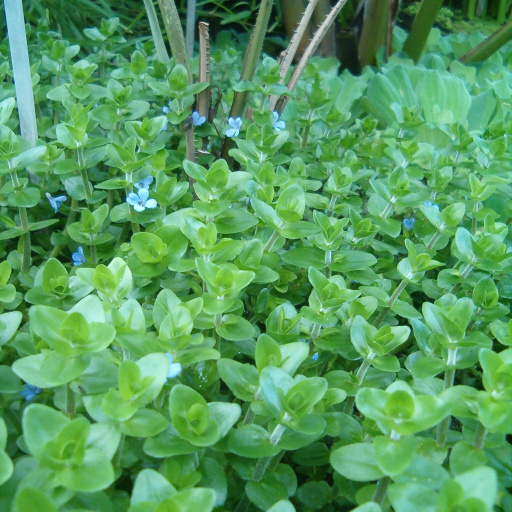
Plant Overview
Often called the "Lemon Bacopa," this charming aquatic perennial is a favorite for both aquarium hobbyists and backyard pond lovers. Native to the marshlands of the Southern United States, it behaves like a submerged succulent, offering a refreshing citrus scent whenever its leaves are handled or trimmed. It is one of the hardiest aquatic plants, making it a "go-to" for beginners who want a lush, green look without the fuss.
🔍 How to Identify
- 🍃 Fleshy Foliage: The leaves are small, oval, and surprisingly thick (succulent-like), growing in opposite pairs directly along a sturdy, upright stem.
- 🌸 Sky-Blue Blooms: When the plant grows above the water's surface (emersed), it produces tiny, bell-shaped flowers in a delicate shade of violet or sky blue.
- 🍋 The "Scent Test": The most reliable way to identify it is to gently crush a leaf between your fingers; it should release a distinct, zesty lemon aroma.
🏡 In Your Garden & Aquarium
- ☀️ Light-Induced Colors: While naturally bright green, this plant is a bit of a chameleon. Under intense light or in low-nitrate environments, the top leaves can "blush" with beautiful shades of bronze, copper, or even rose-red.
- ✂️ Easy Multiplication: It hates being moved frequently due to its delicate root system, but it loves being trimmed. Simply snip the top of a stem and tuck it into the sand or gravel; it will quickly sprout new roots to form a dense "underwater forest."
- 💧 Adaptable Depth: It is highly versatile, surviving completely submerged in a fish tank, floating on the surface, or creeping along the muddy edges of a pond as a groundcover.
⚠️ Safety & Toxicity
- ✅ Safe Status: Bacopa caroliniana is non-toxic and generally considered safe for households with curious cats, dogs, and children.
- 🐟 Aquatic Sanctuary: It is a "best friend" to fish and shrimp. It provides a safe grazing area and hiding spot for baby fish (fry) without releasing any harmful alkaloids into the water.
✨ Fun Fact
In its native swampy habitats, Bacopa caroliniana can grow into massive, floating mats so thick that they act as a natural air freshener; when the wind brushes against the leaves, the entire shoreline can smell faintly of lemons!

Detailed Care Instructions
To grow Bacopa Caroliniana, commonly known as the Carolina Waterhyssop, you can follow these steps:
- Lighting: Provide moderate to high lighting for the plant. If you have a low light aquarium, you may need to provide additional lighting such as LED bulbs or aquarium-specific grow lights.
- Water conditions: Bacopa Caroliniana prefers soft to moderately hard water conditions with a pH range between 6.5 and 7.5. Maintain the water temperature between 72-82°F (22-28°C). Ensure good water circulation in the tank.
- Planting: Plant the Bacopa Caroliniana in the substrate of your aquarium. Create a small hole in the substrate and place the plant gently, making sure that the roots are buried but the stem and leaves are above the substrate.
- Pruning and maintenance: Regularly trim the plant to encourage bushier growth and prevent it from becoming too tall and shading other plants. Remove any dead or decaying leaves to maintain water quality.
- Fertilization: Bacopa Caroliniana grows well with regular fertilization. You can use liquid fertilizers, root tabs, or substrate additives specifically formulated for aquarium plants. Follow the instructions on the fertilizer package for dosage and frequency.
- CO2 injection: While Bacopa Caroliniana can grow without CO2 injection, adding CO2 to the tank can significantly enhance growth and coloration. Consider using a CO2 injection system if you desire faster and lusher growth.
- Water changes: Regularly perform partial water changes to maintain water quality and provide fresh nutrients to the plant.
- Compatibility: Bacopa Caroliniana is a peaceful plant and can usually coexist with other aquarium plants and fish species. However, it's important to ensure that there is enough space for the plant to grow without being shaded or overcrowded.
By following these guidelines, you should be able to successfully grow Bacopa Caroliniana in your aquarium.

Place in a bright room that is sun drenched almost all day. Or directly in a south-facing window.

To properly water this plant, start by checking the soil moisture level before watering. One way to do this is by gently inserting your finger one inch into the soil and feeling for moisture. If the soil feels dry to the touch, it is time to water.
When watering, use room temperature water and pour it directly onto the soil around the base of the plant, avoiding the leaves. Allow the soil to soak up the water until it begins to drain out of the bottom of the pot. Then, empty any excess water from the saucer or tray underneath the pot to prevent the roots from sitting in water.
In general, this type of plant prefers to stay evenly moist, but not waterlogged. It is important not to let the soil dry out completely between waterings, as this can cause stress to the plant and affect its growth. However, overwatering can lead to root rot and other issues, so it is essential to find a balance.
The frequency of watering can depend on various factors, such as the size of the pot, the amount of light and humidity in the environment, and the temperature. In general, it is better to underwater than overwater, as the plant can recover from slight drying out, but not from drowning.
To fertilize this aquatic plant, it is recommended to use a high-quality aquatic plant fertilizer that contains essential macronutrients such as nitrogen, phosphorus, and potassium. The fertilizer should be added to the water column near the base of the plant and in accordance with the manufacturer's instructions. It is important to avoid over-fertilizing, as this can lead to poor plant growth and potential harm to aquatic life. Regular water changes and maintaining proper water parameters can also benefit plant growth and health.
Bacopa Caroliniana prefers a well-draining soil that is fertile and rich in organic matter. The soil should be slightly acidic with a pH range between 6.0 and 7.5. It should be moist but not waterlogged, as the plant can suffer from root rot in overly saturated soil. A mix of loam, sand, and peat moss can create an ideal soil type for Bacopa Caroliniana. Adding fertilizers and compost can help boost the plant's growth and overall health. It is important to avoid using topsoil or heavy clay soils, as they can retain too much moisture and hinder the plant's growth.
Bacopa Caroliniana plant can be propagated through stem cuttings. To do this, select healthy and mature stems from the parent plant. Cut the stem at an angle using a clean and sharp pair of scissors or pruning shears.
Remove the bottom leaves of the stem and make a small cut on the bottom of the stem to promote root growth. Dip the cut end of the stem in rooting hormone powder to encourage root formation.
Plant the stem cutting in a container filled with nutrient-rich soil. Keep the soil moist and provide the plant with enough light. It is best to place a plastic bag over the container to maintain humidity levels until the plant has rooted.
The stem cutting should develop roots within a few weeks. Once the plant has established itself, it can be transplanted to a bigger container or planted in a garden bed.








