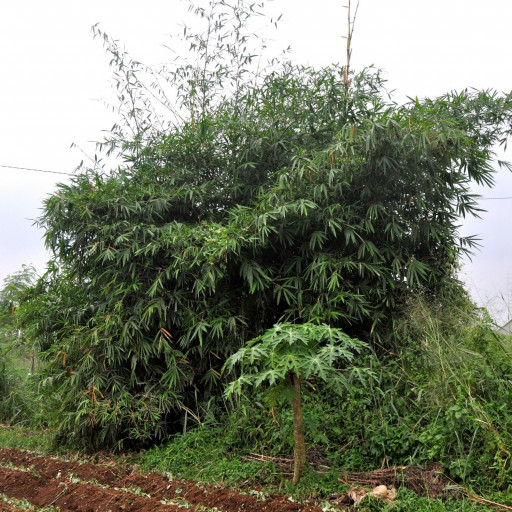
Plant Overview
Meet the "Golden Bamboo," a tropical giant that has fueled human construction, art, and medicine for centuries. Often seen as the face of bamboo globally, Bambusa vulgaris is a "clumping" variety, meaning it behaves much better in a garden than its aggressive "running" cousins. Whether used as a towering privacy screen or a golden ornamental centerpiece, it brings an instant Zen-like atmosphere to any landscape.
🔍 How to Identify
- 🎋 The Culms (Stems): These are smooth, glossy, and woody. While the base species is green, the most popular garden variety (Vittata) features bright golden-yellow stems with dark green vertical stripes.
- 🍃 The Foliage: The leaves are narrow, lance-shaped, and grow on short branches along the upper half of the stem, creating a lush, feathery canopy.
- 🌿 The Clump: Look at the base. It grows in a "sympodial" fashion, meaning new shoots emerge close to the parent plant, forming a tight, predictable circle rather than spreading uncontrollably across the yard.
🏡 In Your Garden
- ☀️ Sun & Space: This bamboo is a sun-worshipper. To reach its full height and maintain those vivid yellow colors, it needs plenty of direct light and enough vertical room to stretch toward the clouds.
- 💧 The Thirsty Giant: It thrives near water sources and loves humidity. While it can survive dry spells once established, its growth will stall if the soil stays parched for too long.
- 🍂 Natural Mulch: It is a heavy leaf-shedder. Instead of raking the fallen leaves away, leave them at the base! They break down into a specialized mulch that returns essential silica back to the bamboo's roots.
⚠️ Safety & Toxicity
- ✅ Pet & Child Friendly: This species is generally considered non-toxic to dogs, cats, and humans. It is a safe choice for family-friendly landscapes.
- 🧤 Physical Safety: Be cautious of the "culm sheaths" (the papery covers on new shoots), which can sometimes have tiny, irritating hairs. Also, old, dry canes can be extremely sharp if snapped.
- 🍲 Edibility Note: While the young shoots are technically edible after thorough boiling, they are quite bitter compared to other species. It is best enjoyed as an ornamental plant rather than a kitchen ingredient.
✨ Fun Fact
Bambusa vulgaris is a true engineering marvel. It is so strong and flexible that in many parts of Asia, it is still used to build scaffolding for skyscrapers! It is often preferred over steel because it is lighter, cheaper, and can withstand the swaying forces of high-altitude winds.

Detailed Care Instructions
To grow Bambusa Vulgaris, also known as bamboo, follow these steps:
- Choose a location: Bamboo prefers full sun to partial shade. Make sure the location has well-drained soil.
- Prepare the soil: Bamboo prefers slightly acidic soil with a pH between 5.5 and 6.5. Amend the soil with organic matter such as compost to improve its fertility and drainage.
- Planting: Dig a hole that is twice as wide and deep as the bamboo rootball. Place the rootball in the hole, making sure the top of the rootball is level with or slightly above the ground surface. Backfill the hole with soil, gently firming it around the roots.
- Watering: Water the bamboo thoroughly after planting, and then water regularly to keep the soil consistently moist. Bamboo plants generally require 1-2 inches of water per week.
- Mulching: Apply a layer of organic mulch around the base of the bamboo to help retain moisture and suppress weed growth. Keep the mulch pulled back a few inches from the plant's stem to prevent rot.
- Fertilizing: Bamboo is a heavy feeder and benefits from regular fertilization. Apply a balanced slow-release fertilizer in the spring and again in mid-summer, following the package instructions for application rates.
- Pruning: Remove any dead or damaged culms (stems) as they appear. Thin out crowded growth to facilitate airflow and reduce the risk of diseases.
- Containment: Bamboo can spread vigorously, so consider using rhizome barriers or container planting to control its growth. This will help prevent it from spreading into unwanted areas.
- Maintenance: Monitor the plant regularly for pests or diseases, which can include mites, mealybugs, or fungal infections. Treat any issues promptly.
- Winter care: Depending on your climate, Bambusa Vulgaris may need protection during winter. In colder regions, consider covering the plant with burlap or moving potted bamboo indoors.
Note: Bambusa Vulgaris can be invasive in some areas, so it's important to check with local authorities before planting it.

Place in a window with dappled sun or a spot in the middle of a room. Or directly in a window facing west or east.

Bambusa Vulgaris is a type of plant that requires regular watering to thrive. To properly water this plant, make sure to check the soil’s moisture level. The best way to do this is to insert your finger into the soil up to the first knuckle. If the soil feels dry, it is time to water the plant.
When watering, it is important to water the soil around the plant’s base and avoid getting water on the leaves. Additionally, make sure to water the plant slowly and deeply to ensure that the water reaches the roots. After watering, allow excess water to drain from the pot or container.
It is recommended to water Bambusa Vulgaris every 3-4 days, depending on the temperature and humidity levels in the plant’s environment. During hot and dry weather, the plant may require more frequent watering.
In summary, to water Bambusa Vulgaris plant, check the soil’s moisture level, water the soil around the plant’s base, avoid getting water on the leaves, water slowly and deeply, and water every 3-4 days depending on environmental conditions.
To provide proper nutrients for this type of plant, use a balanced all-purpose fertilizer. Apply the fertilizer in the springtime, just before new growth appears. You should apply the fertilizer according to the instructions on the label, as over-fertilizing may harm the plant. It is recommended to water the plant well before and after fertilizing. Additionally, use organic matter, like compost, to enrich the soil and support healthy growth.
Bambusa vulgaris is a type of plant that requires well-draining soil that is loose and rich in nutrients. The soil should be well-aerated and have a slightly acidic pH between 5.5 and 6.5. To achieve the ideal soil structure, it is recommended to mix in organic matter such as compost, peat moss, or aged manure. The plant prefers slightly moist soil that is not waterlogged or excessively dry. It is crucial to avoid using soil that contains heavy materials such as clay or sand as they can cause drainage problems. Additionally, the plant requires regular fertilization for proper growth and health. A balanced fertilizer with a ratio of nitrogen, phosphorus, and potassium of 10-10-10 or 20-20-20 is suitable for providing nutrition to the plant.
Bambusa Vulgaris is a plant that can be propagated through several methods, including division, cuttings, and layering.
Division involves separating an established plant into smaller sections, each with its own roots and shoots. To propagate Bambusa Vulgaris through division, one can first select a healthy, mature plant. Using a clean, sharp knife or garden tool, carefully divide the plant into smaller sections. Each section should have roots and stems, and should be planted in a suitable medium. Water the newly planted sections thoroughly and continue to care for them as you would a mature Bambusa Vulgaris plant.
Another way to propagate Bambusa Vulgaris is through cuttings. This method involves taking a cutting from a mature plant and rooting it in water or soil. To propagate through cuttings, one can select a healthy, mature plant and take a cutting from the stem. The cutting should have at least one node and should be between 6 and 12 inches long. The cutting can then be planted in moist soil or placed in a jar of water. Water the cutting regularly and provide it with adequate sunlight until it roots and begins to grow.
Layering is a third method for propagating Bambusa Vulgaris. This method involves taking a stem of the mature plant and bending it down to touch the ground. The stem can then be covered with soil or mulch to encourage rooting. Once the stem has rooted, it can be separated from the parent plant and planted in a suitable medium.
Regardless of the method chosen, it is important to take good care of the newly propagated plants. This includes providing them with adequate water, sunlight, and nutrients, as well as protecting them from pests and diseases. With proper care, propagated Bambusa Vulgaris plants can grow into healthy and thriving specimens.
Common pests of the common bamboo include Thrips. Make a habit of checking your common bamboo frequently for pests so that any infestations can be caught and managed early.








