Plant Overview
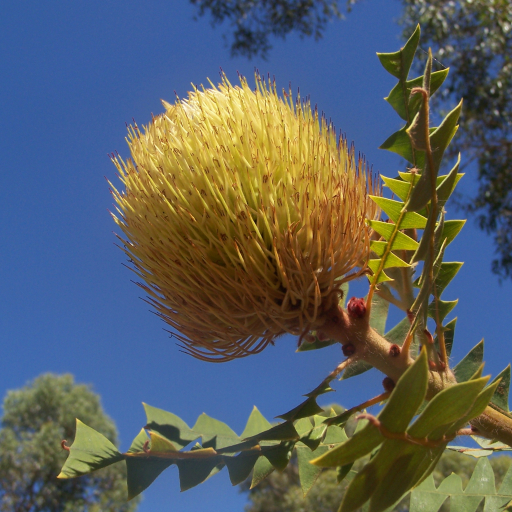
Known as the Bird’s Nest Banksia, this Western Australian icon is a master of geometric perfection. With its distinctive "zigzag" leaves and large, dome-shaped lime flowers, it looks like something designed by an architect rather than grown in the wild. It has long been a favorite in the floral industry because its blooms and foliage remain striking even after they have dried.
🔍 How to Identify
- 📐 The Foliage: The most recognizable feature is the stiff, wedge-shaped leaves with deep, triangular serrations that look like a repeating "V" pattern.
- 🌕 The Blooms: Large, globular flower spikes that are a pale lime-green or buttery yellow. These "cones" sit upright, often nestled within the foliage.
- 🌳 Growth Habit: It typically grows as an upright, multi-stemmed shrub, reaching about 2 to 4 meters in height, creating a dense, mounded silhouette.
🏡 In Your Garden
- 🏜️ Drainage is King: Like many Proteaceae from Western Australia, Banksia baxteri is highly sensitive to "wet feet." It requires very sandy, free-draining soil and will struggle in heavy clay.
- ☀️ Sun Seeker: To get those iconic lime-yellow blooms, place it in a spot that receives full, baking sun. This also helps prevent fungal issues on the leaves.
- 🧪 Special Diet: Never use standard garden fertilizers. This plant has specialized "proteoid" roots that are experts at finding nutrients; high phosphorus fertilizers are actually toxic to it.
⚠️ Safety & Toxicity
- ✅ Non-Toxic: This plant is generally considered non-toxic to humans, cats, and dogs.
- 🌵 Physical Caution: While not poisonous, the leaves are very stiff and the serrated edges can be quite prickly. It’s best to wear gloves when pruning to avoid scratches.
✨ Fun Fact
The Bird's Nest Banksia is a favorite among florists because the flowers don't just look good when fresh—they are "everlasting." Even after the flower dies, it transitions into a woody, ornamental cone that can last for years in a vase.

Detailed Care Instructions

Place in a bright room that is sun drenched almost all day. Or directly in a south-facing window.

The presence of a dry surface layer of soil does not indicate that the plant requires water. Instead, stick your finger 1-2" (3-5 cm) deep in the soil to feel dampness or moisture content. If the soil seems dry, it's time to water your greens. If the soil is still moist, however, it is better not to water your plant and instead wait a day or two. Overwatering or waterlogging raises the risk of root rot. So if the soil takes longer than a week to dry, check the light conditions because it's likely that the plant isn't getting enough light. It's fine if the upper layer of soil is dry between waterings, but the deeper soil layer should always have some moisture.
These plants can thrive without taking help from any fertilizer. However, if the medium of growth is something other than soil for instance sand then you may need to add little fertilizer. The best way to know if your plants need fertilizer or not is to check for yellowing of leaves. If the leaves start to turn yellow it’s fertilizing time.
You may use All Purpose Plant Food or Green Plant Food for your Baxter's Banksia
Common pests of the baxter's banksia include Scale insect, mealybugs, spider mites, thrips. Make a habit of checking your baxter's banksia frequently for pests so that any infestations can be caught and managed early.








