Plant Overview
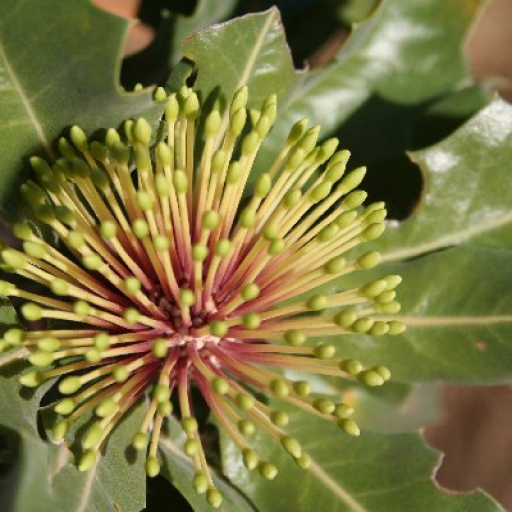
Often mistaken for a holly bush at first glance, the Holly-leaved Banksia is a unique Western Australian treasure. Unlike many of its cousins that sport long, candle-like "cobs," this species features rounded, dome-like flower heads that act as a living mood ring, shifting colors as they mature. It is a resilient survivor that brings architectural drama and year-round interest to a native-style landscape.
🔍 How to Identify
- 🍃 Prickly Foliage: The leaves are stiff, glossy, and dark green with deeply serrated, sharp points that bear a striking resemblance to traditional English Holly.
- 🎨 Chameleon Blooms: The flower heads are dome-shaped clusters that start as a creamy yellow, transition to a vibrant pink, and eventually turn a deep, dull red.
- 🌳 Growth Habit: While it can reach up to 10 meters as a sturdy tree in inland conditions, it often adopts a low, spreading, and wind-swept shrub form when growing near the coast.
🏡 In Your Garden
- 🏜️ Sand Specialist: This species is a specialist of the "Swan Coastal Plain." It thrives in deep, well-draining sandy soils and will struggle significantly in heavy clay or areas with poor drainage.
- 🐦 The Bird Cafe: Because it can produce flowers at almost any time of the year, it is a vital food source for honeyeaters. It acts as a natural bird feeder, providing nectar during seasons when other plants are dormant.
- 🌱 Low Phosphorus: Like most members of the Proteaceae family, it has specialized "proteoid" roots. It is highly sensitive to phosphorus, so you should only use specific "Native" fertilizers to avoid burning the plant.
⚠️ Safety & Toxicity
- ✅ Pet & Human Safe: Banksia ilicifolia is considered non-toxic to humans, dogs, and cats. It is a safe choice for family gardens.
- 🌵 Physical Warning: While not poisonous, the leaves are genuinely sharp. It is best planted away from narrow pathways or children’s play areas to avoid accidental scratches from the stiff, holly-like foliage.
✨ Fun Fact
The dramatic color change of the flowers is a communication tool for pollinators. The yellow flowers are full of nectar to attract bees, while the red color indicates to the birds that the "kitchen is closed," signaling that pollination is complete and the plant is now focusing on seed production.

Detailed Care Instructions

Place in a bright room that is sun drenched almost all day. Or directly in a south-facing window.

Some plants require more regular watering than others, which should be done every few days. It's critical to maintain the soil moist all of the time. The water requirements of the same plant placed in pots with varying sizes will differ. Because the water in the smaller pot evaporates faster than the water in the larger pot, it will require more watering. Regardless of pot size, the surface should constantly be maintained moist.








