Plant Overview
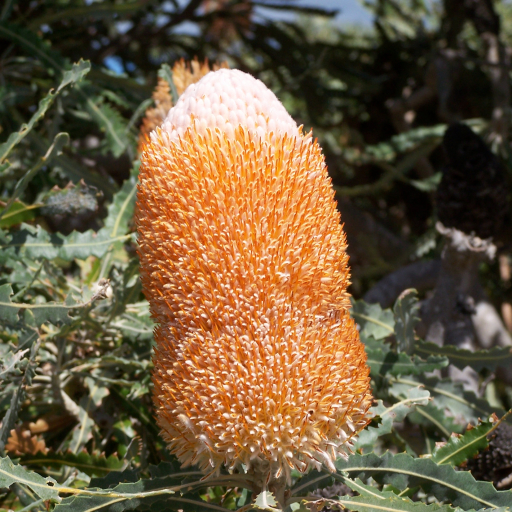
Often called the Acorn Banksia, this Western Australian icon is a showstopper in any Mediterranean-style garden. It is famous for its architectural, woolly flower spikes that look like giant, frosted acorns dipped in vibrant orange sherbet. Beyond its beauty, this plant serves as a vital "bridge" for wildlife, providing nectar during the late summer and autumn months when other food sources are scarce.
🔍 How to Identify
- 🍦 Acorn Blooms: The most striking feature is the large, cylindrical flower spike. It begins as a silvery-white "frosted" bud and opens into a brilliant, glowing orange, creating a distinct two-tone effect.
- 🪚 Saw-Toothed Foliage: The long, narrow leaves are deeply and regularly serrated. The jagged edges look remarkably like a carpenter's saw blade, giving the plant a prehistoric, textured appearance.
- 🌳 Spreading Habit: It usually grows as a large, multi-stemmed shrub or a small tree. In a garden setting, it maintains a rugged, open canopy that allows light to filter through.
🏡 In Your Garden
- 🏜️ Drainage is Non-Negotiable: This species has evolved for the deep, sandy soils of the West Australian coast. It absolutely loathes "wet feet" and is highly susceptible to root rot; if your soil is heavy clay, consider a raised bed or a large pot.
- 🐦 Avian Magnet: Planting an Acorn Banksia is the fastest way to invite honeyeaters and wattlebirds to your yard. The high nectar production makes it a literal refueling station for local birds.
- 🌱 Phosphorus Sensitivity: Like many Australian natives, it has "proteoid" roots designed to scavenge nutrients in poor soil. Avoid standard fertilizers—too much phosphorus can actually poison the plant. Use a dedicated "native" fertilizer only.
⚠️ Safety & Toxicity
- ✅ Safe for All: This plant is considered non-toxic to humans, cats, and dogs. It is a popular choice for family gardens and wildlife-friendly spaces.
- 🧤 Physical Hazards: While not poisonous, the dried, woody "cones" (follicles) and the serrated leaves can be quite sharp. Wear sturdy gardening gloves when pruning to avoid scratches.
✨ Fun Fact
🪚 The species name prionotes is derived from the Greek word prion, which means "saw." It is a direct reference to the perfectly uniform, jagged edges of the leaves that look like they were cut with a precision tool!

Detailed Care Instructions
To grow Banksia Prionotes plant, follow these steps:
- Choose the right location: Banksia Prionotes plant prefers a sunny spot with well-draining soil. It can tolerate dry conditions but performs best in areas with consistent rainfall or regular watering. Avoid areas with strong winds or heavy frosts.
- Prepare the soil: Banksia Prionotes plant prefers sandy or loamy soil with good drainage. If your soil is heavy clay, add organic matter like compost or well-rotted manure to improve drainage and fertility.
- Sow the seeds: Banksia Prionotes plant can be grown from seeds, which are typically enclosed in hard woody capsules. Soak the seeds in water for 24 hours to help with germination. Then, using a sharp knife, make a small cut in the seed coat to allow water to penetrate. Plant the seeds in pots or seed trays filled with a well-draining seed-raising mix, burying them at a depth of about twice their size. Water gently after sowing.
- Provide the right conditions: Place the seed trays/pots in a warm and bright location, such as a greenhouse or a sunny windowsill. Maintain a temperature around 20-25°C (68-77°F). Keep the soil slightly moist but not waterlogged. Germination usually occurs within 2-4 weeks.
- Transplanting: Once the seedlings have developed a few true leaves, transplant them into individual pots filled with a well-draining potting mix. Handle the seedlings carefully to avoid damaging their delicate root systems.
- Watering and care: After transplanting, water the seedlings regularly, keeping the soil moist but not overly wet. As they mature, Banksia Prionotes plants become more drought-tolerant. Fertilize them with a slow-release native plant fertilizer following the package instructions.
- Pruning: Prune the plant lightly during the first few years to encourage a bushy shape and promote branching. Remove dead or damaged branches as needed. Banksia Prionotes prune well and the cut branches can be used for floral arrangements.
- Mulching: Apply a layer of organic mulch around the base of the plant to help retain moisture, suppress weed growth, and regulate soil temperature.
- Pests and diseases: Banksia Prionotes plants are generally pest and disease resistant. However, keep an eye out for common garden pests like aphids and caterpillars. Treat any infestations promptly using organic pest control methods if necessary.
- Enjoy the blooms: Banksia Prionotes plants produce uniquely shaped flowers that attract birds and insects. Enjoy the beautiful blooms and the wildlife they bring to your garden.
Remember that Banksia Prionotes is native to Western Australia and may be challenging to grow in non-native regions. It is important to consider your local climate and growing conditions before attempting to grow this plant.

Place in a bright room that is sun drenched almost all day. Or directly in a south-facing window.

Watering Banksia Prionotes plants depends on their specific needs and requires some knowledge about their natural habitat and growth requirements. Here are some guidelines on how to water this plant effectively:
1. Understanding the natural habitat: Banksia Prionotes plants are native to Western Australia, where they grow in well-drained sandy soils. They are adapted to survive in arid and semi-arid regions with low rainfall.
2. Watering frequency: These plants generally prefer infrequent but deep watering. Allow the topsoil to dry out between waterings to prevent overwatering, which can lead to root rot. As a general rule, water them every 1-2 weeks during the warmer months, reducing frequency during cooler periods.
3. Water quantity: When watering, aim to thoroughly wet the soil to encourage deep root growth. Apply sufficient water until it reaches the root zone, which can be around 6-8 inches deep. This ensures the water reaches the plant's extensive root system.
4. Watering method: Instead of light and frequent sprinkling, which promotes shallow roots, consider using a slow watering method like drip irrigation or soaker hoses. This allows water to penetrate deeply into the soil and encourages the roots to search for moisture.
5. Mulching: Applying a layer of organic mulch around the plant helps retain soil moisture, prevent evaporation, and regulate soil temperature. Mulching also suppresses weed growth, which can compete for water and nutrients.
6. Watering seasonally: Banksia Prionotes plants have different water requirements depending on the season. During the active growth period, typically spring and summer, they require more water. In contrast, during dormancy or cooler periods, they require less frequent watering.
7. Monitoring signs of underwatering or overwatering: Observe the plant for signs of stress. Wilting, yellowing or drooping leaves, and dry soil might indicate underwatering, whereas yellowing leaves, root rot, or fungus growth could indicate overwatering. Adjust your watering accordingly.
Remember, different environmental factors like temperature, soil type, and sunlight can influence watering needs. It's important to assess the specific conditions of your Banksia Prionotes plant and adapt your watering practices accordingly.
To fertilize the Banksia Prionotes plant, use a slow-release, low-phosphorus fertilizer with a balanced ratio of nitrogen, phosphorus, and potassium. Follow these instructions:
- Choose a fertilizer specifically formulated for native Australian plants or suitable for Proteaceae family plants.
- Read the fertilizer package instructions carefully and dilute the recommended amount in water if necessary.
- Apply the fertilizer during early spring or late winter when the plant is actively growing.
- Before applying fertilizer, ensure the soil is moist. Water the plant a day or two prior if necessary.
- Spread the fertilizer evenly around the base of the plant, avoiding direct contact with the stems or leaves.
- Gently work the fertilizer into the top layer of soil using a hand rake or cultivator, without damaging the plant's roots.
- Water the plant thoroughly after fertilizing to help the nutrients reach the root zone.
- Monitor the plant for any signs of nutrient deficiencies or excessive fertilizer application, such as yellowing leaves or wilting.
- Repeat the fertilization process once or twice a year, following the package instructions, and taking into consideration the specific needs of your plant.
- Regularly assess the overall health and growth of the Banksia Prionotes plant and adjust the fertilization regime as necessary for optimal results.
When selecting soil for Banksia Prionotes plants, it is important to consider its native habitat and growth requirements. Banksia Prionotes plants are indigenous to a particular region and typically thrive in well-drained soils. The ideal soil composition for these plants would be slightly acidic to mildly alkaline soil with a pH range of 6 to 7.5.
In terms of soil texture, Banksia Prionotes plants prefer sandy or loamy soils that are well-draining. This type of soil allows excess water to flow away, preventing waterlogging, which can be detrimental to the plant's health. However, it is essential to ensure that the soil retains some moisture as Banksia Prionotes plants do not tolerate extremely dry conditions.
To enhance soil drainage and prevent waterlogging, adding organic matter such as compost or well-rotted manure can be beneficial. This helps improve soil structure, allowing better air circulation to the plant's roots. Additionally, organic matter provides nutrients slowly, benefitting the plant's growth over a more extended period.
While Banksia Prionotes plants are native to regions with low fertility soils, it can still be helpful to incorporate a slow-release fertilizer into the soil during planting. This can provide essential nutrients to support the initial establishment and vigorous growth of the plant.
Overall, the most suitable soil for Banksia Prionotes plants is well-drained, slightly acidic to mildly alkaline, sandy or loamy soil with added organic matter. Maintaining proper soil conditions is vital to support healthy growth, root development, and overall vitality of the Banksia Prionotes plant.
Propagation of Banksia Prionotes can be done through various methods such as seed germination, semi-hardwood cuttings, and grafting. Here are the details on how to propagate this plant:
- Seed Germination:
a. Collect mature seed cones from a healthy Banksia Prionotes plant.
b. Place the cones in a paper bag and allow them to dry for a few weeks until they fully open and release the seeds.
c. Gently shake the bag to separate the seeds from the cones.
d. Fill a propagation tray or small pots with a well-draining potting mix.
e. Place the seeds on the surface of the soil and lightly press them into the mix.
f. Mist the seeds with water and cover the tray or pots with a plastic dome or plastic wrap to create a humid environment.
g. Place the tray or pots in a warm, bright location but avoid direct sunlight.
h. Keep the soil moist but not soggy by misting regularly.
i. Germination should occur within 2-8 weeks. Once the seedlings have grown 2-3 pairs of true leaves, they can be transplanted into individual pots.
- Semi-Hardwood Cuttings:
a. Take semi-hardwood cuttings in late spring or early summer when the plant is actively growing.
b. Choose healthy, non-flowering stems that are partially matured but not yet woody.
c. Cut a 4-6 inch long stem just below a leaf node using a sharp and clean knife.
d. Remove the lower leaves from the cutting, leaving only a few pairs at the tip.
e. Dip the cut end of the cutting into a rooting hormone powder or gel to promote root development.
f. Fill small pots or propagation trays with a well-draining potting mix.
g. Insert the cutting into the soil, ensuring that at least two nodes are buried beneath the surface.
h. Place the pots or trays in a warm, bright location but avoid direct sunlight.
i. Keep the soil consistently moist but not waterlogged.
j. Roots should develop within 4-8 weeks. Once the cuttings have established roots, they can be transplanted into larger pots.
- Grafting:
a. Select a desired Banksia Prionotes cultivar and a suitable rootstock that is compatible.
b. Take a semi-hardwood cutting from the desired cultivar and a rootstock cutting of a related species or variety.
c. Make a clean slanting cut on both the cultivar and rootstock.
d. Join the two cut surfaces together, ensuring they fit snugly.
e. Use grafting tape or rubber bands to secure the union between the cultivar and rootstock.
f. Place the grafted plant in a warm and humid environment such as a greenhouse or a propagation chamber.
g. Keep the graft moist but not waterlogged to promote healing and growth.
h. After a few weeks, remove the grafting tape or rubber bands once the graft union has formed.
i. Transplant the grafted plant into a suitable pot or garden bed once it has developed a strong root system.








