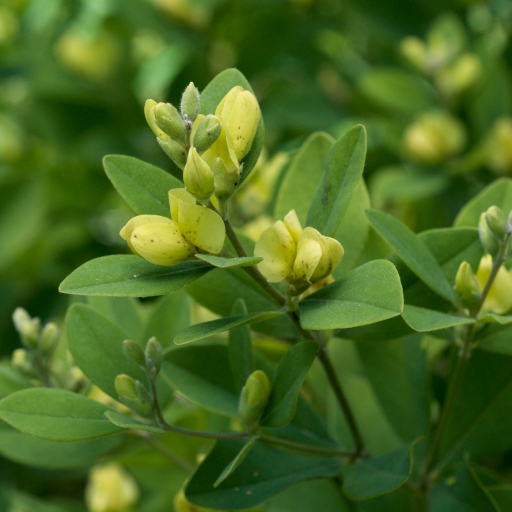
Plant Overview
Often called Nuttall's Wild Indigo, this sun-loving perennial is a hardy staple of the North American coastal plains and prairies. Despite the "Indigo" name, its blooms are a sunny yellow rather than blue, brightening up wild grasslands from Texas to Arkansas. It is a tough, structural plant that tells a story of survival and soil enrichment in the wild American landscape.
🔍 How to Identify
- 🌿 Leaf Shape: It features classic "trifoliate" leaves—meaning each leaf is divided into three distinct leaflets, much like a large, matte-green clover.
- 🌼 Flowering Style: Unlike some of its cousins that grow flowers on long, vertical spikes, Nuttall’s produces yellow, pea-like blossoms that emerge directly from the leaf axils along the stems.
- 🌳 Growth Habit: It forms a sturdy, rounded, shrub-like mound. As the season progresses, the stems become somewhat woody, giving it a very bushy and full appearance.
🏡 In Your Garden
- 🏜️ The Taproot Secret: This plant is a "one-and-done" grower. It develops a deep, woody taproot that allows it to survive intense droughts, but this also means it hates being moved. Choose its home carefully, as transplanting an established Nuttall's Wild Indigo usually results in failure.
- 🧪 Self-Fertilizing: As a member of the legume family, it has a symbiotic relationship with soil bacteria to "fix" nitrogen. It literally pulls nitrogen from the air and puts it into the ground, improving the soil quality for its neighbors.
- 🦋 A Caterpillar Nursery: It is a critical host plant for several rare butterflies, including the Frosted Elfin. Expect to see some "nibbles" on the leaves—this is a sign your garden is supporting local wildlife!
⚠️ Safety & Toxicity
- 🚫 Status: Toxic if ingested.
- 🐾 Details: The plant contains quinolizidine alkaloids, which serve as a natural defense against herbivores. It is toxic to cattle, horses, and household pets. While the bitter taste usually prevents animals from eating much of it, ingestion can cause nausea, vomiting, and abdominal pain.
✨ Fun Fact
🎨 The "Fake" Dye: Early pioneers used species of Baptisia as a more affordable substitute for true Indigo (Indigofera tinctoria) to dye their clothes. While Nuttall's yellow flowers weren't as prized as the blue varieties, the plant still contains small amounts of the compounds that turn a dark, inky color when the plant decays!

Detailed Care Instructions
Growing Baptisia nuttalliana, commonly known as Nuttall's wild indigo, can be a rewarding addition to your garden or landscape, as it is a hardy perennial plant with attractive foliage and flowers. Here are the steps to successfully grow and care for Baptisia nuttalliana:
1. Choose the Right Location
- Sunlight: Baptisia nuttalliana thrives in full sun to partial shade, although it performs best with at least 6 hours of direct sunlight per day.
- Soil Requirements: It prefers well-drained soil and can tolerate a variety of soil types, including sandy or rocky soils. While it can manage poor soil conditions, it performs best in fertile, loamy soils.
2. Planting
- Timing: Plant seeds or young plants in the spring or early fall.
- Seed Preparation: If you are starting from seeds, they benefit from scarification (scratching the seed surface) and stratification (chilling period) to improve germination rates. Soak seeds in warm water for 12-24 hours and then stratify in a refrigerator for 4-6 weeks.
- Planting Seeds: Sow seeds directly in the garden, spacing them about 18-24 inches apart. Cover them lightly with soil. Keep the soil moist until seedlings emerge.
- Transplanting: If using nursery plants, dig a hole twice the size of the root ball, place the plant in the hole, and backfill with soil. Water thoroughly after planting.
3. Watering
- Initial Watering: Keep the soil consistently moist during the first growing season to establish strong roots.
- Established Plants: Once established, Baptisia nuttalliana is quite drought-tolerant. Water during prolonged dry spells but avoid overwatering as it prefers slightly dry conditions once established.
4. Mulching
- Mulching: Apply a 2-3 inch layer of organic mulch around the base of the plant to retain moisture, regulate soil temperature, and suppress weeds.
5. Fertilizing
- Baptisia nuttalliana generally does not require much fertilization. You can incorporate some compost or a balanced, slow-release fertilizer in the planting hole. Over-fertilization can lead to weak stems and leggy growth.
6. Pruning and Maintenance
- Pruning: Cut back old stems in late fall or early spring to clean up the garden area.
- Support: Some species of Baptisia can benefit from staking as they can get quite tall and may flop over, although Baptisia nuttalliana typically remains more upright.
7. Pests and Diseases
- Baptisia nuttalliana is resistant to most pests and diseases. Occasionally, you may encounter problems with slugs, snails, or fungal issues, but these are generally minimal.
8. Propagation
- Seed Collection: Seeds can be collected from the pods that form after flowering. Allow the pods to dry on the plant, then harvest and store in a cool, dry place.
- Division: Mature plants can be divided in early spring or fall, though due to the deep taproot, division should be done carefully and is often challenging.
9. Patience
- Be patient! Baptisia species often take a couple of years to become well-established and may be slow to reach their full potential size and flowering capacity. However, they are long-lived perennials and worth the wait.
By following these guidelines, you can successfully grow Baptisia nuttalliana and enjoy its beautiful blue-green foliage and attractive flowers.

Place in a bright room that is sun drenched almost all day. Or directly in a south-facing window.

To properly water this plant, first check the soil around the base of the plant to ensure that it is dry to the touch. Then, slowly pour water around the base of the plant, taking care not to get water on the leaves or flowers. Water deeply until the soil is thoroughly moistened but not waterlogged. It is important to avoid letting the soil dry out completely between waterings, as this can stress the plant and lead to wilting or other problems. However, overwatering should also be avoided, as it can cause root rot and other issues. A good rule of thumb is to water the plant deeply once a week, or more frequently during periods of hot, dry weather.
Baptisia Nuttalliana, known for its beautiful blue flowers, is a hardy perennial that generally requires minimal fertilization. Here are some fertilizing instructions for this plant:
- Soil Preparation: Before planting, enrich the soil with well-composted organic matter. This will provide a good nutrient base for the plant.
- Initial Planting: At the time of planting, you can mix a balanced, slow-release fertilizer into the soil. Opt for a formula like 10-10-10 (nitrogen-phosphorus-potassium) to provide even nutrients.
- Spring Feeding: As the plant begins to show new growth in the spring, apply a balanced, slow-release fertilizer once more. Again, a 10-10-10 formulation works well. Follow the manufacturer's instructions for the application rate.
- Mid-Season Boost (Optional): If you think your plant needs a mid-season nutrient boost (typically in early summer), you can apply a light feeding of a balanced, water-soluble fertilizer. Avoid over-fertilizing, as this plant does not generally require heavy feeding.
- Mulching: Apply a layer of organic mulch around the base of the plant to help retain moisture and slowly provide nutrients as it decomposes. Mulch also helps to keep weeds at bay.
- Avoid Excess Nitrogen: While some nitrogen is beneficial, excessive amounts can lead to leggy growth and fewer blooms. Stick with balanced fertilizers and avoid high-nitrogen formulations.
- Soil Testing: If you're unsure about your soil's nutrient levels, consider getting a soil test. This will give you a clearer idea of what nutrients may be lacking and can help you adjust your fertilizing routine accordingly.
By following these guidelines, you can help ensure that Baptisia Nuttalliana thrives and produces its striking displays.
Baptisia Nuttalliana is a perennial plant that requires well-draining soil with a pH level between 6.0-7.5. The ideal soil should be loamy with a mixture of sand, silt, and clay to provide proper nutrition and moisture retention for the plant. Adding organic matter in the form of compost, aged manure, or peat can improve soil structure and fertility. It is important to avoid heavy clay or waterlogged soil as this can lead to root rot, and overly rich soil as this can cause excessive foliage growth at the expense of flower production. The plant prefers full sun to partial shade and can tolerate drought conditions once established, but regular watering is necessary during the first year of growth. The use of a balanced fertilizer in spring and early summer can ensure healthy growth and blooming of the plant.
Propagating Baptisia nuttalliana (Nuttall's wild indigo) can be achieved through seeds or division. Here’s a detailed guide for both methods:
Propagation by Seeds
Seed Collection and Preparation:
- Timing: Collect seeds in late summer to early fall when the seed pods have matured and turned dark brown.
- Collection: Gently harvest the pods from the plant.
- Cleaning: Open the pods and extract the seeds. Clean off any remaining pod material.
- Storage: If not planting immediately, store seeds in a cool, dry place in an airtight container.
Seed Germination:
- Scarification: Baptisia nuttalliana seeds have a hard coat. Use a file or sandpaper to gently nick or roughen the seed coat. Alternatively, soak the seeds in hot water for 24 hours to soften the coat.
- Sowing:
- Timing: Sow the seeds in early spring.
- Medium: Use a seed starting mix or well-draining soil.
- Depth: Plant the seeds about 1/4 inch deep.
- Timing: Sow the seeds in early spring.
- Environment:
- Light: Place the seeds in a bright, indirect light location.
- Moisture: Keep the soil consistently moist but not waterlogged.
- Light: Place the seeds in a bright, indirect light location.
- Germination Time: Seeds usually germinate in 2-4 weeks.
Propagation by Division
Timing:
- Best performed in early spring before new growth starts or in the fall after the plant has gone dormant.
Steps:
- Digging Up:
- Carefully dig up the entire plant, ensuring you get a generous portion of the root system.
- Carefully dig up the entire plant, ensuring you get a generous portion of the root system.
- Dividing:
- Use a sharp, clean knife or spade to divide the root mass into sections. Each section should have multiple shoots and a substantial portion of roots.
- Use a sharp, clean knife or spade to divide the root mass into sections. Each section should have multiple shoots and a substantial portion of roots.
- Replanting:
- Immediately replant each division in a prepared garden bed or container at the same depth it was growing before.
- Space divisions 2-3 feet apart to allow for mature growth.
- Immediately replant each division in a prepared garden bed or container at the same depth it was growing before.
- Watering:
- Water the newly planted divisions thoroughly.
- Maintain consistent moisture until the plants are well established, after which they are relatively drought-tolerant.
Site Preparation and Care:
- Water the newly planted divisions thoroughly.
- Soil: Well-draining soil is essential. Sandy or loamy soil types are particularly suitable.
- Sunlight: Full sun to partial shade ensures optimal growth.
- Watering: Once established, Baptisia nuttalliana is drought-tolerant and requires minimal watering.
- Fertilization: Generally, no additional fertilization is needed, as this plant prefers poor to moderately fertile soil conditions.
By following these steps, you can successfully propagate Baptisia nuttalliana through seeds or division, expanding your collection or creating a new planting area in your garden.








