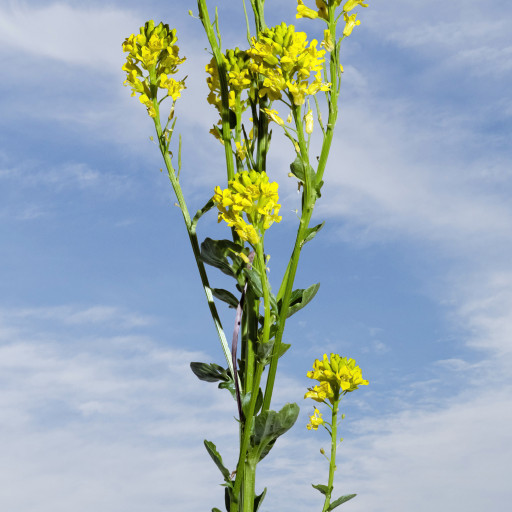
Plant Overview
Commonly known as Yellow Rocket or Herb Barbara, Barbarea vulgaris is the sun-soaked herald of early spring. It earned its name from Saint Barbara, the patron saint of winter’s hardships, because the plant’s hardy green leaves often persist even under a blanket of snow. While many gardeners view it as a persistent weed, it is actually a resilient wild mustard that provides one of the very first splashes of color to the waking landscape.
🔍 How to Identify
- 🌼 Golden Blooms: It features dense clusters of small, bright yellow flowers, each with four petals arranged in a cross shape (characteristic of the mustard family).
- 🌿 Glossy Foliage: The leaves are dark green, shiny, and deeply lobed. The basal leaves have a large, rounded terminal lobe that looks almost like a violin or a lyre.
- 📐 Angled Stems: The plant grows from a low rosette into an upright, branched stalk that is often ribbed or slightly angular to the touch.
🏡 In Your Garden
- 🌱 The Early Bird: Yellow Rocket is a biennial, meaning it spends its first year as a low-growing cluster of leaves and its second year exploding into a golden tower of flowers.
- 🦋 Pollinator Magnet: Because it blooms so early (often while other plants are still dormant), it is a vital nectar source for honeybees and the "Small White" butterfly.
- 🚜 Soil Indicator: It thrives in moist, nitrogen-rich disturbed soil. If you find it popping up in your garden, it’s a sign that your soil is fertile but perhaps a bit compacted.
⚠️ Safety & Toxicity
- 🍽️ Edibility: The young, pre-bloom leaves are edible and packed with Vitamin C, tasting much like spicy watercress. However, they become extremely bitter and tough once the yellow flowers appear.
- 🐾 Pet Safety: It is generally considered non-toxic to dogs and cats, though the high oxalate content and mustard oils can cause mild stomach upset if they graze on it excessively.
- 🧤 Garden Care: Some sensitive individuals may experience mild skin redness after handling the crushed stems, so gloves are recommended if you are clearing a large patch.
✨ Fun Fact
In the Middle Ages, Yellow Rocket was known as the "Greens of the Winter" because it was one of the only reliable sources of fresh vitamins available to peasants during the "hungry gap" between winter storage and the first spring harvest.

Detailed Care Instructions
| Color | Green |
| Soil Ph | 5.5-8.0 |
| Invasive | Weed |
| Lighting | Full Sun |
| Toxicity | Non-Toxic |
| Soil Type | Well-Draining, Chalky, Sandy, Loamy, Clay |
| Bloom Time | Spring, Summer |
| Plant Type | Biennial |
| Mature Size | Up To 3 Feet Tall |
| Native Area | Europe, Asia |
| Sun Exposure | Partial To Full Shade |
| Hardiness Zones | 5-9 |
To successfully grow Barbarea Vulgaris, also known as wintercress or yellow rocket, you will need to follow these steps:
- Choose the location: Select a spot that receives partial shade to full sun. Barbarea Vulgaris prefers moist, well-draining soil.
- Prepare the soil: Loosen the soil using a garden fork or tiller and remove any weeds or debris. Incorporate organic matter such as compost or well-rotted manure to improve soil fertility.
- Sowing: Scatter the seeds over the prepared soil surface, aiming for a density of about 10-15 seeds per square inch. Lightly press the seeds into the soil, ensuring good seed-to-soil contact.
- Watering: After sowing, water the seeds gently but thoroughly. Maintain soil moisture by regular watering, especially during dry periods. Avoid overwatering, as this can lead to fungal diseases.
- Mulching: Apply a layer of organic mulch, such as straw or wood chips, to conserve moisture, suppress weed growth, and protect the young seedlings.
- Maintenance: Weed the area regularly to prevent competition for nutrients and space. Remove any undesirable weeds that may grow around the Barbarea Vulgaris plants.
- Harvesting: Barbarea Vulgaris leaves can be harvested once they reach a suitable size, usually around 8-10 weeks after sowing. Use scissors or pinch off the leaves, leaving some foliage behind for continued growth.
- Pests and diseases: Monitor the plants for common garden pests such as aphids, slugs, and caterpillars. Apply organic pest control methods, such as handpicking or using insecticidal soap, if necessary. Also, watch out for fungal diseases such as powdery mildew, and treat as needed.
By following these steps and maintaining good care, you can successfully grow Barbarea Vulgaris in your garden.

Place in a window with dappled sun or a spot in the middle of a room. Or directly in a window facing west or east.

To water this plant, it is important to first evaluate the soil moisture level by inserting a finger into the soil up to the second knuckle. If the soil feels dry, it is time to water. It is recommended to water deeply and infrequently, ensuring that the water reaches the plant's roots. Overwatering can cause root rot and other plant diseases, so it's best to avoid watering too frequently. It's also important to avoid getting water on the leaves, as wet leaves can encourage fungal growth. The best time to water is early in the morning or late in the evening, as these times allow water to be absorbed into the soil without evaporating quickly.
To fertilize Barbarea Vulgaris, apply a balanced, all-purpose fertilizer once every two weeks during the growing season. Dilute the fertilizer according to instructions on the packaging, and apply it directly to the soil around the base of the plant, avoiding contact with the foliage. Water thoroughly after fertilizing to help distribute the nutrients. Avoid over-fertilizing, as this can cause excessive growth and weaken the plant.
Barbarea Vulgaris prefers a well-draining soil that is rich in nutrients and organic matter. The soil should have a pH range of 6.0-7.5. A mix of loamy soil, compost, and sand can be a good option.
It is important to make sure that the soil is not compacted and allows for proper root development. Adding perlite or vermiculite can help improve drainage and aeration.
The plant also benefits from regular fertilization throughout the growing season. Using a balanced fertilizer with equal amounts of nitrogen, phosphorus, and potassium can be helpful. Applying organic compost or manure can also provide a natural source of nutrients.
Watering the plant regularly but not excessively is also important. It is best to allow the soil to dry out slightly between watering to prevent root rot.
Barbarea Vulgaris can be propagated through plant cuttings or by collecting and planting seeds. To propagate through cuttings, select a healthy stem from the parent plant, approximately 4-6 inches in length, and cut it at a 45-degree angle. Remove any leaves from the lower half of the stem and dip the cut end into rooting hormone. Plant the cutting in a container filled with moist soil and keep the soil damp. The cutting should develop roots in approximately 2-4 weeks.
To propagate through seeds, wait until the plant has finished blooming and the seed pods have formed. Collect the seeds by cutting the pods from the plant and drying them out. Once the pods have completely dried, remove the seeds and store them in a cool, dry place until ready to plant. Plant the seeds in a row or in individual pots filled with potting soil, and keep the soil moist until the seeds germinate. The seeds should germinate within 1-2 weeks.








