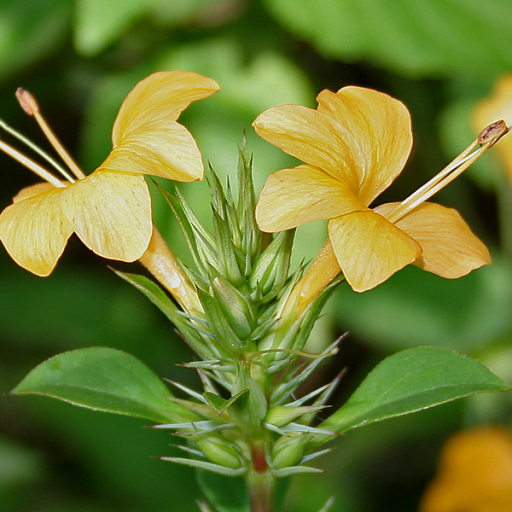
Plant Overview
Known commonly as the "Porcupine Flower" or "Yellow Hedgehog," Barleria prionitis is a sturdy, prickly shrub that has earned a place in history for both its golden blooms and its healing properties. In India, it is famously celebrated as Vajradanti, which translates to "diamond teeth," referencing its ancient use in strengthening gums and dental health. It is as tough as it is beautiful, often found thriving where other plants struggle.
🔍 How to Identify
- 🌼 The Flowers: Look for bright, funnel-shaped blossoms that range from golden yellow to a deep apricot. They typically emerge from the leaf axils in a crowded spike.
- ⚔️ The Spines: True to its "Porcupine" nickname, this plant features sharp, slender spines (usually three to four) located at the base of the leaves.
- 🍃 The Foliage: The leaves are oval-shaped with pointed tips, appearing in opposite pairs along the stem, often displaying a rich, glossy green.
🏡 In Your Garden
- 🛡️ Natural Security: Because of its dense growth habit and formidable thorns, this plant is frequently used as a "living fence" or hedge to keep unwanted visitors (or animals) out of specific garden areas.
- ☀️ Drought Warrior: This species is incredibly hardy; it prefers well-draining soil and can handle intense sunlight and periods of neglect, making it ideal for xeriscaping or rock gardens.
⚠️ Safety & Toxicity
- 🌵 Physical Hazard: While not known for systemic chemical toxicity to humans, the spines are very sharp and can cause painful puncture wounds if handled without gloves.
- 🐾 Pet Safety: It is generally considered non-toxic if nibbled, but the primary danger to pets and children is the physical risk of the thorns. Avoid planting it near high-traffic walkways or play areas.
✨ Fun Fact
In many traditional cultures, the juice of the leaves is mixed with honey and used as a remedy for coughs, while the ash of the burnt plant is used in homemade toothpowders to treat toothaches!

Detailed Care Instructions
To grow Barleria Prionitis, also known as the Vajradanti or Toothbrush Plant, follow these steps:
- Climate: Barleria Prionitis plants thrive in warm tropical climates. Ensure that the temperature remains between 75-85°F (24-29°C) all year round. They need plenty of sunlight, so choose a sunny spot in your garden or indoors near a window.
- Soil: The plant prefers well-draining soil. Use a mixture of garden soil, sand, and organic matter to create a loose and fertile soil. This will allow proper water drainage to prevent root rot.
- Watering: Water the plant regularly, especially during the growing season (spring and summer). Keep the soil evenly moist, but avoid overwatering, as it may lead to fungal diseases. Reduce watering during colder months, but never let the soil completely dry out.
- Fertilizer: Apply a balanced, slow-release fertilizer during the growing season to promote healthy growth. Follow the package instructions for the appropriate amount and frequency.
- Pruning: Prune the plant regularly to maintain its shape and encourage bushier growth. Trim back any dead or diseased branches, and pinch off the tips to promote more compact growth.
- Repotting: If growing indoors, consider repotting the plant every 1-2 years to provide fresh soil and promote healthy root growth. Choose a slightly larger pot and ensure good drainage.
- Propagation: Barleria Prionitis can be propagated from stem cuttings. Take a 4-6 inch long cutting from the tip of a healthy stem, remove the lower leaves, and plant it in a pot filled with moist, well-draining soil. Keep the soil consistently moist until the cutting takes root.
- Pests and diseases: Keep an eye out for common pests like aphids, mealybugs, and spider mites. Use appropriate insecticidal soap or organic pesticides to control infestations. Avoid overwatering to prevent root rot and fungal diseases.
Remember, each plant has its unique requirements, so it's crucial to research and understand the specific needs of your Barleria Prionitis plant to ensure its optimal growth and health.

Place in a bright room that is sun drenched almost all day. Or directly in a south-facing window.

Barleria Prionitis plant prefers to be watered evenly and moderately. The soil should be kept moist but not waterlogged. It is important to avoid overwatering as it can cause root rot. It is recommended to allow the topsoil to dry out slightly before watering the plant again. The frequency of watering may vary depending on the temperature, humidity, and sunlight conditions. It is also important to avoid watering the leaves and focus on watering the base of the plant to prevent fungal growth and disease. Finally, it is best to use room temperature water to avoid shocking the plant.
To fertilize this plant, apply a balanced, slow-release fertilizer during the growing season. Follow the manufacturer's instructions for application rates and frequency. It is important not to over-fertilize, as this can harm the plant. Water the plant thoroughly after fertilizing to help distribute the nutrients.
Barleria Prionitis plant requires well-draining soil that is rich in nutrients. The pH level of the soil should be slightly acidic to neutral (between 6.0 and 7.5). It thrives in sandy loam soil with adequate drainage and ample organic matter. It is essential to avoid heavy soil that retains water as it may lead to root rot. The ideal soil for this plant is the one that drains fast but still holds enough moisture for the roots to absorb. Adding organic matter to the soil enhances nutrient retention and improves the soil structure. The soil should be well-aerated to facilitate proper root development and growth. Regular use of organic fertilizers helps in promoting healthy growth and blooming of this plant.
Barleria Prionitis plant can be propagated through stem cuttings. Select a healthy stem and cut it near the base with a sharp, sterile knife. Ensure that the cutting is at least 3-4 inches long and has 2-3 nodes. Remove the leaves from the lower half of the stem and dip the cut end in rooting hormone powder. Plant the cutting in a well-draining soil mix and water it well. Keep the soil moist and place the cutting in a warm, bright area but away from direct sunlight. It should take 2-3 weeks for the roots to develop. Once the roots have established, the cutting can be transplanted to a larger pot or directly into the ground.








