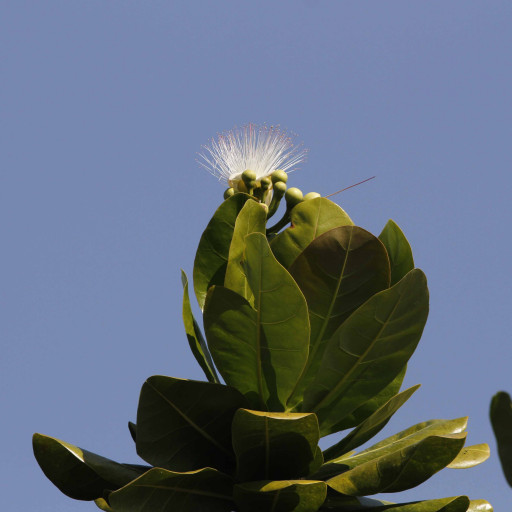
Plant Overview
Commonly known as the Fish Poison Tree or Sea Poison Tree, this majestic coastal giant is famous for its stunning, nocturnal "firework" flowers. Native to the sandy shores of the Indian and Pacific Oceans, it acts as a natural guardian of the coastline, often seen leaning gracefully over turquoise waters. In many island cultures, its floating, box-shaped fruits are as iconic and recognizable as the coconut.
🔍 How to Identify
- 🍃 Large Glossy Leaves: It features oversized, teardrop-shaped leaves that have a thick, leathery texture and a waxy shine designed to resist salty sea breezes.
- 🌸 Pom-Pom Blooms: The flowers are spectacular bursts of hundreds of white and pink filaments, resembling a delicate fiber-optic lamp or a sea anemone.
- 📦 Boxy Fruit: The fruit is remarkably unique—a green-to-brown, four-angled, lantern-shaped "box" that is incredibly buoyant and can float across entire oceans.
🏡 In Your Garden
- 🏝️ Coastal Specialist: Since it naturally grows in sandy, saline environments, it is incredibly salt-tolerant and wind-resistant, making it an elite choice for seaside landscaping or tropical themes.
- 🌕 Nighttime Magic: The flowers open only at night to attract pollinators like moths and nectar-feeding bats; by dawn, the ground is often carpeted with the beautiful fallen pink-tipped filaments.
- 🌱 Slow and Steady: While it can eventually become a massive shade tree, it grows slowly and requires deep, well-draining soil to accommodate its expanding root system.
⚠️ Safety & Toxicity
- 🛑 Toxic Seeds: The seeds and bark contain potent saponins. While historically used by indigenous cultures to "stun" fish for easy catching, they are dangerous if consumed by humans.
- 🐾 Pet Warning: Keep curious dogs or cats away from the fallen fruits; ingestion of the seeds can cause severe gastrointestinal distress and heart-related complications.
✨ Fun Fact
🕯️ Because the flowers drop so quickly after sunrise, they are often called "One-Night Wonders." In the past, the buoyant, boxy fruits were even used by fishermen as natural floats for their fishing nets!

Detailed Care Instructions
| Humidity | Normal |
| Lighting | Part Sun |
| Toxicity | Poisonous |
| Difficulty | Medium |
| Temperature | 18°C - 30°C |
| Hardiness Zones | 11 - 12 |
To grow a Barringtonia Asiatica plant, you can follow these steps:
- Obtain Seeds or Seedlings: You can purchase Barringtonia Asiatica seeds or young seedlings from a local nursery or online. Alternatively, you can collect seeds from mature fruits of a Barringtonia Asiatica tree.
- Choose the Right Location: Barringtonia Asiatica plants thrive in tropical or subtropical climates. Select a location that receives plenty of direct sunlight, as well as some shade during the hottest parts of the day. Avoid areas prone to strong winds.
- Prepare the Soil: Barringtonia Asiatica prefers well-draining soil. You can use a mix of compost, peat moss, and sand to improve the drainage. If the soil is clayey, add some perlite or sand to enhance aeration.
- Planting from Seeds: If planting from seeds, fill seed trays or small pots with the prepared soil mix. Press the seeds gently into the soil, about half an inch deep. Water the seeds lightly.
- Planting Seedlings: When using seedlings, dig a hole that is slightly larger than the root ball of the seedling. Place the seedling in the hole and backfill with soil, gently firming it around the roots. Water the seedling thoroughly.
- Watering: Barringtonia Asiatica plants prefer moderately moist soil. Avoid overwatering, as it can lead to root rot. Water the plant when the top inch of soil feels dry, ensuring the water reaches the root zone.
- Fertilizing: Feed the plant with a balanced, slow-release fertilizer in spring and summer. Follow the manufacturer's instructions for dosage. Alternatively, you can use organic fertilizers like compost or well-rotted manure.
- Pruning: Prune the plant regularly to maintain its shape and promote branching. Remove any dead or damaged branches. This will also help increase air circulation and light penetration.
- Protection from Cold: If you live in a region where the temperature drops below 50°F (10°C), provide protection to the plant. Move it indoors or cover it with a frost cloth during winter.
- Pest and Disease Control: Barringtonia Asiatica plants are generally resilient to pests and diseases. However, keep an eye out for common garden pests like aphids, mealybugs, and scales. Treat them with organic insecticides if necessary.
- Patience and Care: Growing Barringtonia Asiatica from seeds or young seedlings may take time before they become established trees. Be patient and provide consistent care by watering, fertilizing, and protecting them from harsh conditions.
Remember to research any specific requirements or considerations for growing Barringtonia Asiatica in your particular region, as climatic conditions can vary.

Place in a bright room that is sun drenched almost all day. Or directly in a south-facing window.

To water this plant, thoroughly soak the soil until water runs out of the drainage holes at the bottom of the container. Allow the soil to dry out slightly before watering again to prevent overwatering. Water less frequently during the winter months when the plant is in a dormant state. Use room temperature water and avoid getting water on the leaves to prevent damage or disease.
To fertilize this plant, use a slow-release fertilizer during the growing season. Apply the fertilizer evenly around the base of the plant, avoiding direct contact with the stem. Water the plant thoroughly after fertilizing to allow the nutrients to reach the roots. Avoid over-fertilizing, as this can lead to fertilizer burn and cause damage to the plant. Adjust the frequency and amount of fertilizer application based on the plant's growth and the quality of the soil.
For optimal growth and health, the ideal soil for this plant should be loamy, well-draining, and nutrient-rich. It should have a slightly acidic to neutral pH level, with a range of 6.0-7.5. The soil should also be able to retain some moisture, without becoming waterlogged or soggy. A good soil mix can be created by combining a high-quality potting mix, coarse sand or perlite to encourage drainage and a slow-release fertilizer to provide essential nutrients. It is important to avoid using heavy, clay soils or soils prone to compaction, as this can inhibit root growth and reduce plant health. Regular watering, maintenance of drainage, and fertilization will help ensure the success of this plant.
To propagate this plant, first obtain a mature and healthy specimen that is at least two years old and has a healthy root system. Take softwood or semi-ripe cuttings of about 6-8 inches in length during the growing season, which is generally during the summer months. Remove the leaves from the lower half of the cutting, dip the cut end into rooting hormone powder, and stick it into moist rooting medium. Cover the container with a plastic bag and place it in a warm, bright location. Keep the rooting medium moist but not wet, and remove the plastic bag once the cutting has developed roots. Transplant the new plant into a larger container or a well-prepared planting spot in the garden, and water frequently until it is fully established.








