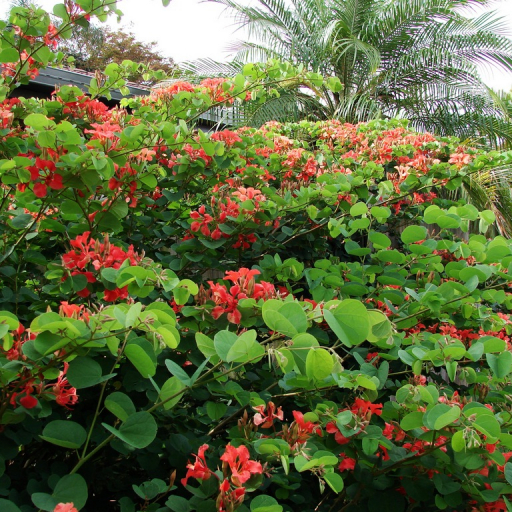
Plant Overview
Often called the "Pride of De Kaap," this South African native is a show-stopper that brings the warmth of a sunset into your backyard. Unlike typical upright trees, this Bauhinia is a "scrambler"—a vigorous, semi-climbing shrub that uses its long branches to drape over fences or neighboring trees. It is beloved by gardeners for its long blooming season and its ability to attract a parade of colorful butterflies.
🔍 How to Identify
- 🍃 The Butterfly Leaf: The foliage is iconic, featuring two rounded lobes joined at the base, closely resembling a butterfly's wings or an ox’s hoof.
- 🌸 Nasturtium-like Blooms: The flowers are a striking brick-red to burnt orange. They have five distinct, spoon-shaped petals that look remarkably like nasturtiums scattered across the bush.
- 🌿 Sprawling Habit: It doesn't grow straight up; instead, it sends out long, flexible "arms" that can spread up to 15 feet if left unpruned.
🏡 In Your Garden
- ✂️ A Shrub with Ambition: Because of its scrambling nature, this plant needs "tough love" with pruning. If you want a neat hedge, you’ll need to trim it regularly; otherwise, let it sprawl over a sturdy pergola for a dramatic floral canopy.
- ☀️ Sun-Seeker: While it can survive in light shade, it is a true sun-worshiper. Basking in full sunlight is the secret to getting the most intense orange pigment in its flowers and a denser leaf structure.
- 🦋 Pollinator Magnet: In the garden, it acts as a bustling airport for wildlife. It is a primary nectar source for several species of butterflies and attracts insect-eating birds who come for the visitors the flowers draw in.
⚠️ Safety & Toxicity
- 🟢 Non-Toxic: Bauhinia galpinii is generally considered safe and non-toxic for humans, dogs, and cats.
- 🌱 Seed Pod Caution: While not poisonous, the woody seed pods that form after flowering are very hard. They can be a minor choking hazard for curious puppies or toddlers if they try to chew on the dried husks found on the ground.
✨ Fun Fact
The Bauhinia genus is named after the Bauhin brothers, two famous 16th-century Swiss botanists. The "twin-lobed" leaves were chosen to represent the two brothers working together in science—two halves of a single whole!

Detailed Care Instructions
To grow Bauhinia galpinii (Pride of De Kaap) plant, follow these steps:
- Climate and light: This plant thrives in warm climates and requires full sun exposure. Therefore, choose a sunny spot in your garden to plant it.
- Soil: Use well-draining soil with a pH range of 6 to 7. If your soil is heavy clay, amend it with organic matter such as compost or peat moss to improve the drainage.
- Planting method: Dig a hole that is twice the size of the root ball of the Bauhinia galpinii plant. Place the plant in the hole, making sure the top of the root ball is level with the soil surface. Backfill the hole with soil, gently firming it around the plant.
- Watering: Water the plant thoroughly immediately after planting to settle the soil and help the roots establish. After that, water the plant regularly, especially during dry spells. However, be cautious not to overwater, as excessive moisture can cause root rot.
- Mulching: Apply a layer of organic mulch around the plant, such as wood chips or shredded bark. Mulching helps retain moisture, suppresses weed growth, and keeps the soil temperature stable.
- Pruning: Bauhinia galpinii responds well to pruning. Prune it in early spring or after flowering to shape the plant and remove any dead or damaged branches. Pruning also encourages the growth of new branches and enhances blooming.
- Fertilizing: Feed the plant with a balanced slow-release fertilizer in spring and summer according to package instructions. This will provide the necessary nutrients for healthy growth and blooming.
- Pests and diseases: Bauhinia galpinii is generally resistant to pests and diseases. However, keep an eye out for common garden pests such as aphids or whiteflies. If you notice any infestations, treat them with insecticidal soap or neem oil.
- Propagation: You can propagate Bauhinia galpinii from seeds or through softwood cuttings. Collect mature seeds and sow them in a well-draining potting mixture. Softwood cuttings can be taken in spring or early summer and should be treated with a rooting hormone before planting.
With proper care, Bauhinia galpinii should grow into a stunning flowering plant with its vibrant orange-red blossoms. Enjoy its beauty and the wildlife it attracts to your garden!

Place in a bright room that is sun drenched almost all day. Or directly in a south-facing window.

To properly water this plant, first check the soil moisture level by inserting a finger or a moisture meter into the soil. If the soil is dry to the touch, it's time to water. Water thoroughly until the water runs out of the drainage holes in the bottom of the pot or seeps into the soil if planted in the ground.
Be careful not to overwater this plant as it is susceptible to root rot. Wait until the soil is dry before watering again. In hot or dry weather, this plant may need more frequent watering.
It is also important to water this plant at the base rather than from above, as wet foliage can lead to fungal diseases. Lastly, avoid getting water on the flowers, as this can cause them to drop prematurely.
To fertilize this plant, begin by selecting a balanced fertilizer with equal parts nitrogen, phosphorus, and potassium. Apply a slow-release granular fertilizer to the soil around the base of the plant, avoiding direct contact with the stem. Water the plant thoroughly after fertilizing to help the nutrients soak into the soil. Fertilize every two to three months during the growing season, decreasing the frequency in the winter months. Be sure not to over-fertilize, as this can cause damage to the plant.
The ideal soil for the plant should be well-draining, fertile and loamy with a neutral pH level. The soil should have a good amount of organic matter like compost, well-rotted manure or leaf- mould to enhance the growth of the plant. It is important to ensure that the soil is not too heavy or too light, as it may either cause waterlogging or excessive drainage. The plant should be grown in a spot that receives adequate sunlight and is sheltered from strong winds. Regular watering and pruning are crucial to maintain the health and appearance of the plant. Additionally, adding a layer of mulch around the base of the plant can help to conserve moisture in the soil and prevent soil erosion.
Bauhinia galpinii can be propagated through stem cuttings, which can be taken from healthy, mature plants. The stem cuttings should be around 4-6 inches long and should have at least three leaves. The lower leaves should be removed, and the cutting should be dipped into rooting hormone to encourage root formation.
The stem cuttings should be planted in a well-draining potting mix and kept in a warm, humid environment with indirect light. It is important to keep the soil moist but not waterlogged, as this can lead to root rot.
After a few weeks, new growth should appear, indicating that the cutting has successfully rooted. Once the roots are established, the new plant can be transplanted into a larger pot or planted directly in a prepared site in the garden.
It is important to note that Bauhinia galpinii is a tropical plant and may not survive in colder climates. It is best grown in USDA zones 9-11.








