Plant Overview
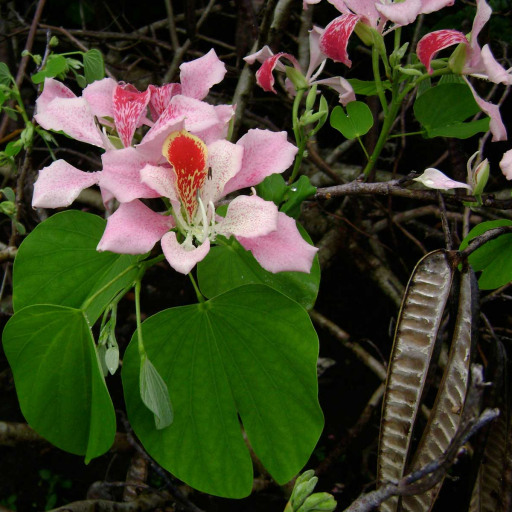
Known as the Pink Orchid Tree or Napoleon’s Plume, this tropical gem is a favorite for those who want the look of exotic orchids on a hardy, fast-growing tree. Originally hailing from Madagascar, it has traveled the world, earning the nickname "Butterfly Tree" because its unique leaves look exactly like the wings of a resting moth or butterfly.
🔍 How to Identify
- 🦋 Butterfly Leaves: The most striking feature is the foliage; each leaf is deeply cleft down the middle, creating two rounded lobes that resemble a cloven hoof or a butterfly.
- 🌸 Orchid-Like Flowers: The blossoms are large and pale pink. If you look closely at the five petals, you’ll notice one "banner" petal is splashed with dramatic dots and streaks of dark purple or red.
- 📏 Single Stamen: Unlike its cousins, Bauhinia monandra typically has only one fertile stamen (the pollen-bearing part), which is why it earned the botanical name "monandra" (meaning "one male").
🏡 In Your Garden
- 🌬️ Wind Sensitivity: While it grows quickly and provides lovely shade, the wood is somewhat brittle. It is best planted in a spot sheltered from heavy winds to prevent the branches from snapping during storms.
- 🍂 Seasonal Habits: In cooler or drier climates, the tree may go "deciduous," dropping its leaves briefly. Don't panic—this is just its way of resting before it puts on a spectacular floral show in the late spring or summer.
- 🌱 Root Awareness: It develops a strong taproot early on, which makes it drought-tolerant but also means it hates being moved. Pick its "forever home" in your garden carefully!
⚠️ Safety & Toxicity
- 🟢 General Status: Bauhinia monandra is generally considered non-toxic to humans and common household pets.
- 🥜 Seed Warning: While not "poisonous" in the traditional sense, the large, flat seed pods that drop in autumn contain hard seeds that can be a choking hazard for small dogs or curious toddlers.
✨ Fun Fact
The genus Bauhinia was named to honor the 16th-century Swiss botanists, the Bauhin brothers. Because the brothers were identical twins who worked together on plants, the two-lobed "twin" leaf of this tree was considered the perfect botanical tribute to their lives!

Detailed Care Instructions
To grow a Bauhinia Monandra plant, follow these steps:
- Obtain seeds or cuttings: You can purchase Bauhinia Monandra seeds or find a local nursery or botanical garden that may have cuttings available.
- Choose a suitable location: Bauhinia Monandra plants require a sunny location with well-drained soil. Ensure the chosen spot receives at least six hours of direct sunlight daily.
- Prepare the soil: The soil should be rich in organic matter and well-draining. If the soil is heavy or clayey, amend it with compost or peat moss to improve drainage.
- Sow seeds or plant the cutting: If you have seeds, sow them directly into the soil at a depth of ¼ inch (0.6 cm). If using cuttings, make a hole in the prepared soil, dip the end of the cutting in rooting hormone, and place it in the hole. Gently firm the soil around the plant.
- Water: After planting the seeds or cuttings, water thoroughly and keep the soil consistently moist, but not waterlogged. Once the plant is established, it will require less frequent watering.
- Mulch: Apply a layer of organic mulch around the base of the plant to help retain moisture, suppress weed growth, and regulate soil temperature.
- Pruning: Bauhinia Monandra plants benefit from light pruning to maintain a compact shape and promote bushier growth. Prune in late winter or early spring before new growth appears.
- Fertilizer: Apply a balanced, slow-release fertilizer in early spring and late summer to provide necessary nutrients for healthy growth.
- Regular maintenance: Monitor the plant for pests or diseases and take appropriate action if needed. Additionally, remove any dead or damaged foliage to maintain plant health.
- Support: If required, provide a trellis or stake to support the growing plant.
The Bauhinia Monandra plant may take some time to establish and grow, but with proper care, it will reward you with its beautiful, orchid-like flowers.

Place in a bright room that is sun drenched almost all day. Or directly in a south-facing window.

Bauhinia Monandra is a tropical plant that requires adequate watering to thrive. To water this plant, you should:
1. Test the soil: Before watering, check the soil moisture level by sticking your finger one inch into the soil. If it feels dry, it's time to water.
2. Water deeply: When watering, make sure to saturate the soil to a depth of at least six inches, ensuring that the roots are well-hydrated.
3. Use room temperature water: Use water that is at room temperature to prevent temperature shock to the plant.
4. Avoid overwatering: Overwatering can cause root rot and other problems. Make sure the soil is slightly moist but not waterlogged.
5. Water frequency: The frequency of watering will depend on the environment and the plant's size. On average, this plant needs to be watered once a week during the growing season.
6. Drainage: Ensure that the container or planting site has adequate drainage to prevent water from pooling at the base of the plant.
7. Adjust water requirements: Adjust watering requirements according to the surrounding environment, temperature, and humidity of the surrounding area and the plant's water-absorbing capacity.
To fertilize this plant, apply a balanced, slow-release fertilizer in early spring, following the recommended dosage on the label. Apply another round of fertilizer in mid-summer to promote healthy growth and flowering. Avoid over-fertilizing, as this can lead to excessive foliage growth and reduce the number of flowers. Water the plant well after fertilizing to ensure that the nutrients are absorbed by the roots.
Bauhinia Monandra is a type of flowering plant that requires well-draining soil that is rich in nutrients. The best soil to use is a mixture of sandy loam and organic matter such as compost or peat moss. The pH level of the soil should be slightly acidic, ideally between 6.0 and 6.5. If the soil is too acidic, lime can be added to raise the pH level. It should be planted in an area with full sun exposure. The soil should be kept moist but not waterlogged. It is important to avoid using soil that is heavily compacted or clay-based, as this can hinder the plant's growth. Amending the soil with fertilizers or other organic materials can also help to promote healthy growth.
Bauhinia Monandra is a plant that can be propagated via cuttings. The first step in propagating the plant is to locate a healthy parent plant. Take a cutting from the parent plant with a sterilized sharp knife or pruning shears. Cut just below a leaf node, where the leaf meets the stem. The cutting should be about 5-6 inches long.
Remove the leaves from the bottom third of the cutting, leaving only a few leaves at the top. Dip the cut end of the stem into rooting hormone, tapping off excess.
Prepare a potting mix with equal parts perlite and peat moss. Moisten the potting mix but do not make it too wet. Insert the cutting into the potting mix and tamp the soil down around it.
Cover the cutting with a clear plastic bag or a plastic dome to create a mini greenhouse environment. This helps to maintain humidity and warmth around the cutting. Place the pot in a warm, bright location but out of direct sunlight.
Ensure that the soil remains moist but not too wet. After a few weeks, check for root development by gently tugging on the cutting. If you feel resistance, then the plant has roots. Gradually increase the amount of light the cutting receives, taking care not to expose it to direct sunlight.
Once roots have developed, remove the plastic bag or dome. Transplant the cutting into a larger pot or into the garden. Wait until the plant has become established before moving it to a permanent location.








