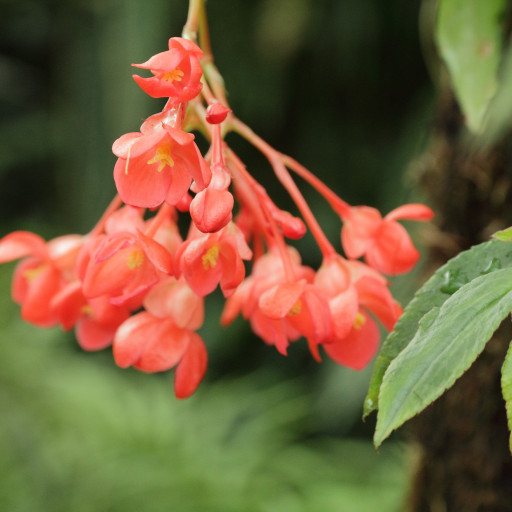
Plant Overview
Known as the Fern Leaf Begonia or Fuchsia Begonia, this Colombian native is a master of disguise. While it is technically a shrubby Begonia, its delicate, arching stems and tiny, tiered leaves create the perfect illusion of a forest fern. It’s a favorite for those who love the "cottagecore" aesthetic but want the charming, dainty blooms that true ferns can't provide.
🔍 How to Identify
- 🌿 The Foliage: Unlike the massive, jagged leaves of other begonias, these are tiny (less than an inch), teardrop-shaped, and glossily dark green. They grow in a flat, pinnate arrangement along the stem.
- 🎋 The Stems: The plant features reddish, succulent-like stems that arch gracefully downward, making it a natural choice for hanging baskets.
- 🌸 The Blooms: Small, drooping white or pale pink flowers hang from the stems, bearing a striking resemblance to bleeding hearts or fuchsia blossoms.
🏡 In Your Garden
- ☁️ Humidity is Key: Because of its thin leaves, this plant is a "humidity hog." It thrives in bathrooms or near humidifiers; if the air gets too dry, it will quickly drop its leaves in protest.
- 💧 Thirsty but Sensitive: It lacks the thick, water-storing rhizomes of other begonias. You’ll need to keep the soil consistently moist, as even a short period of bone-dry soil can lead to crisping and "shattering" of the foliage.
- 🪴 Terrarium Potential: Due to its compact nature and love for moisture, it is one of the best Begonia species for large terrariums or Wardian cases where it can stay lush year-round.
⚠️ Safety & Toxicity
- 🐾 Status: Toxic to pets.
- 🚫 Details: Like most members of the Begoniaceae family, it contains calcium oxalate crystals. If chewed by cats or dogs, it causes intense oral irritation, drooling, and difficulty swallowing. The most toxic parts are underground, but the stems and leaves can still cause significant tummy upset.
✨ Fun Fact
The species name foliosa literally translates to "leafy," which is a bit of an understatement for a plant that produces hundreds of tiny leaves to create its signature feathery, fern-like silhouette!

Detailed Care Instructions
| Humidity | Normal |
| Lighting | Part Sun |
| Difficulty | Medium |
| Temperature | 18°C - 30°C |
| Hardiness Zones | 9B - 11B |
To grow Begonia foliosa plants successfully, follow these steps:
- Choose the right location: Begonia foliosa plants prefer bright, indirect light. Place them near a window where they can receive filtered sunlight or in a spot with bright artificial lighting.
- Select the correct soil: Use a well-draining soil mix that retains some moisture without becoming waterlogged. A mixture of peat moss, perlite, and vermiculite is suitable for Begonia foliosa plants.
- Optimal temperature and humidity: Begonia foliosa plants thrive in temperatures around 65-75°F (18-24°C). They prefer high humidity levels, so mist the leaves regularly or place a humidity tray with water nearby.
- Watering routine: Water your Begonia foliosa plant when the top inch of soil feels slightly dry. Avoid overwatering, as it can lead to root rot. During winter, reduce watering frequency but do not let the plant completely dry out.
- Fertilization: Feed the plant with a balanced, water-soluble fertilizer once a month during the growing season (spring to summer). Follow the package instructions for proper dilution and dosage.
- Pruning and pinching: Regularly pinch off dead or yellowing leaves to maintain the plant's appearance. Prune leggy stems to encourage bushier growth.
- Propagation: Begonia foliosa plants can be propagated from stem cuttings. Take a 3-4 inch stem cutting, remove the lower leaves, dip the cut end in rooting hormone, and place it in a small pot with well-draining soil.
- Pests and diseases: Inspect your plant regularly for pests like aphids or spider mites. If any are found, treat them with insecticidal soap or neem oil. Avoid overwatering to prevent root rot.
By following these guidelines, you can successfully grow and care for Begonia foliosa plants, creating a beautiful and vibrant addition to your indoor garden.

Place in a window with dappled sun or a spot in the middle of a room. Or directly in a window facing west or east.

To properly water this plant, you should first check the soil to see if it has started to dry out. Once the top layer of soil has become slightly dry to the touch, gently water the plant at the base, being careful not to splash water on the leaves.
When watering, be sure to use room temperature or lukewarm water, as cold water can shock the plant's roots. Additionally, avoid overwatering, as this can lead to root rot and other plant health issues.
It is important to note that this plant prefers to be kept consistently moist, but not overly saturated. In very dry environments, it may require more frequent watering to maintain adequate moisture levels.
To properly fertilize this type of plant, use a balanced fertilizer with equal amounts of nitrogen, phosphorus, and potassium during the active growing season. Avoid fertilizing during the dormant period. Dilute the fertilizer according to the package instructions and feed the plant once per month. Water the plant before and after fertilizing to avoid damaging the roots.
The ideal soil for Begonia Foliosa should be well-draining and rich in organic matter. It should be slightly acidic with a pH range of 5.5-6.5. The texture of the soil should be loose and friable to allow proper aeration of the roots. The addition of perlite, sand, or peat moss can also improve the soil texture. The soil should be kept moist, but not waterlogged, as Begonia Foliosa prefers moderate watering. Fertilizer can be added to the soil every 2-4 weeks during the growing season to provide necessary nutrients.
To propagate this plant, you will need a sharp, sterilized knife or scissors, a container filled with fresh potting soil, a clear plastic bag, and rooting hormone (optional).
- Select a healthy stem with a few leaves from the parent plant. The stem should be about 3-4 inches long and have no flowers or buds. Make sure to avoid any diseased or damaged stems.
- Using the sterilized knife or scissors, make a clean cut just below a node (a small bump on the stem where leaves grow from).
- Remove any leaves from the lower half of the stem, leaving only 2-3 leaves at the top.
- If desired, dip the cut end of the stem into rooting hormone powder to encourage root growth.
- Fill the container with fresh potting soil and water lightly.
- Plant the stem in the soil, making sure it is planted deep enough so that the lower nodes are covered with soil.
- Cover the container with a clear plastic bag to create a humid environment.
- Place the container in a bright, indirect light location.
- Check the soil regularly and water as needed to keep the soil moist but not waterlogged.
- In about 2-3 weeks, the stem should develop roots and new growth.
- Once the new plant has grown to a suitable size, it can be transplanted into its own pot with fresh potting soil.
Common pests of the fuchsia begonia include Mealybugs, spider mites, aphids, whiteflies. Make a habit of checking your fuchsia begonia frequently for pests so that any infestations can be caught and managed early.








