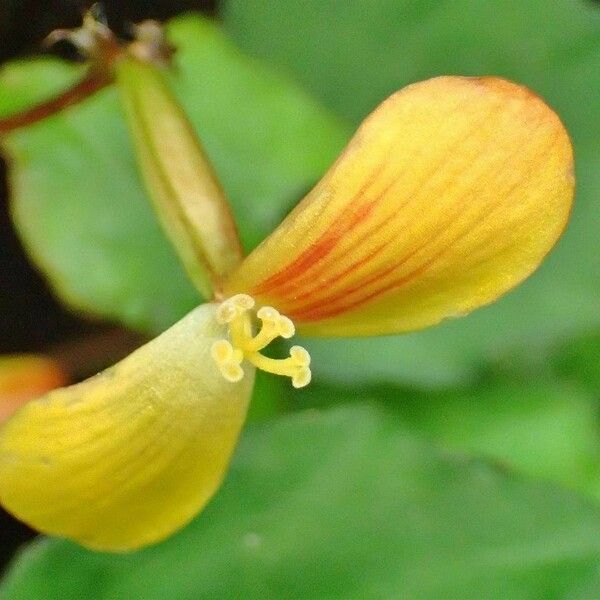
Plant Overview
Often referred to as the "Jewel of Cameroon," Begonia prismatocarpa is a miniature marvel that looks like it belongs in a dollhouse garden. Unlike the massive, showy begonias found in summer flower beds, this tiny species hails from the humid rainforests of West and Central Africa. It is a prized possession for terrarium enthusiasts because of its ability to produce golden-yellow blooms year-round in a compact, creeping form.
🔍 How to Identify
- 🌼 The Golden Blooms: It features small, bright yellow flowers, often tinged with a hint of orange or red at the center. Unlike most begonias that have pink or white petals, these look like tiny glowing lanterns.
- 🍃 Asymmetric Foliage: The leaves are vibrant green, deeply lobed, and stay very small—usually less than an inch or two in length. They have the classic lopsided "begonia shape" but on a micro-scale.
- 🌱 Creeping Habit: This plant grows via a thin, succulent rhizome that crawls along the surface. It forms a dense, lush mat of green rather than growing tall and leggy.
🏡 In Your Garden (Terrarium)
- ☁️ The Humidity Trap: Because it originates from misty tropical forests, this plant struggles in typical home air. It is best grown in a closed terrarium or Wardian case where the humidity stays above 70%, preventing its delicate leaf edges from crisping.
- 💧 Sensitive Roots: While it loves moisture, it hates "wet feet." It thrives when tucked into live sphagnum moss or a very airy, bark-based mix. It is often grown as an epiphyte, meaning it can be mounted directly onto damp wood or rock surfaces.
⚠️ Safety & Toxicity
- 🐾 Toxic to Pets: Like almost all members of the Begonia family, this plant contains calcium oxalate crystals. If ingested by cats or dogs, it can cause oral irritation, drooling, and vomiting.
- 👄 Human Caution: While not usually fatal, the sap can cause a tingling or burning sensation if it comes into contact with sensitive skin or is accidentally tasted by curious children.
✨ Fun Fact
The species name prismatocarpa literally translates to "prism-shaped fruit." If you look closely at the seed pods after the yellow flowers fade, you'll see they have a distinct, three-sided geometric shape that looks like a tiny green crystal!

Detailed Care Instructions
To grow a Begonia Prismatocarpa plant, follow these steps:
- Lighting: Place the plant in a location with bright, indirect sunlight. Avoid placing it in direct sunlight as it can cause leaf burn.
- Temperature: Maintain a temperature range of 60-75°F (15-24°C). Avoid exposing the plant to extreme temperature fluctuations or drafts.
- Watering: Keep the soil consistently moist, but not waterlogged. Water the plant when the top inch of soil feels dry. Use room temperature water and avoid water sitting in the saucer beneath the pot to prevent root rot.
- Humidity: Begonias prefer higher humidity levels. Increase humidity by placing a tray of water near the plant or using a humidifier. Misting the leaves occasionally can also help, but avoid misting directly on the flowers.
- Soil: Use a well-draining, peat-based potting mix. Avoid heavy soils that may retain too much moisture. Adding a small amount of perlite or sand can improve drainage.
- Fertilizer: Feed the plant with a balanced, water-soluble fertilizer every two weeks during the growing season (spring and summer). Dilute the fertilizer to half the recommended strength.
- Pruning: Prune the plant regularly to maintain its shape and remove any dead or damaged leaves and flowers. This encourages new growth and keeps the plant healthy.
- Propagation: Begonias can be propagated from stem cuttings. Take 3-4 inch stem cuttings with a few leaves and insert them into moist potting soil. Keep the soil consistently moist until the cuttings develop roots.
- Pests and diseases: Watch out for pests like mealybugs, aphids, and spider mites. Treat any infestations promptly with insecticidal soap or neem oil. Keep an eye out for common diseases like powdery mildew and botrytis, and address any issues swiftly.
By following these guidelines, you can successfully grow a Begonia Prismatocarpa plant and enjoy its colorful blooms and attractive foliage.

Place in a window with dappled sun or a spot in the middle of a room. Or directly in a window facing west or east.

Begonia Prismatocarpa plants require regular watering to ensure healthy growth and development. It is important to water the plant deeply but infrequently, allowing the soil to dry out slightly between waterings. Over-watering can lead to root rot and may damage the plant.
To water your Begonia Prismatocarpa plant, gently pour water at the base of the plant, avoiding the leaves. Use room temperature water and avoid getting water on the leaves or flowers, as this can lead to fungal diseases. Watering in the morning will allow the plant to absorb water during the day, while evening watering can increase the risk of fungal infection.
Monitor the soil moisture levels regularly and adjust your watering schedule if necessary. The plant may require more frequent watering during hot, dry weather or if it is grown in a low-humidity environment.
It is also important to avoid letting the plant sit in standing water, as this can lead to root suffocation and disease. Ensure that the pot has adequate drainage and remove any excess water from the saucer or tray underneath the pot.
Regular watering, along with proper care and maintenance, will help your Begonia Prismatocarpa plant thrive and produce beautiful foliage and flowers.
- Begin fertilizing when the plant is actively growing in the spring and summer months.
- Use a balanced fertilizer with equal parts nitrogen, phosphorus, and potassium.
- Dilute the fertilizer to half strength before applying to the soil.
- Apply the fertilizer once every two weeks during the growing season.
- Water the plant lightly before and after fertilizing to prevent burning the roots.
- Discontinue fertilizing in the fall and winter months when the plant is dormant.
The Begonia Prismatocarpa plant requires a specific type of soil composition in order to thrive. This type of soil should be well-drained and rich in organic matter. It should also be slightly acidic with a pH range of 5.5 to 6.5. The ideal soil for this plant would be a mixture of peat moss and perlite. Additionally, it is important to avoid using heavy clay soils, as these types of soils can retain too much water and cause root rot. Overall, the soil used for Begonia Prismatocarpa should be loose, well-aerated, and provide good drainage to promote healthy growth.
To propagate this plant, you will need to take stem cuttings during its growing season. Make sure the stem cutting is around 4-6 inches long and has at least two nodes. Remove the leaves from the bottom of the stem, leaving just a few at the top. Dip the bottom end of the stem cutting in rooting hormone and plant it in a moist soil mixture that contains peat moss. Cover the pot with a plastic bag to create a humid environment and place it in a bright, indirect light. Make sure to keep the soil moist but not overly saturated. In a few weeks, you should see roots developing and new growth appearing. Once the new plant has grown, it can be transplanted into its permanent pot or garden bed.
Common pests of the begonia prismatocarpa include Mealybugs, spider mites, aphids, whiteflies. Make a habit of checking your begonia prismatocarpa frequently for pests so that any infestations can be caught and managed early.








