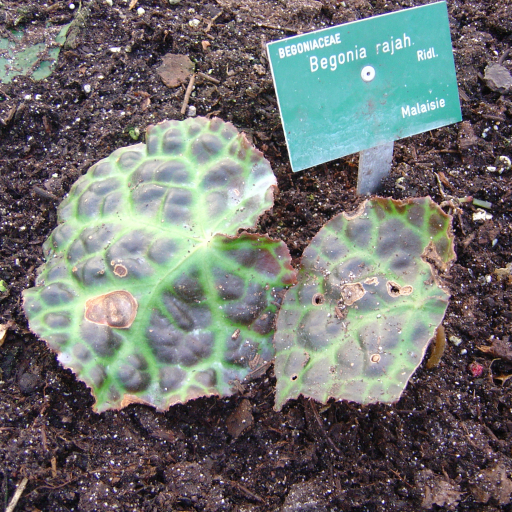
Plant Overview
Known as the "King’s Begonia," this Malaysian treasure was once thought to be extinct in the wild until its rediscovery. It looks like a living piece of stained glass with its deep bronze foliage and neon-green veining. It is a crown jewel for any terrarium enthusiast who loves a plant with a bit of "regal" mystery and high-contrast beauty.
🔍 How to Identify
- 🍃 Exquisite Foliage: The leaves are round to heart-shaped with a dramatic "bullate" (puckered) texture that catches the light.
- 🎨 Stained-Glass Patterning: Deep chocolate-bronze or dark forest-green centers are interrupted by bright lime-green or yellow patches that trace the veins.
- 🌱 Creeping Growth: It is a rhizomatous begonia, meaning it grows horizontally across the soil via thick, fuzzy stems rather than growing upright like a tree.
🏡 In Your Garden
- ☁️ Humidity is Essential: This species is a true rainforest native and a high-humidity diva. It thrives best in a cloche or terrarium because it struggles with dry indoor air, which quickly causes the delicate leaf edges to crisp and turn brown.
- 🪴 Shallow Feet: Because its rhizomes grow along the surface, it prefers wide, shallow pots rather than deep ones. It hates "wet feet," so a chunky, airy mix is vital to prevent the creeping stems from rotting.
⚠️ Safety & Toxicity
- 🐾 Toxic to Pets: Like most Begonias, Begonia rajah contains calcium oxalate crystals.
- 👄 Irritant: If nibbled, it can cause immediate mouth pain, swelling, and drooling in cats and dogs. It is best kept inside a glass cabinet or on a high shelf out of reach of curious paws.
✨ Fun Fact
- 👑 A Lost Legend: For a long time, this plant was only known to exist in botanical gardens and private collections. It was "lost" to science in its native habitat of Terengganu, Malaysia, for decades before being found again in the wild!

Detailed Care Instructions
To grow Begonia Rajah plants, you can follow these steps:
- Choose a suitable location: Begonia Rajah plants prefer bright, indirect sunlight. Find a spot in your home or garden that receives partial shade.
- Prepare the soil: Begonia Rajah plants thrive in well-draining soil. Use a mixture of potting soil, perlite, and peat moss to ensure proper drainage. If you're planting them outdoors, amend the soil with organic matter.
- Planting: If you have a young Begonia Rajah plant, transplant it into a larger pot or container. Make sure the container has drainage holes. Place the plant in the pot, ensuring that the soil level remains the same as the previous container. Gently press down the soil to secure the plant.
- Watering: Begonia Rajah plants prefer consistently moist, but not waterlogged soil. Water the plant thoroughly when the top inch of soil feels dry to the touch. Empty any excess water from the pot's saucer to prevent the roots from rotting.
- Humidity: Begonia Rajah plants appreciate high humidity levels. You can increase humidity by placing a tray of water near the plant, using a humidifier, or misting the leaves regularly.
- Fertilization: Feed your Begonia Rajah plant every month or every other month during the growing season with a balanced, water-soluble fertilizer. Follow the package instructions for dilution rates. Reduce or stop fertilization during the winter months.
- Pruning: Regularly prune your Begonia Rajah plant to encourage a bushier growth habit. Pinch off the tips of the stems to promote branching. Remove any dead or yellowing leaves.
- Propagation: You can propagate Begonia Rajah plants through stem cuttings. Take a healthy stem cutting, remove the lower leaves, and place it in a well-draining soil mix. Keep the soil moist and provide bright, indirect light. Roots should develop within a few weeks.
- Winter care: During winter, reduce watering and let the soil dry out slightly between waterings. Place the plant in a slightly cooler area (around 55-65°F or 13-18°C) to encourage a period of dormancy.
By following these steps, you can successfully grow Begonia Rajah plants and enjoy their vibrant foliage and stunning blooms.

Place in a window with dappled sun or a spot in the middle of a room. Or directly in a window facing west or east.

Begonia Rajah plant requires a sufficient amount of water to grow and bloom to its full potential. It is essential to water the plant regularly, but not in excess as it can lead to root rot. Before watering, it is important to ensure that the soil is dry to about 1-2 inches deep.
To water the plant, fill a watering can or a container with lukewarm water and pour it directly onto the soil. Avoid watering the leaves or flowers as it can lead to fungal diseases. Allow the water to drain out from the holes at the bottom of the pot.
During summers, it is important to water the plant frequently as the soil dries out faster. In winters, reduce the frequency of watering as the plant enters its dormant phase.
It is important to maintain consistent moisture levels in the soil as any drastic changes can affect the growth and health of the plant. Always use a well-draining potting mix to prevent waterlogging.
To fertilize this plant, use a balanced fertilizer with equal parts nitrogen, phosphorus, and potassium. Apply the fertilizer once per month during the growing season, which typically runs from late spring through summer. Water the plant thoroughly before fertilizing and avoid getting the fertilizer on the foliage or stem of the plant. Apply the fertilizer evenly around the soil at the base of the plant and water it in well after application. Over-fertilizing can lead to burnt roots, so be sure to follow the instructions on the fertilizer packaging carefully.
Begonia Rajah requires well-draining soil with ample organic matter and a slightly acidic pH range. The soil should be able to hold moderate moisture and allow air circulation to the roots. A mixture of peat moss, vermiculite, and perlite can be used to create a well-draining, moisture-retentive soil mix. The soil should also be enriched with organic matter such as compost or leaf mold to provide nutrients and support root growth. Additionally, it is important to avoid using heavy soils that can lead to waterlogging and root rot.
Begonia Rajah plant is a species of flowering plant that belongs to the Begoniaceae family. It can be propagated through several methods including division, stem cuttings, and leaf cuttings.
To propagate Begonia Rajah through division, one should carefully remove the parent plant from its pot and separate the clumps by gently pulling the roots apart. Each clump should contain at least one healthy leaf and some roots. The newly separated clumps should be planted in a pot with well-draining soil and watered regularly until new growth appears.
To propagate Begonia Rajah through stem cuttings, one should cut a stem from the parent plant that is at least 3 inches in length and has at least two healthy leaves. The stem should be dipped in rooting hormone and planted in a pot with well-draining soil. The soil should be kept moist but not waterlogged. It is important to keep the pot in a warm and humid environment to encourage root growth.
To propagate Begonia Rajah through leaf cuttings, one should carefully cut a healthy leaf from the parent plant, ensuring that a petiole is attached. The leaf should be planted in a pot with well-draining soil making sure that the petiole is inserted into the soil. The pot should be kept in a warm and humid environment to encourage root growth.
Regardless of the method used, newly propagated Begonia Rajah plants should be kept in a warm and humid environment until they establish themselves. Once established, they should be watered regularly and given appropriate light conditions.
Common pests of the begonia rajah include Mealybugs, spider mites, aphids, whiteflies. Make a habit of checking your begonia rajah frequently for pests so that any infestations can be caught and managed early.








