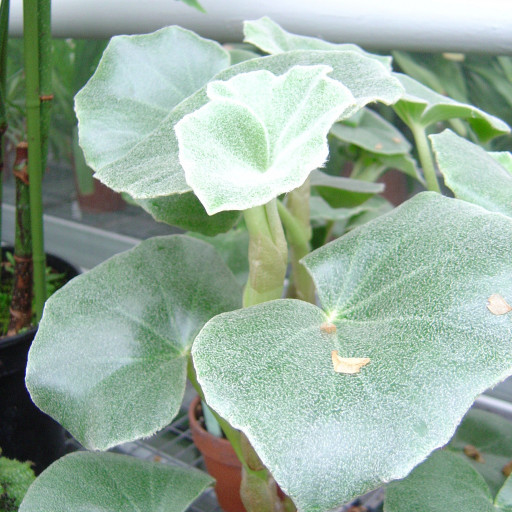
Plant Overview
Often called the "Veined Begonia," this Brazilian beauty looks more like a modern sculpture than a typical houseplant. With its stiff, felted leaves and papery stems, it breaks the mold of the soft, colorful begonias most people know. It is a rugged survivor that brings a sophisticated, silver-green architectural look to any indoor collection.
🔍 How to Identify
- 🍃 Felted Foliage: The leaves are thick, cupped, and covered in dense, white microscopic hairs (trichomes) that give them a soft, felt-like texture and a silvery sheen.
- 📜 Papery Stipules: Large, translucent, brown-veined stipules wrap around the stems like delicate parchment paper, protecting the new growth and giving the plant its "veined" nickname.
- ☁️ Fragrant Blooms: In late spring or summer, it produces clusters of small, snowy-white flowers that have a light, sweet scent—a rarity for many begonia species.
🏡 In Your Garden
- ☀️ Sun Protection: The silver hairs are actually a natural "sunscreen." This plant loves much more light than your average Rex Begonia and can handle bright, indirect rays that would scorch its cousins.
- 🌵 Succulent Strategy: Think of this as a "succulent begonia." It stores water in its thick leaves and stems, meaning it is highly susceptible to root rot. It prefers to dry out almost completely between waterings, making it perfect for the forgetful gardener.
⚠️ Safety & Toxicity
- 🐾 Toxic to Pets: Begonia venosa contains soluble calcium oxalates, which are toxic to cats and dogs. Ingestion can cause oral irritation, drooling, and vomiting.
- 👶 Child Safety: While not deadly, the plant can cause painful swelling of the mouth and throat if chewed. It’s best kept on a high shelf or pedestal away from curious little hands.
✨ Fun Fact
- 🕵️ A Rare Find: This species was first discovered in Brazil in 1898. While most begonias hide in the damp, shaded floors of rainforests, Begonia venosa evolved to thrive in drier, more exposed rocky outcrops, which is why it looks and acts so much like a desert plant!

Detailed Care Instructions
To successfully grow Begonia Venosa plants, follow these steps:
- Plant Selection: Choose a healthy Begonia Venosa plant with vibrant leaves and strong stems.
- Light Requirements: Begonia Venosa plants thrive in bright, indirect light. Place them near a window or in a location that receives filtered sunlight.
- Soil: Use well-draining soil that retains moisture without becoming waterlogged. A mixture of peat moss, perlite, and compost works well.
- Planting: Select a container with drainage holes and fill it with the prepared soil mixture. Gently remove the Begonia Venosa plant from its nursery pot and place it in the container. Ensure the soil covers the roots but not the stem.
- Watering: Water the Begonia Venosa plant thoroughly when the top inch of soil feels dry. Avoid overwatering, as it can lead to root rot. Let the excess water drain out of the container.
- Humidity: Begonia Venosa plants prefer humid environments. You can increase humidity by placing a tray filled with water near the plant or using a humidifier.
- Temperature: Keep the Begonia Venosa plant in a warm environment, ideally between 60-75°F (15-24°C). Avoid exposing it to cold drafts or sudden temperature drops.
- Fertilizer: Feed the plant once a month during the growing season (spring and summer) with a balanced, water-soluble fertilizer. Follow the package instructions for proper dosage.
- Pruning: If the Begonia Venosa plant becomes too leggy or overgrown, prune it to promote bushier growth. Trim back any dead or yellowing leaves as well.
- Propagation: You can propagate Begonia Venosa plants through stem cuttings. Take a healthy stem cutting with at least two nodes, remove the lower leaves, and place it in a glass of water or a small pot with moist soil. Keep it warm and well-humidified until roots develop.
- Repotting: Once the Begonia Venosa plant outgrows its current pot, move it to a slightly larger container with fresh soil.
Remember to regularly monitor the plant for signs of pests or diseases and take appropriate measures if needed. With proper care, your Begonia Venosa plant should flourish and grow beautifully.

Place in a dark room with little light, like a dark bedroom or a spot far away from a window or directly in a north-facing window.

To water this type of plant, it is important to first understand its watering needs. Begonia Venosa plants prefer regular waterings, but not excessively. Overwatering can lead to root rot, so it is important to let the soil dry out slightly before watering again.
To water Begonia Venosa plants, start by checking the soil moisture level. Stick your finger about an inch into the soil to see if it feels dry. If it does, you can water the plant. It is best to water the plant at the base, avoiding getting water on the leaves.
When watering, pour water slowly onto the soil until it begins to drain out the bottom of the pot. You may want to place a saucer or tray under the pot to catch excess water.
During active growth periods, Begonia Venosa plants may require more frequent watering. However, during dormant periods or periods of low light, the plant may need less water. It is important to adjust your watering schedule accordingly.
Overall, be mindful of the plant's water needs and aim to keep the soil consistently moist but not saturated.
To fertilize the Begonia Venosa plant, follow these instructions:
- Choose a balanced, water-soluble fertilizer with equal ratios of nitrogen, phosphorus, and potassium (N-P-K). For example, a 10-10-10 or 20-20-20 formulation.
- Dilute the fertilizer according to the package instructions. Generally, a 1/4 to 1/2 strength solution is sufficient for Begonia Venosa plants.
- Make sure the soil is moist before applying fertilizer. If dry, water the plant thoroughly and allow excess water to drain.
- Apply the diluted fertilizer evenly to the soil around the base of the plant, avoiding direct contact with the leaves or stems. Be cautious not to over-fertilize, as this can lead to leaf burn or other damage.
- After applying the fertilizer, water the plant again to help distribute the nutrients and prevent any potential burning. Ensure that excess water drains from the pot.
- Fertilize the Begonia Venosa plant every 4-6 weeks during the growing season, which typically spans from spring to early fall. Reduce or stop fertilization during the dormant period in winter.
- Monitor the plant's response to the fertilizer. If the leaves start to turn yellow or show signs of fertilizer burn, reduce the frequency or strength of the fertilizer solution.
Remember to always read and follow the specific instructions provided with your chosen fertilizer brand, as different products may have varying guidelines for application.
To grow the Begonia Venosa plant, you will need a well-draining soil mix that consists of a blend of peat moss, perlite, and high-quality topsoil. It is important to avoid using heavy and compacted soils as the plant's roots can easily rot. The soil should also be slightly acidic with a pH between 5.5 and 6.5. Adding some organic matter and fertilizer to the soil mix can help provide the necessary nutrients for the plant's growth and development. Additionally, you should make sure to water the plant regularly but avoid overwatering it to prevent any root-related problems.
Begonia venosa is a popular and attractive plant that can be propagated by various methods. Here are some detailed steps to propagate Begonia venosa:
- Select a healthy Begonia venosa plant that you would like to propagate. Make sure it is disease-free and free from any visible pests.
- Decide on the propagation method you would like to use. Begonia venosa can be propagated by stem cuttings or by leaf cuttings. Both methods have their own advantages and success rates.
- If you are using stem cuttings, select a healthy stem from the parent plant. The stem should be relatively young and non-flowering. Cut below a leaf node using a clean, sharp pair of scissors or pruning shears. The cutting should be around 4-6 inches long.
- Remove the lower leaves from the stem cutting, leaving only a few leaves at the top. This helps to reduce moisture loss during the rooting process.
- Dip the bottom end of the cutting in a rooting hormone powder or gel. This helps to promote root development. Shake off any excess hormone, so it does not inhibit the rooting process.
- Prepare a well-draining propagation medium. You can use a mixture of peat moss and perlite or a combination of coconut coir and perlite. Fill a small pot or a seed tray with the propagation medium, leaving enough space for the cutting.
- Make a small hole in the propagation medium using your finger or a pencil. Insert the bottom end of the cutting into the hole, ensuring that the cutting remains upright and firm in the medium.
- Gently firm the medium around the cutting, making sure it is secure. Water the cutting lightly to settle the medium and provide initial moisture.
- Place the pot or seed tray in a warm and bright location, away from direct sunlight. Maintain a consistent temperature between 70-75°F (21-24°C) for optimal rooting.
- Keep the medium slightly moist but not overly wet. Mist the cutting regularly to maintain humidity and prevent excessive moisture loss.
- After a few weeks, check for root development by gently tugging on the cutting. If resistance is felt, it indicates that roots have formed, and the cutting has successfully rooted.
- Once the cutting has sufficient root development, you can transplant it into a larger pot with well-draining soil. Gradually acclimate the new plant to its desired growing conditions.
Remember, propagation can be a patience-testing process. Not all cuttings may successfully root, so it's recommended to take multiple cuttings to increase your chances of success.
Common pests of the begonia venosa include Mealybugs, spider mites, aphids, whiteflies. Make a habit of checking your begonia venosa frequently for pests so that any infestations can be caught and managed early.








