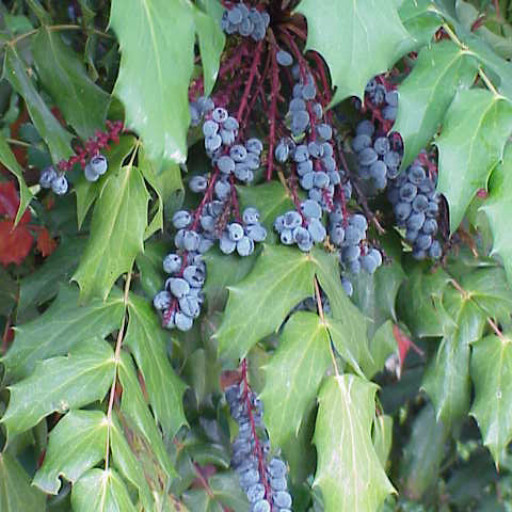
Plant Overview
Known as the "Leatherleaf Mahonia," this plant looks like it stepped right out of a prehistoric landscape. With its stiff, holly-like fronds and striking winter blooms, it serves as a structural masterpiece in shade gardens. It earned its nickname from the tough, waxy texture of its leaves that can withstand the harshest winter winds when other plants have long since gone dormant.
🔍 How to Identify
- 🌿 The Foliage: Large, leathery, compound leaves with sharp, spine-tipped edges that resemble holly. They are a deep blue-green color and grow in a distinct horizontal "tiered" pattern along the stems.
- 🟡 Winter Blooms: Tall, upright spikes (racemes) of lemon-yellow flowers emerge in late winter, filling the chilly air with a sweet scent reminiscent of Lily of the Valley.
- 🍇 The Berries: Following the flowers, the plant produces dense clusters of teardrop-shaped berries that turn a dusty, waxy blue as they ripen, looking much like miniature grapes.
🏡 In Your Garden
- 🌑 Shade Specialist: Unlike many flowering shrubs, the Leatherleaf Mahonia thrives in deep to partial shade. It is an excellent candidate for those "difficult" dark corners of the yard or under the canopy of large trees where other plants struggle to grow.
- 🐦 Pollinator Lifeline: Because it blooms in the heart of winter or very early spring, it provides a critical nectar source for early-emerging bees. Later, songbirds will flock to your garden to feast on the blue berries.
- 🏗️ Architectural Growth: This plant grows with an upright, multi-stemmed habit that gives it a "sculptural" look. It prefers acidic, well-drained soil and generally dislikes being moved once established due to its sensitive root system.
⚠️ Safety & Toxicity
- ⚔️ Physical Hazard: The primary safety concern is the foliage. The leaves are incredibly sharp and can easily scratch skin or pierce thin gardening gloves. It is best planted away from narrow walkways or areas where children play.
- 🐾 Mild Toxicity: While the berries are technically edible for humans (though very tart and seedy), they contain berberine. Ingesting large quantities may cause mild stomach upset or nausea in pets or small children.
✨ Fun Fact
If you were to snap a twig of this plant, you would find the wood inside is a brilliant, neon yellow! This is due to the high concentration of berberine, which has been used historically as a natural dye for wool and silk.

Detailed Care Instructions
Here are some steps to help you grow Berberis Bealei plant:
- Choose the right location: Berberis Bealei plants prefer full sun to partial shade. Make sure the area has well-draining soil.
- Prepare the soil: The soil should be fertile and rich in organic matter. If your soil is heavy or clayey, amend it with compost or peat moss to improve drainage.
- Planting: Dig a hole slightly larger than the root ball of the plant. Place the plant in the hole and backfill with soil, gently firming it around the roots. Water thoroughly after planting.
- Watering: Berberis Bealei plants need regular watering, especially during the growing season. Keep the soil consistently moist, but not waterlogged. Mulching around the base of the plant can help retain moisture.
- Fertilizing: Apply a balanced slow-release fertilizer in early spring and late summer to provide essential nutrients. Follow the instructions on the fertilizer packaging for the correct dosage.
- Pruning: Berberis Bealei plants benefit from regular pruning to maintain their shape and promote healthy growth. Prune in late winter or early spring before new growth begins. Remove dead or damaged branches, and thin out overcrowded growth.
- Pest and disease control: Berberis Bealei plants are generally resistant to pests and diseases. However, they can occasionally suffer from aphids, scale insects, or fungal leaf spot. Monitor your plants regularly and take appropriate action if you notice any issues.
- Protection in winter: Berberis Bealei plants can tolerate mild frost, but severe cold temperatures may damage them. Consider providing a layer of mulch around the base of the plant to insulate the roots during winter.
By following these steps, you can successfully grow Berberis Bealei plants and enjoy their beautiful foliage and vibrant berries.

Place in a window with dappled sun or a spot in the middle of a room. Or directly in a window facing west or east.

Berberis Bealei plant requires regular watering to thrive and stay healthy. The best time to water this plant is early in the morning or in the evening, when the sun is not too intense. The frequency of watering may vary depending on the temperature and humidity of the environment, but generally, it needs to be watered once or twice a week during the growing season.
When watering, make sure to wet the soil thoroughly, but don't overwater, as this can lead to waterlogging and root rot. It's best to water slowly and deeply, to ensure that the water penetrates deep into the soil and reaches the roots.
It's essential to monitor the soil moisture level regularly to avoid both underwatering and overwatering. You can check the soil moisture by inserting your finger into the soil or by using a moisture meter. If the top inch of the soil feels dry to the touch, it's time to water.
During the dormant period, which is usually in winter, watering should be reduced, and the soil allowed to dry out slightly between watering.
Overall, maintaining consistent and appropriate watering practices is crucial to promote healthy growth and development of the Berberis Bealei plant.
- Choose a balanced fertilizer: Select a fertilizer that has a balanced N-P-K ratio, such as 10-10-10 or 20-20-20. This means it contains equal amounts of nitrogen (N), phosphorus (P), and potassium (K).
- Timing: Apply fertilizer in early spring or late winter, before the plant enters its active growth phase. Avoid fertilizing during periods of extreme heat or cold.
- Dilute or granular: If using liquid fertilizer, dilute it according to the package instructions. If using granular fertilizer, sprinkle it evenly around the base of the plant.
- Application amount: Apply the fertilizer according to the recommended dosage on the package. Use a measuring cup or scale to ensure accurate application.
- Placement: Distribute the fertilizer evenly around the base of the plant, extending it slightly beyond the drip line. Avoid placing the fertilizer directly against the stem or trunk of the plant.
- Watering: After applying the fertilizer, water the plant thoroughly. This helps to distribute the nutrients and prevent any potential fertilizer burn.
- Re-application: Repeat the fertilizing process once every 4-6 weeks during the growing season, typically from spring to early fall. However, avoid over-fertilizing, as excessive nutrients can harm the plant.
- Organic alternatives: If desired, you can opt for organic fertilizers, such as compost or well-rotted manure. Apply these natural fertilizers in a similar manner, ensuring even distribution and proper watering afterward.
Remember to always follow the specific instructions provided with your chosen fertilizer, as different brands and formulations may vary. Observing the plant's response to the fertilizer and adjusting the amounts or frequency accordingly can also be beneficial.
When selecting soil for Berberis Bealei, it is important to consider its natural habitat and preferences. This plant thrives in well-draining soil that is rich in organic matter. The ideal soil type for Berberis Bealei is typically a loamy or sandy loam soil.
Loamy soil contains a balanced combination of clay, silt, and sand particles, allowing for proper drainage while also retaining enough moisture and nutrients for healthy plant growth. Sandy loam soil, on the other hand, is well-draining and provides good aeration for the roots of the plant.
To create an optimal growing environment for Berberis Bealei, the soil should be slightly acidic to neutral in pH, with a range of around 5.5 to 7.0. This pH range ensures proper nutrient availability to the plant and promotes healthy root development.
In terms of organic matter, Berberis Bealei appreciates soil that is enriched with compost or well-rotted manure. Adding organic matter helps improve soil structure, water retention, and nutrient availability. It also encourages beneficial microbial activity in the soil, which enhances overall soil health.
Before planting Berberis Bealei, it is advisable to amend the soil with organic matter and ensure good drainage. This can be achieved by incorporating compost or well-rotted manure into the topsoil. Furthermore, regularly monitoring soil moisture levels and avoiding overwatering is crucial to prevent waterlogged conditions that can lead to root rot.
In summary, Berberis Bealei typically thrives in loamy or sandy loam soil that is slightly acidic to neutral in pH. The soil should be well-draining, rich in organic matter, and amended with compost or well-rotted manure for optimal growth and overall plant health.
To propagate Berberis Bealei plant, you can follow these steps:
- Select a healthy parent plant: Choose a mature and healthy Berberis Bealei plant as your source for propagation. Ensure that it is disease-free and shows vigorous growth.
- Timing: The best time to propagate Berberis Bealei is during late spring or early summer when the plant is actively growing.
- Prepare the potting medium: Create a well-draining potting mix by combining equal parts of perlite and peat moss or a commercial potting mix suitable for shrubs. This will provide the right balance of moisture retention and drainage.
- Take cuttings: Using a sterilized pair of pruning shears, carefully cut 4-6 inch (10-15 cm) stem cuttings from the parent plant. Make the cuts just below a leaf node. Remove any leaves from the lower half of the cutting, leaving only a few at the top.
- Apply rooting hormone (optional): To increase the chances of successful rooting, you can dip the bottom end of the cuttings into a powdered or liquid rooting hormone. This can help stimulate root growth.
- Plant the cuttings: Make small holes in the prepared potting medium using a pencil or your finger. Insert the bottom end of the cuttings into the holes, ensuring that at least 2-3 nodes are buried beneath the soil.
- Watering: Gently water the potting medium until it is moist but not waterlogged. Avoid overwatering, as this can cause rotting of the cuttings.
- Provide proper conditions: Place the potted cuttings in a warm area with indirect sunlight. Maintain a temperature around 70-80°F (21-27°C) for optimal root development. Avoid exposing the cuttings to harsh direct sunlight or cold drafts.
- Mist the cuttings: Mist the cuttings regularly to increase humidity and prevent them from drying out. You can use a spray bottle to mist the foliage and the potting medium.
- Monitor and wait: It may take several weeks for the cuttings to develop roots. During this time, check the moisture level of the potting medium regularly and mist as needed. Do not disturb the cuttings as this can disrupt root formation.
- Transplanting: After the cuttings have rooted and established a healthy root system, typically 8-10 weeks after propagation, they can be transplanted into individual pots or directly into the garden soil.
By following these steps, you can successfully propagate Berberis Bealei plant from stem cuttings.








