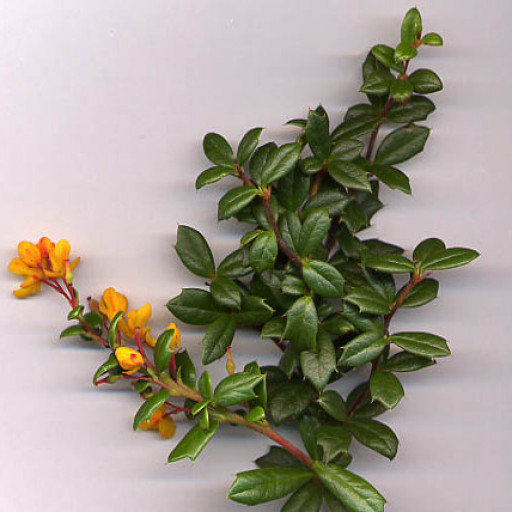
Plant Overview
Often called Darwin’s Barberry, this evergreen shrub is a showstopper in the spring with its fiery explosion of orange blossoms. First documented by Charles Darwin himself during his voyage on the HMS Beagle in 1835, it has since become a favorite for gardeners seeking a "beautiful but bitey" landscape addition. It serves as a stunning ornamental piece that doubles as an impenetrable, living security fence.
🔍 How to Identify
- 🍃 The Foliage: Small, leathery, dark green leaves that look remarkably like miniature holly leaves, complete with three sharp spines at the tips.
- 🧡 The Blooms: Drooping clusters of rich, golden-orange flowers that are bell-shaped and appear in late spring, often covering the entire bush.
- 🍇 The Fruit: In late summer, the flowers give way to small, oval, blue-black berries that feature a dusty, waxy "bloom" on the skin.
🏡 In Your Garden
- 🛡️ Natural Security: Because of its dense growth habit and incredibly sharp thorns, it is one of the best plants for creating a "defensive" hedge to discourage intruders or roaming pets.
- 🌱 Tough as Nails: This shrub is famously resilient; it can thrive in poor soil and is highly resistant to wind and coastal salt spray, making it ideal for exposed gardens.
- ✂️ Pruning Caution: It requires very little maintenance, but if you do prune it to shape, wear heavy-duty leather gloves. Its "bite" is much worse than its bark!
⚠️ Safety & Toxicity
- 🧤 Physical Hazard: The primary danger is the sharp spines. Scratches can be painful and may lead to minor skin irritation or secondary infections if not cleaned.
- 🐾 Pet & Human Safety: The berries are technically edible but very acidic and tart. While not considered "deadly," the plant contains berberine, which can cause stomach upset, vomiting, or diarrhea in pets and children if consumed in large quantities.
✨ Fun Fact
Charles Darwin discovered this species in Chile, but today it is so successful that it has been classified as an invasive "environmental weed" in parts of New Zealand and Australia because it spreads so easily via bird-dispersed seeds!

Detailed Care Instructions
To grow a Berberis Darwinii plant, you can follow these steps:
- Choose the right location: Berberis Darwinii thrives in full sun to partial shade. Find a spot in your garden that receives at least 4-6 hours of direct sunlight per day. Ensure the soil is well-draining and not too wet.
- Prepare the soil: Berberis Darwinii prefers slightly acidic to neutral soil with a pH range of 5.5-7.5. Loosen the soil and mix in organic matter such as compost to improve drainage and fertility.
- Planting: Dig a hole that is as deep as the plant's root ball and twice as wide. Place the plant in the hole, making sure the top of the root ball is level with or slightly above the ground. Backfill the hole with soil, gently firming it around the roots.
- Watering: After planting, water the Berberis Darwinii thoroughly to settle the soil and provide moisture for the roots. Water regularly during the first year, keeping the soil moist but not waterlogged. Once established, the plant is drought-tolerant and may only require occasional watering.
- Mulching: Apply a layer of organic mulch around the base of the plant to help conserve moisture, suppress weeds, and regulate soil temperature. Avoid placing the mulch directly against the stem.
- Pruning: Berberis Darwinii can benefit from annual pruning to maintain its shape and encourage better flowering. Prune after the plant finishes blooming, usually in late spring or early summer. Remove any dead, damaged, or crossing branches. You can also shape the plant as desired.
- Fertilizing: Berberis Darwinii generally does not require much additional fertilizer. However, if your soil is deficient, you can apply a balanced, slow-release fertilizer in early spring.
- Pest and disease control: Berberis Darwinii is relatively resistant to pests and diseases. However, it can be susceptible to aphids or fungal infections in humid conditions. Monitor the plant regularly and treat any pest or disease issues promptly with appropriate methods.
Remember to check your local gardening zone and growing conditions to ensure that Berberis Darwinii is suitable for your area.

Place in a bright room that is sun drenched almost all day. Or directly in a south-facing window.

This plant hails from South America and thrives in full to partial sun exposure. It prefers well-draining soil and requires moderate watering. Water the plant thoroughly once a week during the growing season, allowing the soil to dry out slightly between watering. During the winter months, reduce watering and only provide enough moisture to prevent the soil from drying out completely. Avoid overwatering as this can lead to root rot and other pest problems. When watering the plant, aim to water the soil directly and avoid getting the foliage wet, especially during the evening as this increases the risk of fungal diseases.
For optimal growth, feed the shrub in early spring with a slow-release, balanced fertilizer. Apply the fertilizer to the soil around the base of the plant, taking care not to touch the leaves or stems. Water the plant thoroughly after fertilizing. Avoid fertilizing the shrub during the summer months, as this can promote excessive growth that is vulnerable to frost damage.
When selecting soil for this plant, it is important to choose a type that is well-draining and slightly acidic in nature, with a pH range between 5.0 and 6.5. This will provide ideal growing conditions for the plant and encourage healthy root development. It is recommended to mix the soil with other organic materials such as peat moss or compost to improve the overall fertility and moisture retention capabilities of the soil. Finally, it is important to ensure that the soil is free of any pathogens or pests that could harm the plant.
Berberis Darwinii is a plant that belongs to the Berberidaceae family and is native to South America. The plant can be propagated through seeds or stem cuttings.
To propagate Berberis Darwinii through seeds, the first step is to collect ripe fruit from the plant. The ripe fruit should be cleaned and the seeds extracted. The seeds should be soaked in water for a few hours and then sown in a seed tray with well-draining soil. The seed tray should be placed in a sunny location and kept moist. Germination may take several weeks to several months.
To propagate Berberis Darwinii through stem cuttings, the first step is to select a healthy stem from the plant. The stem should be cut from the parent plant and the leaves on the lower part of the stem should be removed. The stem should be dipped in rooting hormone and then planted in well-draining soil. The cutting should be watered and placed in a shaded location. The cutting should be monitored and kept moist. Once roots have developed, the cutting can be transplanted to a larger container or planted directly in the ground.








