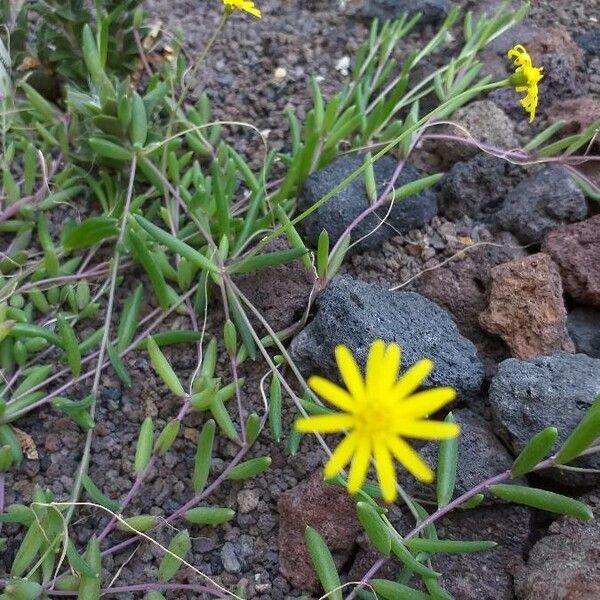
Plant Overview
Often called the Multiple-headed Bergeranthus or "Gold-tongue," this charming succulent from the Eastern Cape of South Africa is a master of the afternoon show. It forms dense, emerald-green mats of architectural foliage that suddenly burst into a carpet of gold when the sun reaches its peak. It is a favorite for "living rock" enthusiasts because of its rugged beauty and clockwork blooming habits.
🔍 How to Identify
- 🍃 Leaf Geometry: The leaves are smooth, fleshy, and distinctly triangular in cross-section, growing in tight, upward-reaching pairs.
- 🌼 Sun-Dial Blooms: It produces bright, golden-yellow daisy-like flowers that are often larger than the leaf clusters themselves.
- 🏗️ Clumping Habit: True to its name (multiceps means "many-headed"), the plant naturally divides at the base to form a low, multi-layered cushion of rosettes.
🏡 In Your Garden
- ☀️ The Afternoon Show: This plant is strictly "helianthemic," meaning its flowers only open in bright afternoon sunlight. If placed in a shady spot, you may never see its golden petals, as they stay tightly furled on cloudy days.
- 🪨 Rock Garden Specialist: Because it grows in rocky crevices in the wild, it hates "wet feet." It requires a very gritty, fast-draining mineral soil. It is particularly well-suited for troughs or rockeries where water can escape the root zone quickly.
⚠️ Safety & Toxicity
- ✅ Pet & Child Friendly: The Bergeranthus multiceps is generally considered non-toxic to humans, cats, and dogs.
- 🧤 Gentle Handling: Unlike many succulents, it lacks sharp spines or irritating sap, making it a very safe choice for households with curious pets or small children.
✨ Fun Fact
The Bergeranthus belongs to the "Ice Plant" family, but it’s much hardier than its cousins. In its native habitat, it survives intense heat and prolonged droughts by shrinking slightly into the soil to protect its moisture reserves.

Detailed Care Instructions
| Color | Green, Dark-Green With Red, Orange, Or Yellow Flowers |
| Soil Ph | 6.1–7.8 |
| Humidity | Normal |
| Lighting | Full Sun |
| Soil Type | Well-Draining, Succulent Soil |
| Bloom Time | Winter |
| Difficulty | Medium |
| Plant Type | Dwarf Evergreen, Succulent |
| Mature Size | Up To 6 In. Tall |
| Native Area | Southern Africa |
| Sun Exposure | Partial Shade To Partial Sun |
| Hardiness Zones | 8-10 |
To grow Bergeranthus Multiceps plant, you can follow these steps:
- Choose the right location: Bergeranthus Multiceps plant prefers bright light, so make sure to place it in a spot where it can receive at least 6-8 hours of sunlight per day. However, it is also important to protect it from intense midday sun.
- Prepare the soil: This plant thrives in well-draining soil. Use a cactus potting mix or create your own by mixing equal parts of regular potting soil, coarse sand, and perlite or pumice. Avoid using heavy or water-retaining soils.
- Potting: Select a pot that has drainage holes to prevent waterlogging. Transplant the Bergeranthus Multiceps plant into the pot, making sure the roots are not crowded. It is recommended to use a pot slightly larger than the current root ball.
- Watering: Bergeranthus Multiceps plant is a succulent and doesn't need frequent watering. Allow the soil to dry out completely between waterings. It is better to underwater than overwater this plant as it can be prone to root rot. During winter, reduce watering to just once a month.
- Fertilization: Feed the plant with a diluted balanced liquid succulent fertilizer during the growing season (spring to early fall) once a month. Follow the instructions provided on the fertilizer packaging for correct dosage.
- Temperature and humidity: Bergeranthus Multiceps plant prefers warm temperatures between 65-80°F (18-27°C). It can tolerate low humidity but doesn't perform well in high humidity environments. Avoid exposing the plant to frost or freezing temperatures.
- Pruning: Remove any dead or discolored leaves to maintain a tidy appearance. Pruning is not necessary unless you want to control the size or shape of the plant.
- Propagation: Bergeranthus Multiceps plant can be propagated through stem cuttings. Take a healthy stem cutting, let it callus for a few days, and then plant it in a well-draining soil mixture. Keep the soil lightly moist until the cutting establishes roots.
- Pests and diseases: This plant is generally resistant to pests and diseases. However, keep an eye out for mealybugs and aphids. If you notice any infestation, treat it with a suitable insecticidal soap or neem oil.
- Enjoy and observe: Watch your Bergeranthus Multiceps plant grow and enjoy its unique appearance. Remember to provide occasional rotation to ensure even growth and prevent leaning towards sunlight.
Remember to research and understand the specific needs and requirements of the Bergeranthus Multiceps plant to ensure its optimal growth.

Place in a bright room that is sun drenched almost all day. Or directly in a south-facing window.

Bergeranthus Multiceps is a succulent plant that requires watering once a week during its growing season. The most effective way to water this plant is by using the soak and dry method. This means that you should water the plant until the water drains out of the bottom of the pot, and then wait for the soil to dry completely before watering it again. It is important to ensure that the soil is well-draining, as this plant can be sensitive to overwatering. During the winter months, it is best to reduce watering to once every two to three weeks. When watering, it is recommended to avoid getting any water on the leaves or stem of the plant, as this can cause damage or rot. Always water the soil directly at the base of the plant.
To fertilize this plant, use a balanced liquid fertilizer once a month during the growing season. Dilute the fertilizer to half strength and apply it to the soil around the base of the plant. Avoid getting any fertilizer on the leaves or stem. During the dormant season, refrain from fertilizing. Water the plant well before and after fertilizing to prevent root burn.
Bergeranthus Multiceps is a succulent plant that is commonly grown in containers and rock gardens. It requires well-draining soil that is rich in nutrients. A good soil mix for this plant should consist of a combination of coarse sand, perlite or pumice, and organic matter such as coconut coir or peat moss. The soil pH should be slightly acidic to neutral, between 6.0 and 7.0. It is important to plant Bergeranthus Multiceps in a pot with drainage holes to prevent water from accumulating in the soil and causing root rot. The plant prefers full sunlight and can tolerate hot and dry conditions, making it a great choice for xeriscaping.
Bergeranthus Multiceps plant propagation can be easily done through stem or leaf cuttings. For stem cuttings, select a healthy stem with at least one node and cut it cleanly with a sharp knife or scissors. Allow the cuttings to dry for a few days before planting them in well-draining soil. Water the cuttings sparingly until they root and begin to grow.
For leaf cuttings, select healthy leaves and gently twist them from the stem to avoid damaging the plant. Allow the cuttings to dry for a few days before planting them in well-draining soil. Water the cuttings sparingly until they root and begin to grow.
Propagation can also be done by dividing the parent plant. Carefully remove the plant from its pot or the ground and gently separate the root system into two or more sections. Plant each section in its own pot or in the desired location in the ground and water sparingly until new growth appears.
Propagation can be done year-round, but it is best to do so during the growing season when the plant is actively growing. With proper care and attention, Bergeranthus Multiceps plant will quickly establish and produce beautiful foliage.








