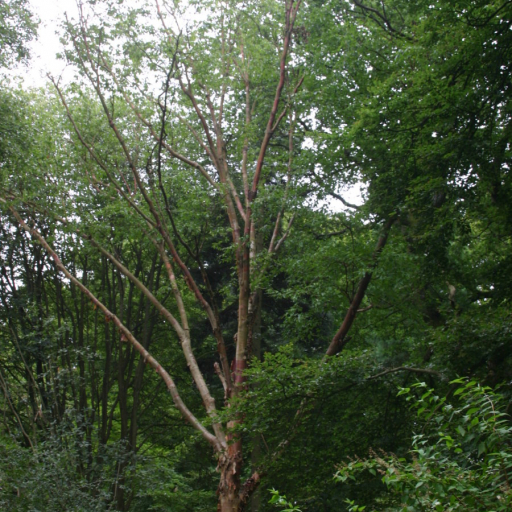
Plant Overview
Known as the Chinese Red Birch, this tree is often called the "Chameleon of the Forest" for its breathtaking, ever-changing bark. Originating from the high-altitude forests of Western China, it is prized by gardeners worldwide for its paper-thin, translucent bark that peels away to reveal a glowing palette of copper, pink, and honey-orange. It is a tree that provides visual "theater" in every season, especially in winter when its trunk seems to glow against the snow.
🔍 How to Identify
- ✨ The Bark: Its most iconic feature; the bark peels in large, curly sheets, revealing a shimmering under-layer that ranges from creamy apricot to deep cinnamon.
- 🍃 The Foliage: Medium-green, ovate leaves with sharply pointed tips and "toothed" edges that turn a brilliant, clear yellow in the autumn.
- 🎋 The Catkins: In early spring, it produces drooping, yellowish-brown "tails" (male catkins) that sway elegantly from the branch tips before the leaves fully emerge.
🏡 In Your Garden
- 💧 Cool Feet, Sunny Head: Like most birches, it thrives when its roots are kept cool and moist with a thick layer of mulch, while its canopy enjoys full sun to partial shade.
- 🌬️ Stress Management: While more resistant to the Bronze Birch Borer than many other species, it dislikes extreme drought and high humidity; it is at its best in temperate climates with distinct seasons.
⚠️ Safety & Toxicity
- ✅ Pet & Child Safe: The Chinese Red Birch is generally considered non-toxic to cats, dogs, and humans.
- 🤧 Allergy Alert: Like all members of the Betula genus, it produces wind-borne pollen in the spring which can be a significant trigger for hay fever sufferers.
✨ Fun Fact
The bark of the Chinese Red Birch is so thin and smooth that it was historically used in its native regions as a natural writing surface, much like ancient papyrus!

Detailed Care Instructions
To grow Betula Albosinensis, also known as Chinese red birch or red-barked birch, follow these steps:
- Choose the right location: Betula Albosinensis thrives in full sun or partial shade. Select a spot that has well-draining soil.
- Prepare the soil: Ideally, the soil should be moist and loamy. If the soil is heavy or clay-like, consider adding organic matter like compost to improve drainage and fertility.
- Planting the tree: Dig a hole that is at least twice as wide as the root ball and slightly shallower than the depth of the root ball. Place the tree in the hole, making sure that the top of the root ball is level with or slightly above the surrounding soil. Fill the hole with soil, gently firming it around the roots. Water thoroughly to settle the soil around the roots.
- Watering: Provide consistent moisture to Betula Albosinensis, especially during its first year of growth. Keep the soil evenly moist, but not waterlogged. Water deeply once or twice a week, depending on weather conditions.
- Mulching: Apply a layer of organic mulch, such as wood chips or bark, around the base of the tree to help retain moisture and suppress weeds. Avoid piling mulch against the trunk to prevent rotting.
- Pruning: Betula Albosinensis usually requires minimal pruning. However, you can shape it during its dormant season if desired. Remove any dead, damaged, or crossing branches to maintain a healthy tree structure.
- Fertilizing: Apply a balanced, slow-release fertilizer in spring to promote healthy growth. Follow the instructions on the fertilizer package for the correct application rates.
- Protect against pests and diseases: Betula Albosinensis is generally resistant to common pests and diseases. However, regular inspection for signs of problems like aphids, leaf miners, or fungal diseases is recommended. Treat any issues promptly using appropriate treatments.
- Winter care: Betula Albosinensis is generally hardy, but providing a thick layer of mulch around the base of the tree can help protect the roots during winter.
- Regular maintenance: Monitor the tree's growth and health regularly. Prune as necessary, remove any dead branches, and continue providing regular irrigation and fertilization as needed.
By following these steps and providing proper care, you can successfully grow and maintain a Betula Albosinensis plant.
To water this plant, ensure that the soil is somewhat dry before you begin. Slowly and evenly pour water around the base of the plant, allowing it to soak into the soil and reach the roots. Avoid getting water on the leaves or foliage, as excess moisture can lead to disease or damage. Do not overwater the plant, as this can also lead to root rot. Monitor the soil regularly and adjust your watering schedule as needed to maintain consistent moisture levels.
- Choose a well-draining moist soil mixture with a pH of 5.5-7.5.
- Apply a slow-release granular fertilizer with a balanced NPK ratio in early spring before the new growth emerges.
- Alternatively, use a liquid fertilizer diluted with water and apply it every two weeks during the growing season from spring to fall.
- Avoid over-fertilization as it can lead to excessive growth and weaken the plant's structure.
- Water the plant thoroughly after applying fertilizer to prevent burning the roots.
The preferred soil for Betula Albosinensis should have good drainage and moisture retention capabilities. It should be rich in organic matter and nutrients to promote healthy growth. The ideal pH range of the soil should be slightly acidic to neutral. A mixture of loam and organic compost is recommended for this plant. Avoid using heavy clay soils or soils that are too sandy, as they may not provide the necessary conditions for this plant to thrive.
Betula Albosinensis is a deciduous tree that belongs to the Betulaceae family. This plant can be propagated through a few different methods, including seeds, cuttings, and layering.
To propagate Betula Albosinensis from seed, collect the seeds in the fall and store them in a cool, dry place until the spring. In the spring, plant the seeds in a mixture of peat moss and sand, and keep the soil moist. The seeds will germinate in about 2-3 weeks, and once they have grown large enough, they can be transplanted into pots or directly into the ground.
For propagation through cuttings, take hardwood cuttings from the plant in the fall or winter when the plant is dormant. The cuttings should be about 10-15cm long and have several buds. Dip the cuttings into rooting hormone and plant in a mixture of peat moss and sand, keeping the soil moist. The cuttings will root over the winter and can be transplanted into pots or directly into the ground the following spring.
Layering is another method of propagation for Betula Albosinensis. In the spring, select a low branch and bend it down towards the ground. Scrape the bark and make a small notch where the branch touches the soil. Cover the branch with soil, leaving the tip exposed. Over time, roots will form from the notch and the branch can be cut from the parent plant and transplanted.








