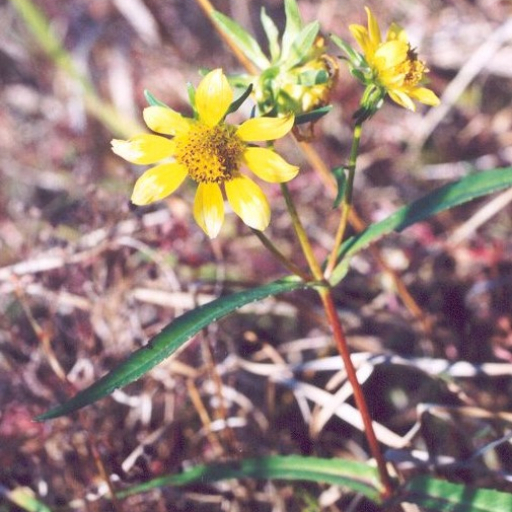
Plant Overview
Often called the Larger Bur-Marigold or Smooth Beggarticks, this vibrant yellow beauty is a staple of North American wetlands. While it looks like a cheerful daisy at first glance, it has a "sticky" secret that earned it the nickname "Beggarticks." It is a resilient survivor that brings a burst of late-season sunshine to soggy landscapes where other plants might struggle to breathe.
🔍 How to Identify
- 🌼 Sunny Blooms: It features large, brilliant yellow flower heads, typically 2 to 4 inches wide, with 7–8 distinct petals (rays) surrounding a dense yellow center.
- 🍃 Smooth Foliage: Unlike many of its cousins, the stems and leaves are notably smooth (the Latin laevis means smooth). The leaves are lance-shaped, serrated along the edges, and grow opposite each other.
- 🔱 The "Two-Teeth" Seeds: After the flowers fade, they produce flat, wedge-shaped seeds equipped with two downward-pointing barbed "teeth" designed to latch onto fur or fabric.
🏡 In Your Garden
- 💧 The Wetland Specialist: This plant doesn't just like water; it craves it. It is the perfect candidate for a "rain garden" or the muddy edges of a backyard pond where the soil stays consistently saturated.
- 🦋 Pollinator Powerhouse: In late summer and autumn, when other flowers begin to fade, Bidens laevis becomes a critical nectar station for migrating butterflies and native bees preparing for winter.
⚠️ Safety & Toxicity
- ✅ General Safety: This plant is considered non-toxic to humans and common household pets like dogs and cats. It is often used in restoration projects because it is safe for local wildlife.
- 🪝 Mechanical Irritation: While not chemically toxic, the "beggarticks" (seeds) can be a physical nuisance. The sharp barbs can poke through thin clothing or get tangled deeply in long-haired pet fur, which may cause minor skin irritation or discomfort during removal.
✨ Fun Fact
- 📜 Evolutionary Velcro: The genus name Bidens comes from the Latin bis (two) and dens (tooth). These "teeth" are a brilliant evolutionary tactic called epizoochory—the plant essentially uses passing animals (and hikers!) as a free taxi service to transport its seeds to the next muddy patch of land.

Detailed Care Instructions

Place in a window with dappled sun or a spot in the middle of a room. Or directly in a window facing west or east.

Some plants require more regular watering than others, which should be done every few days. It's critical to maintain the soil moist all of the time. The water requirements of the same plant placed in pots with varying sizes will differ. Because the water in the smaller pot evaporates faster than the water in the larger pot, it will require more watering. Regardless of pot size, the surface should constantly be maintained moist.







