Plant Overview
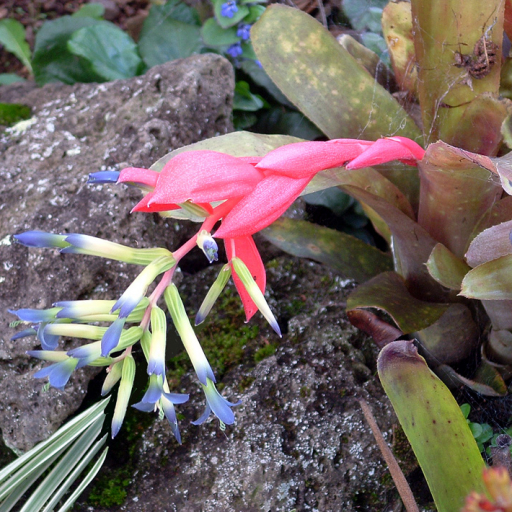
Often called "Queen’s Tears" or "Friendship Plants," Billbergias are the elegant, drama-free aristocrats of the Bromeliad world. Native primarily to the rainforests of Brazil, these epiphytes have traded traditional deep roots for a central "tank" designed to catch falling rain and debris. They are celebrated for their stunning, weeping flowers that look like hand-painted glass ornaments hanging from vibrant pink ribbons.
🔍 How to Identify
- 🍃 Stiff, Tubular Growth: The leaves grow in a tight, upright rosette, forming a slender central "vase" or "cup" used to store water and nutrients.
- 🎨 Mottled Foliage: Many species feature striking silver bands, cream splotches, or deep purple marbling that looks almost like camouflage against the green leaf.
- 💧 Pendant Inflorescence: Unlike many bromeliads that grow upright spikes, Billbergia flowers typically arch downward in a graceful display of hot pink bracts and neon blue, green, or yellow petals.
🏡 In Your Garden
- 🏺 The "Tank" Technique: To keep a Billbergia happy, focus on the center of the plant. In the wild, they survive by capturing water in their central rosette; at home, you should keep this "cup" filled with fresh water while keeping the soil only slightly moist.
- 👯 Clumping Habit: These are some of the fastest-growing bromeliads. They rapidly produce "pups" (baby offsets) at their base, eventually forming a lush, dense colony that can be easily divided and shared.
- 🌬️ Air-Loving Roots: Because they naturally grow on trees (epiphytes), they despise heavy, soggy potting soil. They thrive best in airy, chunky orchid bark or even mounted directly onto driftwood or cork.
⚠️ Safety & Toxicity
- ✅ Non-Toxic Status: Billbergias are generally considered safe and non-toxic to cats, dogs, and horses, making them an excellent choice for pet owners.
- ✂️ Serrated Edges: While not poisonous, be careful when wiping the leaves. Many species have "marginal spines"—tiny, saw-like teeth along the leaf edges that can cause itchy scratches on sensitive skin.
✨ Fun Fact
The most popular species, Billbergia nutans, earned the nickname "Friendship Plant" because it is so hardy and prolific that gardeners traditionally pass the easy-to-remove "pups" to neighbors and friends, spreading the plant throughout entire communities.

Detailed Care Instructions
To grow a Billbergia plant, follow these steps:
- Choose a suitable location: Billbergia plants thrive in bright, indirect light, so find a spot near a window that receives ample sunlight. They can tolerate some shade but avoid placing them in direct sunlight, as it may scorch the leaves.
- Select a well-draining soil mix: Use a well-draining potting mix that contains a combination of peat moss, perlite, and vermiculite. This helps prevent waterlogging, which can lead to root rot.
- Provide the right temperature and humidity: Billbergia plants prefer temperatures between 60-80°F (15-27°C). They can tolerate slightly cooler temperatures but are sensitive to frost. Maintain a moderate to high humidity level, around 50-70%, to mimic their natural tropical habitat. You can achieve this by placing a tray of water near the plant or using a humidifier.
- Watering: Water your Billbergia plant thoroughly, allowing excess water to drain from the bottom of the pot. Allow the top inch of soil to dry out before watering again. They prefer slightly moist soil but can tolerate some dryness between waterings.
- Fertilizing: Feed your Billbergia plant with a balanced, water-soluble fertilizer once a month during the growing season (spring and summer). Dilute the fertilizer according to the instructions on the package.
- Repotting: As Billbergia plants grow, they may outgrow their pots. Repot them every 2-3 years, preferably in spring, using a slightly larger pot with fresh potting mix. This promotes healthy root growth and prevents the plant from becoming root-bound.
- Propagation: Billbergia plants can be propagated by division. When repotting, carefully separate the offshoots or "pups" that have formed around the base of the mother plant. Plant these pups in their separate pots, ensuring they have their own root system.
- Watch for pests and diseases: Monitor your Billbergia plant for common pests like mealybugs, spider mites, or aphids. If detected, treat them using insecticidal soap or horticultural oil. Additionally, ensure good air circulation around the plant to avoid fungal diseases.
By following these care tips, your Billbergia plant should grow and flourish.

Place in a window with dappled sun or a spot in the middle of a room. Or directly in a window facing west or east.

To water this type of plant effectively, it is important to give it a thorough watering, but not to let it sit in standing water. This can lead to root rot and other issues. When watering, make sure to water deeply, allowing the soil to become fully saturated. However, be sure to drain any excess water from the pot or saucer. Additionally, this plant typically prefers slightly acidic soil, so consider using a specialized fertilizer that is formulated for acid-loving plants. Finally, be sure to monitor the plant's growth and adjust watering frequency as necessary based on its needs.
To fertilize this plant, you will want to use a balanced water-soluble fertilizer. Dilute the fertilizer according to the instructions on the package, and apply the solution around the base of the plant. Fertilize the plant every 2-3 weeks during the growing season, and reduce fertilization to once a month during the winter months. Avoid getting the fertilizer on the leaves or in the center of the plant, as this can lead to burning.
The ideal soil for this plant is a well-draining, nutrient-rich soil that is slightly acidic with a pH range between 5.5 and 6.5. The soil should be a mixture of organic matter such as peat moss, perlite, and vermiculite. The plant prefers soil that is moist but not waterlogged and can be susceptible to root rots if the soil is too waterlogged. The soil should also be free from any disease-causing pathogens and pests that could harm the plant. A soil mix that has been sterilized by either baking it in an oven or using a commercial sterilization method is highly recommended.
There is a plant species that belongs to the family Bromeliaceae, and it is propagated by removing the offsets or "pups" that grow at the base of the mature plant. These pups can be separated and potted individually once they reach a few inches in size and have developed their own root system. Propagation can also be done by saving the seeds that are produced after the plant has flowered and matured. Alternatively, the parent plant can be divided into smaller sections, each with its own set of leaves and roots, and re-potted. When propagating, it is important to ensure that the new plants are placed in well-draining soil and provided with the right amount of light and moisture to support their growth.







