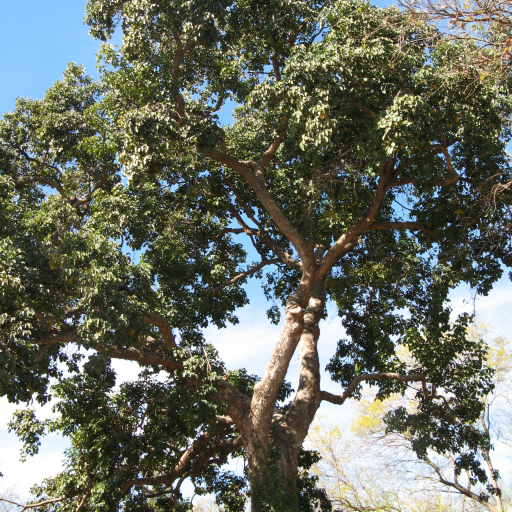
Plant Overview
Known as the Bishop Wood or Java Cedar, this majestic evergreen is a true giant of the tropical world. While it starts as an attractive, glossy-leaved sapling often mistaken for a common houseplant, it quickly transforms into a massive shade tree with a dense, rounded canopy. In its native Southeast Asian forests, it is revered for its resilient, reddish wood and its ability to provide a cool sanctuary from the tropical sun.
🔍 How to Identify
- 🍃 The Trifoliate Leaf: Its most defining feature is the leaf arrangement; three large, oval leaflets grow from a single stalk, often with finely "toothed" or wavy edges.
- 🪵 Reddish-Brown Bark: The trunk features a distinctive bark that turns a rich cinnamon or reddish-brown as it matures, often peeling in long, thin strips.
- 🍒 Berry Clusters: During the fruiting season, the tree produces hanging clusters of small, pea-sized berries that transition from green to a dusty brown or reddish hue.
🏡 In Your Garden
- 🌳 The Space Seeker: This is not a tree for small suburban plots. It is a "space hog" that grows incredibly fast, reaching heights that can dwarf a two-story home in just a few years.
- 💧 Thirsty Roots: It thrives in moist, well-drained soil. Because of its vigorous root system, it should never be planted near underground pipes, septic tanks, or sidewalks, as the roots are known to be quite "pushy."
- ☁️ Natural Umbrella: If you have the acreage, it provides one of the densest shade canopies available, making it perfect for creating a "forest floor" microclimate for ferns and orchids.
⚠️ Safety & Toxicity
- 🐾 Mildly Toxic: While not considered deadly, the berries and leaves can cause digestive upset (vomiting or diarrhea) if ingested by curious dogs, cats, or horses.
- 🧤 Sap Sensitivity: The milky sap found in the stems may cause mild skin irritation or dermatitis for people with sensitive skin. It is best to wear gloves when pruning.
✨ Fun Fact
In many traditional cultures throughout the Pacific Islands, the bark of the Bishop Wood is boiled to create a rich, dark red or chocolate-brown dye used specifically to paint intricate patterns on "Tapa" (bark cloth).

Detailed Care Instructions
To grow Bischofia javanica, also known as the Bishopwood tree, you can follow these steps:
- Climate and soil: Bishopwood trees thrive in tropical and subtropical regions. They prefer well-draining soil with a slightly acidic to neutral pH level. Ensure the soil is rich in organic matter and nitrogen.
- Germination: Collect fresh Bischofia javanica seeds from the tree during its fruiting season. Soak the seeds in water for about 24 hours to soften the seed coat and enhance germination. Seeds can also be scarified by lightly sanding the outer coating to help water absorption.
- Seed planting: Sow the seeds in containers or directly into the ground, about 1 inch deep. Water thoroughly after planting. Ensure a warm and moist environment, as the seeds typically take 3 to 8 weeks to germinate.
- Transplanting: Once the seedlings grow to a height of around 6 to 12 inches, they can be transplanted into individual pots or a prepared planting site. Ensure the planting hole is twice the size of the seedling's root ball. Gently remove the seedling from its current container or carefully dig it out of the ground, taking care not to damage the roots.
- Watering: Bischofia javanica requires regular watering, especially during its early growth stages. Water deeply and frequently enough to keep the soil consistently moist but not waterlogged.
- Sunlight: Bishopwood trees prefer full sun but can tolerate partial shade. Ensure they receive at least 6 hours of direct sunlight each day.
- Pruning and shaping: As Bischofia javanica grows, prune it regularly to shape it and remove dead or damaged branches. This will help maintain a healthy appearance and structure.
- Fertilization: Apply a balanced, slow-release fertilizer during the growing season to promote healthy growth and flowering. Follow the package instructions for the appropriate amount and frequency of application.
- Mulching: Apply a layer of organic mulch around the base of the tree to conserve moisture, suppress weed growth, and improve soil fertility. Take care to keep the mulch a few inches away from the trunk to prevent rot.
- Pest and disease control: Monitor the tree for any signs of pest or disease infestations, such as aphids, leaf spot diseases, or root rot. If necessary, treat them with appropriate organic or chemical methods.
Remember, the growth rate of Bischofia javanica can vary, so be patient as it establishes itself in its new location. Regular care, consistent watering, and proper nurturing will help your Bishopwood tree thrive and grow.

Place in a bright room that is sun drenched almost all day. Or directly in a south-facing window.

Bischofia Javanica plant can be watered by checking the soil moisture level before watering. This can be done by inserting a finger into the soil up to the second knuckle. If the top layer of soil feels dry to the touch, it is time to water the plant. The plant requires moderate watering, meaning the soil should be moist but not waterlogged. Overwatering can lead to root rot, which is harmful to the plant. The frequency of watering will depend on environmental factors such as humidity, temperature, and light conditions. It is recommended to use lukewarm, distilled, or rainwater to avoid chlorine and fluoride, which can harm the plant. Water can be applied slowly and evenly around the base of the plant, allowing it to penetrate the soil gradually. Additionally, it is advised to avoid getting water on the foliage as this can lead to fungal diseases.
To fertilize this plant, use a balanced, slow-release fertilizer applied in early spring. Apply fertilizer at least 6 inches away from the base of the plant and at a rate recommended on the fertilizer package. Water well after fertilization to help the nutrients penetrate the soil. Avoid over-fertilizing as it can lead to burn or damage to the roots. If the plant is in a container, fertilize regularly throughout the growing season with a water-soluble fertilizer. Consult with a gardening professional or refer to a plant-specific care guide for more detailed instructions.
Bischofia javanica is a plant that prefers soil that is well-draining and rich with nutrients. It can tolerate a range of pH levels, from slightly acidic to slightly alkaline. The ideal soil for this plant is one that has good organic matter content and is slightly moist, but not waterlogged. It is recommended to plant this species in loamy soil that is free from heavy clay or sand. Adding organic compost or manure will also help to improve soil fertility and structure. It is important to avoid using soil that is rich in nitrogen as this can cause the plant to grow too vigorously and become prone to disease or insect attack. Overall, the soil chosen for Bischofia javanica should be able to support its growth and development, as well as provide adequate drainage and moisture retention.
Bischofia Javanica plant can be propagated using two methods:
- Seed propagation:
Collect the matured seeds from the plant. Then, soak the seeds in water for 24 hours. After that, sow the seeds in a pot filled with a well-draining potting mix. Place the pot in a warm and bright location and maintain the soil moist. Germination usually takes two to four weeks.
- Stem cutting propagation:
Take a stem cutting of about 6 inches long from the plant, preferably from a matured and healthy branch. Remove the lower leaves and make a clean cut using a sharp knife. Dip the cut end into rooting hormone powder and plant it into a pot filled with a well-draining potting mix. Cover the pot with a plastic bag or place it in a propagator to increase humidity. Place the pot in a bright and warm location – indirect sunlight is ideal – and maintain the soil moist. After a few weeks, you should notice new growth, and once the roots have formed, you can transfer the plant to a larger pot or the garden.








